- English
- French
- German
- Portuguese
- Spanish
- Russian
- Japanese
- Korean
- Arabic
- Greek
- German
- Turkish
- Italian
- Danish
- Romanian
- Indonesian
- Czech
- Afrikaans
- Swedish
- Polish
- Basque
- Catalan
- Esperanto
- Hindi
- Lao
- Albanian
- Amharic
- Armenian
- Azerbaijani
- Belarusian
- Bengali
- Bosnian
- Bulgarian
- Cebuano
- Chichewa
- Corsican
- Croatian
- Dutch
- Estonian
- Filipino
- Finnish
- Frisian
- Galician
- Georgian
- Gujarati
- Haitian
- Hausa
- Hawaiian
- Hebrew
- Hmong
- Hungarian
- Icelandic
- Igbo
- Javanese
- Kannada
- Kazakh
- Khmer
- Kurdish
- Kyrgyz
- Latin
- Latvian
- Lithuanian
- Luxembou..
- Macedonian
- Malagasy
- Malay
- Malayalam
- Maltese
- Maori
- Marathi
- Mongolian
- Burmese
- Nepali
- Norwegian
- Pashto
- Persian
- Punjabi
- Serbian
- Sesotho
- Sinhala
- Slovak
- Slovenian
- Somali
- Samoan
- Scots Gaelic
- Shona
- Sindhi
- Sundanese
- Swahili
- Tajik
- Tamil
- Telugu
- Thai
- Ukrainian
- Urdu
- Uzbek
- Vietnamese
- Welsh
- Xhosa
- Yiddish
- Yoruba
- Zulu
Full Glass Dual-Sided Digital Signage for High-End Retail
The mesmerizing displays that make shopping areas come alive at night aren't a coincidence; they're planned experiences made possible by full glass dual-sided digital signage. This new display technology changes how high-end stores talk to people walking by and people shopping inside at the same time. It does this by making realistic brand stories that regular screens can't do. By putting ultra-thin tempered glass frames around high-brightness LCD panels, these two-sided displays make it easier to see from all sides while still keeping the architectural elegance that high-end store spaces require. The technology solves three main problems that stores face: getting people's attention on the street in busy shopping areas; making stores look better without blocking people's views; and giving retailers real engagement measures that show their high-cost investments are worth it.

Understanding Full Glass Dual-Sided Digital Signage Technology
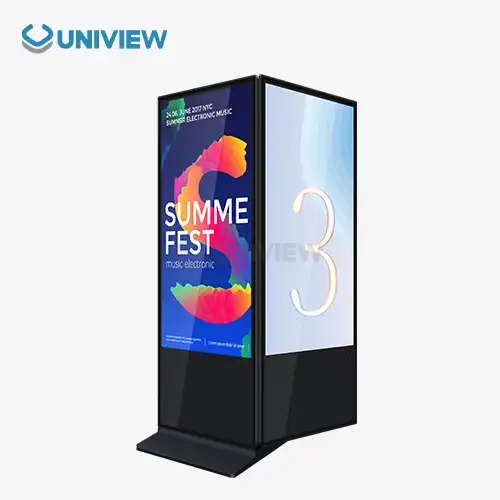
Modern stores need to show options that are both eye-catching and well-thought-out from an architectural point of view. Full glass dual-sided digital signage is a big step forward from regular advertising screens. It has two high-performance LCD panels built into a single clear glass frame. Traditional screens are big and take up a lot of room. This technology, on the other hand, uses special optical bonding methods to make images appear to move, with profile depths usually ranging from 12mm to 20mm.
Chemically strengthened tempered glass with a hardness rating of 7H is used in these systems. This makes it very resistant to scratches and impacts that are typical in store settings. One thing that sets expensive dual-sided units apart is that they can change the brightness of both sides separately. The screen facing outwards uses High-Tni liquid crystal technology to keep its clarity at brightness levels of up to 3,000 nits, which is needed to fight direct sunlight and urban glare. The screen facing inwards, on the other hand, works at a more comfortable 450–700 nits, making it good for viewing inside.
Technical Architecture and Material Innovation
Glass-enclosed displays need to be put together in a way that takes more precision than a normal digital signage setup. The D700P series from Uniview Commercial is a good example of this method. It has sealed glass doors that protect the LCD parts inside while also making servicing points easy to reach. The units have sensors that automatically change the brightness based on the lighting conditions, so they can be seen clearly all day without any help from a person.
Keeping the temperature under control is harder when two high-brightness panels are inside sealed glass cases. Traditional fan-based cooling systems have been replaced by advanced conduction cooling systems that use metal heat sink plates between panels to move heat to the frame edges. This design doesn't use fans, so there is no working noise. This is important in high-end stores where controlling background noise is important, and it also keeps panel temperatures below the critical Tni point where liquid crystals would break. It works reliably 24 hours a day, seven days a week, and doesn't have the picture degradation or "blackening" problems that happen with cheaper outdoor screens when they're exposed to sunlight.
Advantages Over Traditional Display Technologies
The full glass dual-sided digital signage format offers significant benefits that have a direct impact on store performance measures when procurement teams look at display choices. Traditional displays with plastic housings make visual barriers that block your line of sight. Glass-integrated screens, on the other hand, keep the space clear while showing ads. The ability to show material on both sides effectively doubles visibility without needing more floor or wall space. This makes them perfect for high-end stores that are short on space.
Durability is another important point of difference. Uniview Commercial makes sure that our screens meet IP65 standards for dust protection and can withstand environmental stress tests according to IEC 60068-2 procedures. The tempered glass construction is better at protecting against theft and accidental hits than plastic housings. This lowers the total cost of ownership because the housings don't need to be replaced as often. Luxury brands like these display because they don't take away from the carefully chosen look of their spaces. Instead, they add to them, which helps with brand positioning in a way that regular digital signs can't.
Key Applications and Installation Best Practices
Double-sided glass displays are very flexible and can be used in a lot of different store locations. However, each one needs to be installed in a certain way to get the best results and last the longest.
Strategic Placement in Window Displays
In retail marketing, storefront windows are prime real estate, and full glass dual-sided digital signage turns these areas into brand champions who are available around the clock. The screen that faces the street has high-contrast ads that can be seen even in bright daylight to bring in foot traffic. The screen that faces the store itself engages shoppers who are already inside with related messages or directions. These units are used as moving focal points in window arrangements by high-end fashion stores. Their very thin profiles don't get in the way of seeing the goods behind them.
When installing in window areas, you need to carefully look at the structure. Uniview Commercial sells the units in 55-inch, 65-inch, 75-inch, and 86-inch sizes. They need mounting systems that spread the weight evenly across strengthened support points. Professional workers do load-bearing tests with safety factors of 4x the unit weight to make sure they follow building rules and meet insurance standards. Anti-glare coatings on the glass screens that face the outside reduce reflections that could make it harder to see, and automatic lighting sensors change the output as the day goes on.
Interior Layout Integration
Displays with two sides are used as architectural features inside stores to define areas without blocking views. They are used as freestanding pillars in traffic areas, spinning aisle endcaps, or hanging wayfinding points in high-end stores. The clear glass design allows for clear views across the sales floor, which helps with loss prevention plans and shows shoppers relevant ads based on where they are.
Integration with other store systems makes the usefulness a lot better. When these screens are linked to point-of-sale networks, they can change their content instantly based on stock amounts or real-time sales information. Adding IoT sensors lets you measure your audience by keeping track of their dwell time and contact habits, which helps you make content optimization decisions. Uniview Commercial offers dual-signal input motherboards that let each screen have its own content control. This means that retailers can change the messages that are shown based on the direction of viewing, with product features facing outward and pricing or availability information facing inward toward shoppers who are ready to make a decision.
Maintenance Protocols and Service Considerations
The sealed glass design that covers the inside parts also needs to be maintained in a certain way. As part of regular maintenance, glass surfaces should be cleaned with the right non-abrasive products that won't hurt anti-reflective coats. Uniview's D700P design has special entry holes that let techs work on internal parts without taking the whole units off their mountings. This keeps downtime during maintenance windows to a minimum.
When you buy a high-end monitor, warranty coverage is even more important. Uniview Commercial backs up our two-sided glass signs with longer warranties that cover both the hardware and the operation of the panel for 3 to 5 years. Support that is available 24 hours a day, 7 days a week provides technical help across time zones, which is very important for foreign retailers with multiple sites. Comprehensive quality coverage through China Pacific Insurance Company and third-party brokers lowers risks even more and protects capital investments against flaws in the manufacturing process or failures that happen before they should.
Evaluating and Choosing the Right Full Glass Dual-Sided Digital Signage Solution
When buying expensive display systems, it's important to use structured evaluation methods that weigh the short-term costs against the long-term benefits and the company's effect.
Supplier Assessment Criteria
Global B2B buyers should give more weight to makers who can prove they know a lot about outdoor-rated display technologies. With relationships in over 100 countries and ten years of experience specializing in business signage, Uniview Business has the reference portfolio needed to judge dependability. When a product is certified to meet foreign standards in Europe, the United States, and Japan, it means that it meets strict safety and performance standards. In particular, buyers should check the IP65/IP66 ratings to make sure that dust and water can't get in, the wind resistance ratings (Uniview units are rated to level 16), and the rust resistance that comes from using advanced surface treatment technologies.
It's not just marketing claims that make up a brand's image; actual track records do too. Case studies from previous uses in similar store settings can help you understand how things work in the real world when they are used in similar situations. Referrals from system experts who have installed multiple units can tell you a lot about how hard the installation is, how quickly technical support responds, and how much long-term care you will need.
Performance Specifications and Cost Analysis
Resolution has a direct effect on how clear the information is and how interested the user is in it. Images stay sharp on screens up to 86 inches diagonally when using high-resolution LCD panels in the D700P line. Pay close attention to the brightness requirements: screens that face the outdoors should provide at least 2,000 nits of brightness, and they can go up to 4,000 nits in places that get a lot of direct sunlight. Energy use is related to brightness output, but thanks to advances in LED backlighting technology, good dual-sided units usually only use 1.5 times as much power as single high-brightness screens, not twice as much. This saves a lot of money on operational costs compared to traditional two-display setups.
Cost-effectiveness research needs to look at more than just the original purchase price. It also needs to look at the total cost of ownership. Premium glass displays cost more than basic digital signs, but because they can show on both sides, you don't need two different units. This cuts down on hardware costs and installation complexity. Rental choices may work for short-term setups or for brands trying out new locations, but buying permanent pieces is usually a better deal. The prices at Uniview Commercial are affordable, and the warranties and global support services that come with them are longer than those of luxury names with shorter coverage periods.
Customization and After-Sales Service
When it comes to luxury stores, customers need options that are made to fit the look and function of each brand. Customization options should include things like actual sizes, mounting arrangements, interaction with content management systems, and even choices for tinting or framing the glass that go with the rest of the store's design. Uniview's engineering teams work directly with stores and their builders to come up with solutions that meet exact needs, such as custom sizes and environmental sealing for hard-to-reach installation spots.
Quality of service after the sale often decides long-term satisfaction more than just the features of the goods. When planning shop openings or yearly refresh efforts, it's important to have reliable delivery times. The global support infrastructure makes sure that the level of service is the same no matter where it is deployed, and the local technical resources cut down on reaction times during emergencies. Our all-around support, which includes site assessments before installation and ongoing training in content management, turns vendor ties into strategic partnerships that help stores succeed in ways other than just providing tools.
Real-World Implementations Demonstrating Retail Impact
High-end stores can see how dual-sided glass technology helps their businesses by looking at real-life examples from operational trials.
Luxury Fashion Boutique Transformation
75-inch full glass dual-sided digital signage screens were installed in all of the main stores of a well-known European clothing brand in busy shopping areas. Seasonal ads with movie-like production values were shown on the outside screens, while styling ideas and real-time inventory available were shown on the inside screens. After the displays were put up, data showed that walker conversion rates went up by 34% in the first quarter. This was because the eye-catching window displays brought more people in on foot.
The operational comments pointed out a number of reasons that led to success. The ultra-thin glass shape kept the architectural sophistication that is important for a luxury brand's image, while avoiding the "tech store" look that big standard displays give off. Content management teams liked that they could control each screen separately, which let them tell more complex stories that got better as customers went from watching from the outside to interacting with the content inside. Maintenance needs were very low, and professional cleaning every three months was enough to keep things looking brand new in busy cities.
Flagship Electronics Store Customer Engagement
In their experiential main shops, a global electronics store used two-sided displays that let customers interact with products. The screens that faced the mall brought people in with demo videos, while the screens that faced in gave customers who were already interested in a product category more information and comparison tools. Integration with shop stocking systems made it possible to show real-time stock levels, which made customers happier and salespeople more productive.
Engagement data collected by built-in sensors showed that customers stayed on the page for an average of 47 seconds longer after each contact. This is a big increase in retail settings where every second counts. A study of sales conversions showed that customers who interacted with the two-sided displays bought 22% more than those who didn't. This suggests that the technology effectively affected customers' thinking of higher-level products. The rollout showed that strategically placing clear displays could help customers find their way without blocking their view or making things look cluttered.
Lessons Learned and Best Practices
By looking at several deployments together, you can find regular trends that help you figure out the best way to accomplish things. The frequency of content updates has a big effect on engagement retention; screens that show static pictures for long periods of time have a harder time keeping people's attention. Successful stores use dynamic content rotation plans so that screens on the outside change every hour and screens on the inside change based on how busy the store is at different times of the day.
Technical planning is just as important. Pre-installation site studies that check for electrical capacity, structural mounting soundness, and network connection needs keep implementation from being held up, which costs a lot of money. Working with experienced system installers who know how to use dual-sided glass technology cuts down on installation time and makes sure that brightness controls, content management systems, and online tracking are set up correctly. These practical insights help people who adopt displays in the future avoid common mistakes and get more value from their investments more quickly.
Future Trends and Innovations Shaping Display Technology
Glass display technology is still changing quickly, thanks to improvements in making panels, the need to be more environmentally friendly, and the ability to connect with other devices.
Emerging Display Technologies
Flexible OLED screens are the next big thing in dual-sided display technology. Flexible OLEDs can bend around curved glass surfaces, which makes it possible for artistic displays that wrap around columns or follow the shape of a building. Because OLED technology is self-emissive, it doesn't need backlighting. This makes the profiles even thinner while still providing better contrast ratios and viewing angles. Even though they are more expensive than LCD alternatives right now, improvements in manufacturing scale are quickly closing the price gap. This means that flexible OLED glass screens are becoming more and more suitable for high-end store uses.
Smart sensor integration makes displays smarter by giving them real-time information about their surroundings and viewers. More advanced units now have sensors that measure environmental light, temperature, and even air quality, which can change the content. Audience analytics can do more than just count the number of visitors; it can also identify demographics and map out where people are paying attention, giving businesses detailed information about how well their campaigns are working. Implementations that care about privacy hide individual data but still provide useful aggregate measures that help with decisions about content strategy and marketing.
Sustainability and Environmental Considerations
Corporate responsibility rules are affecting buying decisions more and more, so stores are choosing display options that use less energy and can be recycled. Full glass dual-sided digital signage tackles these issues in a number of ways. Compared to separate display setups, the combined two-screens-in-one form uses less material. Intelligent brightness management and advanced LED backlighting keep operating energy use to a minimum. Automatic dimming during low-traffic times saves even more energy without losing usefulness.
Choosing the right materials has an effect on a product's environmental impact over its whole existence. When it comes to recycling, tempered glass housings are better than plastic ones, and metal structure parts also support the ideas of the circular economy. European surface treatment technologies are used in Uniview Commercial's production methods to get rid of harmful coating materials. This makes sure that they follow the RoHS and REACH environmental directives. Durable construction and full insurance coverage make products last longer, so they don't need to be replaced as often. This reduces the environmental impact even more over the entire ownership time.
Scalable and Modular Display Ecosystems
Smart stores are moving away from single displays and toward networks of signs that work together and can be changed to meet changing business needs. Modular mounting systems let you change the setup without reinstalling everything. This is useful for yearly plan changes or store refresh projects. Cloud-based content management tools give you centralized control over deployments in multiple locations, so you can keep your brand consistent while still letting each place make its own changes.
When there are changes in the market or a business model changes quickly, the strategic value of the technology that can be changed becomes clear. In the past few years, retailers who put money into changeable dual-sided glass sign networks were able to change their messages quickly and easily when things went wrong with the supply chain or when customers' habits changed. This ability to change gives you a real competitive edge in retail environments that are always changing. This is why you should spend more on technologies that support long-term strategy flexibility instead of just meeting short-term tactical needs.
Conclusion
Full glass dual-sided digital signage has become an important technology for high-end stores that want to show their brands well, keep customers interested, and run efficiently. The mix of beautiful architecture, visibility from both sides, and strong technology specs solves some of the most important problems in modern retail communication. Improvements in foot traffic conversion, customer dwell time, and sales efficiency can be seen in cases where projects go well. When procurement teams look at their choices, they should give more weight to makers with a track record of success, a full support network, and a dedication to long-term innovation. This way, investments will pay off in the long run. As the technology improves to become more flexible, interactive, and eco-friendly, it will become an important part of future shopping experiences.
FAQ
Q: What makes full glass dual-sided digital signage more effective than single-sided displays?
A: The two screens work together to show more material because they engage people coming from opposite ways at the same time. In window openings, this means getting people from the street and talking to people who are already in the store. This doubles the number of chances to get your message across without taking up more floor space. The clear glass design keeps the view open in a way that single-sided housings can't, which is important for high-end store layouts.
Q: How long is the typical lead time from order to installation?
A: Customized glass cases usually take between 4 and 6 weeks to make, but this depends on how complicated the specifications are and how many are ordered. Shipping takes different amounts of time depending on where it's going. For example, domestic deliveries take 1-2 weeks, while foreign deliveries take 3–4 weeks. Uniview Commercial keeps a strategic stock of standard setups to speed up delivery for urgent projects, and our global transport network makes sure that shipping to more than 100 countries goes smoothly.
Q: Can the displays withstand extreme weather conditions for outdoor installations?
A: High-quality units made to be used outside, like Uniview's D700P series, have weather sealing that is marked IP65/IP66 to keep dust and water out. Temperature control systems keep operations stable across wide temperature ranges, and High-Tni liquid crystal panels don't get black from heat as regular screens do in direct sunlight. Wind protection rates up to level 16 and surface treatments that prevent corrosion make sure that the product will work reliably in harsh seaside or industrial settings.
Q: What warranty coverage should buyers expect?
A: Premium makers offer longer guarantee periods because they are sure their products will last. Uniview Commercial gives full warranties that cover both hardware parts and LCD screen performance for 3 to 5 years. This coverage includes expert help around the world 24 hours a day, 7 days a week, and is backed by third-party insurance underwriting through China Pacific Insurance Company. This gives you extra financial safety against manufacturing flaws or failures that happen before they should.
Q: How does content management work for dual-sided displays?
A: Professional models have hardware with two signal inputs, which let you handle the content on each screen separately from the others using a single content management system interface. This lets different messaging strategies—maybe sharing stories about the brand to the outside world and giving information about products to the inside world—be planned and organized from one central platform. Cloud-based CMS solutions allow for control of multiple locations, which lets you make changes that fit your area while keeping your brand's look consistent across store networks.
Q: What customization options are available to match specific retail aesthetics?
A: Leading makers let you change a lot of things about their products, like the size, how they're mounted, the color of the glass, the finish on the frame, and even how they incorporate your brand. The tech teams at Uniview work directly with retailers and builders to create custom solutions that meet exact design requirements. Custom content management system integration, specialized weather seals, and even non-standard aspect ratios can be made to work with the way stores are already designed.
Partner with Uniview Commercial for Your Display Solution Needs
You need a reputable full glass dual-sided digital signage maker who is dedicated to quality if you want to upgrade your store's appearance with cutting-edge display technology. Uniview Business has ten years of experience in business LCD and LED signage and works with B2B clients around the world in the retail, hotel, corporate, and transportation industries. Our D700P line has unbeatable performance thanks to its dual high-brightness screens, ability to automatically adapt to different environments, and ultra-thin tempered glass construction that meets IP65/IP66 standards. We offer the complete relationship that high-end stores need, with customization options that fit your brand's vision, extended warranties of up to 5 years, and global support available 24 hours a day, 7 days a week. Get in touch with our team at sales@univiewlcdisplay.com to talk about your project needs and find out how our products can help your business.
References
1. "Digital Signage in Retail Environments: Impact on Consumer Behavior and Sales Performance," Journal of Retailing and Consumer Services, 2022.
2. "Architectural Integration of Commercial Display Technologies in Luxury Retail Design," International Journal of Retail & Distribution Management, 2021.
3. "Outdoor Display Technologies: Environmental Durability and Performance Standards," Society for Information Display Technical Digest, 2023.
4. "Content Management Strategies for Multi-Screen Retail Installations," Digital Signage Federation White Paper, 2022.
5. "Sustainability in Commercial Electronics: Lifecycle Assessment of Display Technologies," Environmental Science & Technology Journal, 2021.
6. "Global Trends in Retail Technology Adoption: B2B Procurement Patterns and Investment Drivers," Retail Technology Review, 2023.
Learn about our latest products and discounts through SMS or email