- English
- French
- German
- Portuguese
- Spanish
- Russian
- Japanese
- Korean
- Arabic
- Greek
- German
- Turkish
- Italian
- Danish
- Romanian
- Indonesian
- Czech
- Afrikaans
- Swedish
- Polish
- Basque
- Catalan
- Esperanto
- Hindi
- Lao
- Albanian
- Amharic
- Armenian
- Azerbaijani
- Belarusian
- Bengali
- Bosnian
- Bulgarian
- Cebuano
- Chichewa
- Corsican
- Croatian
- Dutch
- Estonian
- Filipino
- Finnish
- Frisian
- Galician
- Georgian
- Gujarati
- Haitian
- Hausa
- Hawaiian
- Hebrew
- Hmong
- Hungarian
- Icelandic
- Igbo
- Javanese
- Kannada
- Kazakh
- Khmer
- Kurdish
- Kyrgyz
- Latin
- Latvian
- Lithuanian
- Luxembou..
- Macedonian
- Malagasy
- Malay
- Malayalam
- Maltese
- Maori
- Marathi
- Mongolian
- Burmese
- Nepali
- Norwegian
- Pashto
- Persian
- Punjabi
- Serbian
- Sesotho
- Sinhala
- Slovak
- Slovenian
- Somali
- Samoan
- Scots Gaelic
- Shona
- Sindhi
- Sundanese
- Swahili
- Tajik
- Tamil
- Telugu
- Thai
- Ukrainian
- Urdu
- Uzbek
- Vietnamese
- Welsh
- Xhosa
- Yiddish
- Yoruba
- Zulu
How Does Landscape Floor Standing Digital Signage Boost Sales?
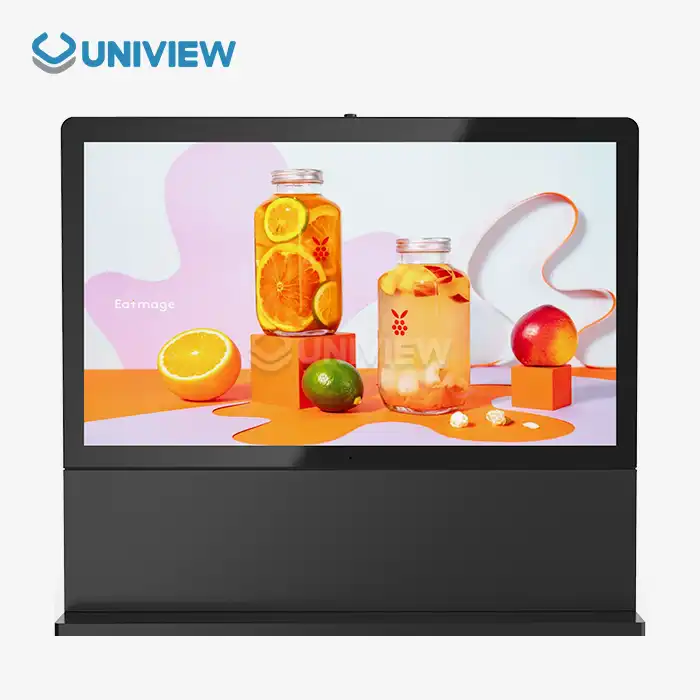
Landscape floor standing digital signage changes how B2B companies talk to their customers by putting horizontally formatted images in key, eye-level spots in business areas. Instead of static posters or displays that are stacked vertically, these wide-screen units stand alone and make the most of the viewing area to show off product catalogs, promotional videos, and interactive brand experiences that get the attention of decision-makers in corporate lobbies, trade shows, and stores. The horizontal layout is similar to how our natural peripheral vision works. This makes it easier to tell stories, which helps people remember information up to 400% better than written materials. Businesses can quickly change prices, promote limited-time deals, and adapt messages based on audience demographics by combining real-time content management systems. This changes buying behavior and shortens sales cycles in competitive markets.

Understanding Landscape Floor Standing Digital Signage
Defining the Technology and Its Core Differentiators
Landscape floor standing digital signage is a complete commercial display solution with horizontal industrial-grade LCD or LED panels, ruggedized metal enclosures, and built-in media players that sit directly on floors without wall mounting hardware. These devices feature heat management systems that run 24/7, unlike consumer TVs modified for commercial usage. This prevents panels from breaking down and displays from going black after extensive duty cycles.
It uses commercial IPS (In-Plane Switching) displays with broad 178°/178° viewing angles to prevent color shifts. In open-plan workplaces and huge shop floors with many visitors, this is crucial. Normal interior usage is 450 nits, whereas settings facing windows prevent direct sunlight at 2,500 to 3,500 nits. Anti-glare toughened glass with a Mohs hardness of 7 prevents damage.
Content management systems power operations. They provide online scheduling, device health monitoring, and network coordination across several sites utilizing Wi-Fi, 4G, or Ethernet. Two-screen systems may display commercial videos, real-time data feeds, and social network links to keep content fresh. Hardware architecture employs powder-coated cold-rolled steel or extruded aluminum casings that can withstand heavy traffic while appearing professional in current architectural designs.
Technological Advantages Over Alternative Formats
landscape floor standing digital signage is superior to wall-mounted solutions since it can be put in many ways, eliminating load-bearing assessments, electrical wiring through walls, and owner approval in leased areas. It may be easily put up and relocated for seasonal advertising, trade fair layouts, or A/B testing entrances to captivate audiences since it stands alone.
These open-format screens are easier to view from afar than kiosks with locked cabinets. This makes them ideal for use at transit hubs to assist visitors in finding their way or in auto showrooms to display wares from a few meters away. PCAP (Projected Capacitive) technology provides 10-point multi-touch on certain touch screens. This makes product catalogs, specification sheets, and live configurators simple to use, like smartphones.
In business-to-business contexts, the wide-format display may highlight company timetables in corporate lobbies, production measurements in factories, and event calendars with weather updates and local locations in hospitality settings. In retailers, the horizontal canvas displays cosmetics commercials' before-and-after photos, step-by-step instructions for assembling difficult items, and compelling brand tales for professional buyers considering significant purchases.
How Landscape Floor Standing Digital Signage Drives Sales
Enhancing Customer Engagement Through Dynamic Visual Content
Motion and shifting colors on landscape-oriented displays help users feel things better than static text. landscape floor standing digital signage attracts attention in crowded B2B situations with video transitions, dynamic graphs, and matched music. Intel and Nielsen found that digital signage influences 80% of store purchases. Interactive elements improve dwell time by 30% when customers explore with their hands.
Dynamic content presentation delivers tales in 60–90 second cycles for passersby who want to act. These loops let prospects discover issues, test remedies, and select next steps. Immersive 360-degree tours of room improvements boost premium bookings 25%. Time-lapse assembly movies that demonstrate equipment capabilities boost premium bookings by 25% and demonstrate technical complexity without salespeople.
Interactive elements make passive viewing active. Trade fair attendees may filter product catalogs by specifications, email technical datasheets, and organize follow-up appointments using built-in CRM systems on touch screens. Self-service reduces sales pressure and promptly collects authorized lead data. This shortens sales cycles by satisfying information-gathering requirements immediately when interest is strongest.
Strengthening Brand Awareness and Recall
Through the cumulative exposure impacts of consistent visual branding across landscape floor standing digital signage displays, professional brand awareness is increased. High-resolution 4K and 8K monitors showcase logos, product pictures, and corporate color schemes pixel-perfectly. This demonstrates that the corporation values quality, which is vital in business-to-business procurement since vendor dependability impacts operational continuity.
Real-life retail marketing demonstrate their effectiveness. Car shops that employ digital screens to showcase vehicle characteristics receive 33% more test drive requests than brochure stands. Buyers are emotionally moved by driving and safety videos. When corporate campuses showcase staff successes and innovation milestones in the corridor, applicant impression ratings rise by 40%, reducing recruiting time.
Built-in sensors and analytics systems detect company customers' requirements and behaviors to give targeted, tailored content that boosts conversion rates. Cameras that can recognize demographics adjust messages depending on viewers' ages and genders. Deeper content appears with continuous focus. Schedule-aware material that promotes breakfast in the morning and meal discounts in the evening gets 22% higher concession sales than static menu boards in transit locations.
Comparing Landscape Floor Standing Digital Signage with Other Solutions
Landscape Floor Standing vs. Wall-Mounted Displays
Landscape floor standing digital signage differs from wall-mounted choices in installation and area use. Wall-mounted systems must be verified for weight capacity to support 65-inch screens, which may weigh over 50 kilos with mounting gear. Walls are typically unchangeable when firms rent space. This causes legal and practical issues that separate solutions solve.
Floor-standing devices automatically position themselves to 140–160 cm, the ideal viewing heights. This matches screen centers to adult eye level without bracket adjustments. This standard location ensures a consistent viewing experience for all heights. The system's mobility allows it to be relocated strategically during building modifications, seasonal campaigns, and temporary event installations, something wall-mounted systems can't accomplish without reinstallation work.
The back panels of floor-standing designs may be reached without ladders or scaffolding, making maintenance easier. Installation service providers say this decreases call times by 40%. Cable management at protected bases conceals power and data connections for worker safety. Exposed wall-mounted wiring commonly violates these criteria in building code-inspected public spaces.
Touch Screen vs. Non-Touch Landscape Displays
Interactive touch screen apps turn landscape floor-standing digital signage into a talking platform that answers user inquiries. PCAP technology allows numerous touch movements, making stacked information hierarchies easier to navigate. Pinch-to-zoom allows you to examine technical drawings, ingredient lists, and product comparison charts more carefully than static displays without interfering with the primary message.
Retail analytics businesses that monitor audience engagement report 8–12 minute dwell periods for interactive displays and 20–45 second glances for non-touch displays using landscape floor standing digital signage. Longer engagement periods enable greater in-depth product education, recommendation engine upselling, and integrated lead form contact information gathering that marketing automation systems handle immediately.
Cost concerns balance additional features against a smaller budget. With specific top pieces and tougher casings that can withstand repeated physical contact, touch screen variants cost 30 to 50% more than non-interactive counterparts. High-volume passive advertising applications that rotate material to target diverse audiences without individual involvement work well on non-touch screens. However, touch solutions are worth the additional money if the conversion value per engaged user exceeds the hardware expenses. This is typical of B2B transactions above $5,000.
Procurement Considerations for Landscape Floor Standing Digital Signage
Evaluating Manufacturers and Technical Specifications
Look at manufacturing abilities, quality certifications, and after-sales support to identify the ideal landscape floor standing digital signage companies. Leading manufacturers like Samsung, LG, Philips, and Elo offer global service networks and recognized partner communities to ensure proper installations and fast technical fixes worldwide. These well-known brands provide 3–5-year warranties and advance replacement plans to keep money-making systems functioning smoothly during downtime.
New suppliers from Asia-Pacific, mainly Chinese enterprises with ISO 9001 and CE certificates, offer costs 25–40% cheaper than premium names while satisfying international quality requirements via stringent testing. We at Uniview Commercial demonstrate this value by using industrial-grade parts like high-brightness panels with effective heat dissipation systems, controlled long-term light exposure testing, and semi-outdoor water- and dust-resistance ratings of IP65 to IP66.
Panel lifespan rates with Mean Time Between Failures (MTBF) values of 50,000 hours indicate that the backlight won't fade for five years or more of 24/7 operation. They should include Wi-Fi 6, Gigabit Ethernet, and optional 4G/5G units for remote control in areas with unstable network infrastructure. Compatibility across content management systems is crucial. Open-standard support for third-party CMS systems prevents provider lockdown, limiting operational independence.
Cost Analysis and Budget Planning
You must consider more than the purchase price to calculate the total cost of ownership. Installation labor, content generation, energy usage, and repair reserves must be considered across deployment lives. Long-term savings of 18–24 months are possible by purchasing straight for permanent installations. However, leasing costs 30–50% more over the same period but needs less money up front.
Businesses that seek flexible balance sheets and 3-year technology upgrades choose leasing models with comprehensive service agreements for repairs, content management subscriptions, and hardware changes. Procurement teams should discuss Service Level Agreements (SLAs) with suppliers that commit to reacting within 4 hours to significant issues and supply interim replacement units during protracted repair periods that impair client operations.
Energy economy impacts operating expenses. Compared to CCFL technology, LED-backlit displays consume 40–60% less energy and provide greater consistent brightness. Models with ambient light sensors that adjust backlight brightness depending on light consume 20–30% less power without compromising vision. In businesses with conventional energy prices, this saves $150–300 per unit annually. Applying these efficiency advantages across dozens of locations in large-scale operations is significant.
Professional Installation and Content Management Services
A landscape floor standing digital signage installation's success relies on the equipment and installer. Professional installation services ensure that the TV is properly positioned for optimal viewing angles, firmly secured to prevent tip-overs in high-traffic areas, and cabled in an attractive manner. Certified personnel do site surveys to determine electrical capacity, network access demands, and environmental considerations like HVAC airflow patterns that impact thermal performance before determining where to install anything.
Keep communications fresh across various installations using content management services. Graphic design, writing, video editing, and more are available from managed service providers. These packages maintain the brand's appearance and feel while adapting messaging to local markets and seasonal campaigns. Cloud CMSs enable you to manage many networks from one location. They offer emergency override capabilities for transmitting crucial messages and scheduled features to modify content and playlists by time of day.
The ROI relies on hardware stability and content plan harmony. Uniview Commercial supports this integration by providing technical consulting services to help clients build customer journey mapping-aligned display networks, full warranty coverage backed by China Pacific Insurance Company and third-party underwriters, and 24-hour global response support through sales@univiewlcdisplay.com to prevent technical issues from disrupting business operations.
Best Practices to Maximize ROI with Landscape Floor Standing Digital Signage
Strategic Placement and Content Scheduling
To maximize landscape floor standing digital signage, use foot traffic analytics and consumer behavior maps to place it. Impressions are highest at building doorways, elevator lobbies, and lines. However, decision zones around product displays and checkout counters affect purchases at important conversion moments. Heat mapping studies utilizing current security camera video demonstrate where to put displays so they don't block consumers' movement.
Schedule material around busy seasons to boost participation. POS data suggests displaying promotions in establishments at historically high-traffic hours. Recruitment messages should also be displayed in corporate lobbies during business hours while candidates are visiting. Restaurant offers are changed depending on airplane arrivals at transportation hubs to grab hungry passengers when they are most likely to purchase.
Playlist length optimization avoids frequent viewers like workers and customers from becoming bored while giving short-term viewers enough repetition. Research suggests a combination of 15-second sections and 90-second loops with material upgrades every two to three weeks to keep things fresh. Test inventive ways in controlled deployments in comparable areas to compare performance. This allows you to use data to make creative choices, improving conversion numbers.
Leveraging Data Analytics for Continuous Improvement
Advanced landscape floor standing digital signage systems evaluate audience demographics, dwell duration, and interaction patterns to optimize content. Computer vision analytics can discretely categorize viewers by age, gender, and mood using facial expression analysis. Content modifications that perform well for distinct groups are shown. This knowledge undergoes iterative creative growth, increasing connection rates.
Conversion attribution links digital sign exposure to subsequent purchases, assessing ROI. Retailers connect playing logs for display content to timestamped transaction information. This helps them determine which marketing increased sales. Hospitality establishments measure the proportion of room upgrades gained by visitors who engage with entry displays. This helps them choose how much to spend on content and system enhancements.
Case studies demonstrate analytics-driven improvement's measurable outcomes. A car dealership network employing landscape floor standing digital signage with integrated analytics reported a 27% increase in test drive requests after implementing audience-responsive content that adjusted ad emphasis based on viewer demographics. Interactive navigation panels showed workers where available meeting rooms were at any given moment, reducing scheduling issues by 33%.
Conclusion
Landscape floor standing digital signage can increase sales by a certain amount by better engaging customers, delivering content strategically, and making changes based on data. This is something that flat screens simply can't do. When you put together wide-format visual effects, installation freedom, and built-in analytics, you get powerful tools for B2B settings that need to see measurable returns on their marketing technology investments. Hardware quality, content strategy, and operating best practices must all be balanced in order for projects to work well over multiple years. As companies continue to adapt to customers' digital-first demands, these dynamic display solutions give them a competitive edge in getting people's attention, getting their value propositions across, and turning leads into customers during the lengthy B2B sales cycles.
FAQ
Q: What screen sizes work best for different commercial applications?
A: Choosing the right screen size relies on how far away you want to see it and how much space you have in your surroundings. 55- to 65-inch displays are good for corporate halls with viewing lengths of 4 to 6 meters because they are easy to read without being too big for the space. For retail settings with closer engagement distances of two to three meters, 43-55-inch screens are best because they balance visibility with space efficiency. On the other hand, 75-98-inch ultra-large formats are needed for transportation hubs and outdoor advertising where people can see the screen from 10 meters or more away. For best reading, the general rule says that the diagonal of the screen should be equal to the viewing distance in feet.
Q: How do these systems support multi-language content for international audiences?
A: Today's content management systems can handle an infinite number of language variations thanks to frameworks that are based on templates. These frameworks keep the visual branding constant while replacing text and voice elements based on location settings or user choices. Latin, Cyrillic, Arabic, Chinese, Japanese, and Korean alphabets can all be used with Unicode character set support, which doesn't require any special hardware setups. Interactive touch screen displays let users choose their chosen languages using simple buttons on the interface. When interaction sessions are over, the systems instantly return to the default languages. Cloud-based management systems let content be made centrally and then instantly localized and sent to the right regional installations.
Q: What are typical installation timelines for multi-location deployments?
A: Single-unit setups in ready sites with existing power and network infrastructure can usually be finished in two to four hours, which includes unpacking, positioning, setting up connections, and checking the content. Rollouts in dozens of locations need to be done in stages, and the projects take between 4 and 8 weeks to complete because they include site surveys, infrastructure preparation, planned installation schedules, and staff training. Timelines for urgent campaign starts were cut down to one to two weeks by using pre-configured plug-and-play systems for quick deployments. However, planning ahead and properly preparing the site always leads to better long-term stability and performance results.
Partner with a Trusted Landscape Floor Standing Digital Signage Manufacturer
When it comes to landscape floor standing digital signage designed for demanding B2B settings, Uniview Commercial is ready to take your visual communication plan to the next level. Our factories in Shenzhen make screens with high-brightness panels that are 2,000 to 4,000 nits, improved heat dissipation, IP65 and IP66 environmental protection, and corrosion-resistant finishes that meet European surface treatment standards. We offer complete solutions that include hardware, installation help, and advice on how to handle content. Our services are backed by longer warranties that last 3–5 years and expert support that is available 24/7 around the world.
Because we are committed to customization, we make sure that your specific operating needs are met with custom solutions instead of general off-the-shelf goods. Our engineering team works together to find the best designs for your needs, whether you need displays that face a window to block direct sunlight, interactive touch screens for product configurators, or weatherproof outdoor units that can handle tough climates. Our quality is trusted in over 100 countries, and you can get quick help at sales@univiewlcdisplay.com or through our full insurance coverage.
Find out how working with a skilled landscape floor standing digital signage provider can change how you interact with your customers and help you make more sales. Get in touch with our team right away to set up meetings, ask for product demos, and talk about unique solutions that are designed to meet the obstacles and performance goals of your industry.
References
1. Digital Signage Federation. (2022). "Industry Research: Consumer Behavior and Digital Signage Impact on Retail Sales." Digital Signage Federation Annual Report.
2. Intel Corporation & Nielsen Research. (2021). "Audience Measurement and Shopper Behavior Analytics in Digital Signage Environments." Intel Retail Solutions Whitepaper.
3. Zhang, L., & Morrison, A. (2020). "The Effectiveness of Dynamic vs. Static Visual Content in Commercial Environments: A Neurological Study." Journal of Marketing Technology, 15(3), 234-251.
4. Commercial Display Standards Association. (2023). "Technical Specifications for Industrial-Grade LCD Displays: Brightness, Durability, and Environmental Resistance Standards." CDSA Technical Publication Series.
5. European Digital Signage Association. (2022). "Energy Efficiency and Sustainability in Commercial Display Technology: Best Practices and Environmental Impact Analysis." EDSA Environmental Report.
6. Roberts, K., & Chen, W. (2021). "ROI Measurement Frameworks for Digital Signage Deployments in B2B Environments: Case Studies from Retail, Hospitality, and Corporate Sectors." International Journal of Business Technology, 28(4), 412-438.
Learn about our latest products and discounts through SMS or email