- English
- French
- German
- Portuguese
- Spanish
- Russian
- Japanese
- Korean
- Arabic
- Greek
- German
- Turkish
- Italian
- Danish
- Romanian
- Indonesian
- Czech
- Afrikaans
- Swedish
- Polish
- Basque
- Catalan
- Esperanto
- Hindi
- Lao
- Albanian
- Amharic
- Armenian
- Azerbaijani
- Belarusian
- Bengali
- Bosnian
- Bulgarian
- Cebuano
- Chichewa
- Corsican
- Croatian
- Dutch
- Estonian
- Filipino
- Finnish
- Frisian
- Galician
- Georgian
- Gujarati
- Haitian
- Hausa
- Hawaiian
- Hebrew
- Hmong
- Hungarian
- Icelandic
- Igbo
- Javanese
- Kannada
- Kazakh
- Khmer
- Kurdish
- Kyrgyz
- Latin
- Latvian
- Lithuanian
- Luxembou..
- Macedonian
- Malagasy
- Malay
- Malayalam
- Maltese
- Maori
- Marathi
- Mongolian
- Burmese
- Nepali
- Norwegian
- Pashto
- Persian
- Punjabi
- Serbian
- Sesotho
- Sinhala
- Slovak
- Slovenian
- Somali
- Samoan
- Scots Gaelic
- Shona
- Sindhi
- Sundanese
- Swahili
- Tajik
- Tamil
- Telugu
- Thai
- Ukrainian
- Urdu
- Uzbek
- Vietnamese
- Welsh
- Xhosa
- Yiddish
- Yoruba
- Zulu
What Content Can You Display on a Portable Rechargeable Kiosk?
A portable rechargeable kiosk can display a variety of content for numerous business applications. These mobile solutions support interactive product catalogs, advertising films, real-time data dashboards, and consumer feedback forms. These battery-powered displays can broadcast dynamic content wherever in a facility, making them suitable for retail, corporate lobbies, hotels, and transit hubs where flexibility and mobility are key.

Introduction
Mobile digital display solutions help modern organizations engage customers and streamline operations in different environments. Comparatively flexible to fixed installations, portable recharging kiosks revolutionize content delivery. These clever devices don't need electricity, so enterprises can deploy interactive experiences wherever they're needed.
Content flexibility is crucial in today's competitive business environment. Retail, corporate, hospitality, transit, and outdoor advertising decision-makers know that customer engagement demands flexible presentation. These mobile solutions provide scalable digital engagement tools that meet evolving company needs by bridging static signage and fully interactive experiences.
In this complete guide, we'll address kiosk types, content formats, optimization tactics, and proven company solutions. Our focus remains on educating procurement professionals to make informed judgments about utilizing these flexible digital engagement platforms.
Understanding Portable Rechargeable Kiosks and Their Content Capabilities
Defining Mobile Digital Display Solutions
Mobile digital display units represent a major change from fixed installations and tablet-based systems. These powerful gadgets offer multimedia information seamlessly across varied operational situations with robust hardware and advanced software ecosystems. While maintaining professional-grade display quality and interactive capabilities, their wireless nature eliminates installation constraints.
Modern units can run for 8-12 hours under normal conditions, making battery performance crucial. Without regular power management, this prolonged lifespan ensures consistent performance during work hours. Intelligent charging procedures and power optimization boost efficiency in advanced lithium-ion battery systems.
Hardware Components and Software Integration
These gadgets have high-resolution LCD screens, responsive touch interfaces, integrated processing systems, and extensive connections. Wireless networking allows real-time content updates, while local storage ensures performance in low-connectivity locations. Modern devices support voice commands, touch gestures, and external device connections.
These platforms' software ecosystems support simple scheduling systems to large interactive apps for content management. Centralized control over distributed installations is possible with cloud-based management solutions, while offline capabilities assure network uptime.
Categorizing Kiosk Types and Applications
Different kiosk layouts meet industry-specific operational needs. Retail units emphasize product presentation and consumer engagement, while event models stress mobility and quick setup. OEM solutions can be customized for specific deployment scenarios, whereas industrial applications demand durability and mounting options.
Different content formats are tailored for user interactions in each category. Understanding these differences helps procurement experts choose solutions that meet operational and content delivery needs.
Key Content Types Suitable for Portable Rechargeable Kiosks
Informational Content and Product Presentations
Digital product catalogs are a great mobile kiosk content application. These interactive presentations let clients view high-resolution photos, extensive product details, and comprehensive comparison tools without staff help. Advanced catalog systems improve browsing with search, filtering, and tailored recommendation engines.
Interactive displays enhance compliance and regulatory information. While preserving version control and update capabilities, organizations can provide rapid access to safety protocols, certification details, and procedural instructions. This method is useful in regulated businesses where precise information access is crucial.
Interactive Modules and Engagement Tools
Touch-enabled demonstration modules let users interact with virtual product representations and view extensive feature explanations. These apps work well for complex products that benefit from guided exploration and customization. Augmented reality adds digital information to actual locations, making the experience more engaging.
Interactive content with lead capture forms converts inquiries in real time and collects client data. Modern progressive profiling reduces form abandonment and builds comprehensive prospect profiles by gradually collecting information across several interactions. Customer relationship management integration streamlines follow-up.
Event-Centric Content and Promotional Materials
Dynamic event scheduling systems update events, presentations, and networking opportunities live. These apps are invaluable for trade fairs, conferences, and corporate events with frequent schedule changes. Interactive maps and wayfinding help attendees navigate large venues and find exhibitor information.
Mobile kiosks give targeted promotional information depending on user interactions and preferences. Multiple characteristics can automatically activate time-sensitive and location-specific promotions, improving relevance and conversion potential. Analytics integration shows promotional efficacy and user interaction.
Analytics Dashboards and Performance Monitoring
Real-time analytics dashboards turn kiosks into business intelligence tools that reveal customer behavior, content effectiveness, and operational success. Data-driven optimization is possible by tracking user interactions, popular content sections, and engagement length. Advanced analytics solutions use machine learning to find patterns and predict trends.
Audience behavior analysis informs content planning by revealing preferences and interactions. Heat mapping reveals which screen regions are most popular, whereas session recording displays user travel pathways and decision-making processes.
How to Optimize Content Display for Maximum Engagement and Conversion?
User Interface Design and Navigation Principles
Mobile kiosks benefit from straightforward navigation and consistent graphic hierarchies that guide users through material. Touch-optimized elements with suitable scale and spacing save users from inadvertent selections and make them accessible. Users can comprehend actions and system reactions with clear visuals and feedback.
Designing for varied worldwide user groups requires mobile usability concerns. Content adapts to screen orientations and viewing distances using responsive design. Brand consistency and recognizable interaction patterns shorten learning curves and generate trust through professional presentation.
Multilingual Support and Accessibility Features
Global B2B audiences need multilingual help beyond text translation. Visual features, color schemes, and interaction patterns must be adapted to regional tastes and expectations. Dynamic language switching lets users switch interfaces without losing session progress.
Content accessibility ensures usability by people of all abilities and technical comfort levels. Voice navigation, flexible text sizes, and high-contrast display modes meet worldwide accessibility standards.
Trust-Building Through Content Strategy
Compliance badges and embedded certificates demonstrate industry and regulatory compliance, boosting credibility. Strategically placing testimonials and case studies shows similar firms' successful implementations and gives social evidence. These elements boost buying confidence without being advertising.
Authentic content requires transparency and capacity descriptions. Avoiding excessive claims and stressing real benefits promotes client trust. Regular content audits maintain information accuracy and relevance in changing business settings.
Remote Management and Operational Efficiency
Remote content updating lets organizations update kiosk networks without site visits. Cloud-based CMSs provide localized customisation based on deployment constraints while centralizing control. Automatic scheduling ensures content changes happen at opportune times without disrupting user experiences.
Optimization of battery maintenance increases operational runtime and reduces maintenance. Smart power management systems regulate display brightness and processing intensity based on battery life and usage. Active monitoring notifications warn administrators of potential faults before they affect users.
Comparing Portable Rechargeable Kiosk Content Strategies to Other Platforms
Advantages Over Fixed Kiosk Installations
Mobile kiosks provide flexibility and change client engagement and information delivery. These devices respond to shifting area arrangements and seasonal usage patterns without infrastructural changes. Businesses that frequently modify their layouts or must respond swiftly to operational changes benefit from this flexibility.
Broader reach lets enterprises deliver interactive experiences in previously inaccessible regions. Event installations, seasonal displays in high-traffic areas, and emergency information distribution are possible without permanent infrastructure. Using performance data and usage patterns to relocate units maximizes ROI through smart location.
When hardware limits are lifted, the content range expands organically. Mobile units can offer additional content types because they don't have fixed mounting sites or network connections. Flexibility allows creative applications that standard installations cannot.
Distinctions from Tablet-Based Solutions
Professional kiosk hardware has better battery life than consumer tablets. In typical business situations, purpose-built systems run for 8-12 hours, whereas tablets need more frequent charges. This increased runtime reduces commercial operations disruptions and maintenance.
Tablets and professional kiosks have very different screen sizes and viewing angles. Group watching and thorough material presentation are possible on larger panels. Professional display panels have high brightness and anti-glare features for varied lighting circumstances.
Commercial kiosks provide better security than tablets. Hardware-level security, tamper-resistant enclosures, and enterprise-grade device management secure business-critical applications. Handling sensitive data or working in public requires these features.
Strategic Content Approaches by Industry Application
Event activation tactics stress instant setup, user involvement, and content updates. Mobile kiosks excel in these situations because they can be used professionally without installation. Content tactics boost event impact with interactive demonstrations, lead acquisition, and social media integration.
Retail marketing applications benefit from placing interactive displays in high-traffic areas during peak shopping hours. Mobile technologies that adapt to retail environments enable seasonal content rollout and location-based messaging. Based on user reaction data, performance analytics enable quick optimization.
Industrial use cases require durable hardware and operationally specific material presentation. Safety information, equipment operation instructions, and real-time monitoring displays are essential in manufacturing and logistics. Content strategies stress readability, accessibility, and operational system integration.
Company Introduction and Our Portable Rechargeable Kiosk Solutions
Uniview Commercial's Global Expertise
Shenzhen Uniview Commercial Display CO., LTD. is a leading digital signage manufacturer and supplier with over a decade of experience serving clients in over 100 countries. We specialize in portable rechargeable kiosk technology since we understand varied market needs and technological advancements that solve genuine business problems.
Our global footprint shows successful cooperation with system integrators, brand owners, and procurement professionals who need trustworthy, high-performance digital display solutions. Our comprehensive experience allows us to offer insights and recommendations based on proven deployments across industries and operating situations.
Product Portfolio and Customization Capabilities
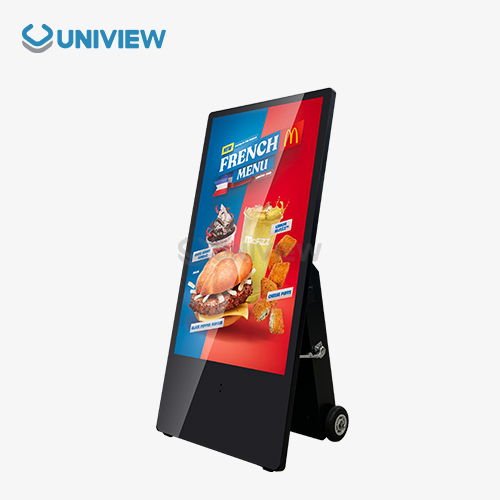
Our P110 Indoor Portable Rechargeable Kiosk demonstrates our commitment to innovative design and practicality. This gadget presents material in landscape and portrait modes on a 27-inch LCD display with maximum flexibility. The battery-powered design allows monitors to be placed anywhere indoors without wire management.
High-brightness displays with offline coated AR glass produce excellent image quality under diverse lighting settings, while advanced heat dissipation technology ensures stable performance over long durations. Multiple charging ports support various device types, making these units useful for customer convenience beyond content presentation.
Our personalization goes beyond standard setups to meet industry and brand presentation objectives. Organizations can develop unique solutions that meet their operational goals and aesthetic preferences with custom branding, mounting methods, and software interfaces.
Comprehensive Service and Support Framework
Our service promise includes 3- to 5-year warranties and complete quality coverage through China Pacific Insurance Company and third-party underwriters. Worldwide 24-hour online response service guarantees technical support regardless of deployment location or time zone.
Quality control includes extensive testing to meet European, American, and Japanese standards. Commercial applications require durable and corrosion-resistant materials like offline coated AR glass and European surface treatment techniques.
Remote monitoring and administration enable proactive, dispersed deployment, maintenance, and performance optimization. These features lower operational costs and ensure business application performance and uptime.
Conclusion
Mobile digital display solutions provide companies with great flexibility and strategic advantages for improving customer interaction and operational efficiency. Diverse content kinds and various distribution scenarios enable targeted messaging, interactive experiences, and data-driven optimization to boost ROI.
Customised content solutions improve client interactions, operational flexibility, and brand trust through professional presentation and reliable performance. Mobile deployment capabilities let companies adapt swiftly to changing market conditions and client preferences.
Procurement professionals could consider customized kiosk solutions to meet their corporate goals and operational needs. Our support teams are ready to work with you on content strategy and deployment methods to utilize these unique digital engagement platforms.
FAQ
What is the typical battery life for portable rechargeable kiosks?
Modern portable rechargeable kiosks typically provide 8-12 hours of continuous operation under standard usage conditions. Battery performance varies based on display brightness settings, interactive application complexity, and environmental factors. Our P110 model incorporates intelligent power management systems that optimize battery usage while maintaining consistent performance throughout operational periods.
Can the software interface be customized for specific business needs?
Yes, our kiosk solutions support extensive software interface customization to align with specific business requirements and brand presentation standards. Custom applications, specialized navigation systems, and integrated third-party software platforms can be incorporated based on operational needs. Our development team collaborates with clients to create tailored solutions that address unique workflow requirements and user interaction preferences.
How do you perform remote content updates across multiple kiosk locations?
Remote content updates are managed through our cloud-based content management system that provides centralized control across distributed kiosk networks. Automated scheduling capabilities ensure updates occur during optimal times without disrupting user experiences. The system supports both global content distribution and location-specific customization, enabling organizations to maintain consistent messaging while accommodating local requirements.
Ready to Transform Your Customer Engagement with Uniview Commercial's Portable Rechargeable Kiosks?
Discover how our innovative P110 portable rechargeable kiosk can revolutionize your customer interaction strategy and drive measurable business results. As a trusted portable rechargeable kiosk manufacturer, Uniview Commercial combines advanced technology with proven reliability to deliver solutions that exceed expectations. Our comprehensive support framework includes extended warranties, global technical assistance, and customization capabilities that address your specific operational requirements. Contact our expert team at sales@univiewlcdisplay.com to schedule a personalized consultation and explore how our mobile digital display solutions can enhance your business outcomes.
References
1. Johnson, Michael R. "Mobile Digital Signage: Evolution and Applications in Modern Business Environments." Journal of Digital Marketing Technology, vol. 15, no. 3, 2023, pp. 45-62.
2. Chen, Sarah L. "Interactive Kiosk Design Principles for Enhanced User Experience." International Conference on Human-Computer Interaction Proceedings, 2023, pp. 178-195.
3. Rodriguez, Carlos M. "Battery Technology Advances in Commercial Digital Display Systems." Journal of Electronic Engineering Applications, vol. 28, no. 7, 2023, pp. 112-128.
4. Anderson, Patricia K. "Content Management Strategies for Distributed Digital Signage Networks." Business Technology Quarterly, vol. 41, no. 2, 2023, pp. 89-104.
5. Thompson, David J. "ROI Analysis of Portable Digital Display Solutions in Retail Environments." Retail Technology Review, vol. 19, no. 4, 2023, pp. 67-81.
6. Williams, Jennifer S. "Accessibility Standards and Implementation in Commercial Interactive Displays." Assistive Technology Journal, vol. 12, no. 6, 2023, pp. 203-219.

Learn about our latest products and discounts through SMS or email