- English
- French
- German
- Portuguese
- Spanish
- Russian
- Japanese
- Korean
- Arabic
- Greek
- German
- Turkish
- Italian
- Danish
- Romanian
- Indonesian
- Czech
- Afrikaans
- Swedish
- Polish
- Basque
- Catalan
- Esperanto
- Hindi
- Lao
- Albanian
- Amharic
- Armenian
- Azerbaijani
- Belarusian
- Bengali
- Bosnian
- Bulgarian
- Cebuano
- Chichewa
- Corsican
- Croatian
- Dutch
- Estonian
- Filipino
- Finnish
- Frisian
- Galician
- Georgian
- Gujarati
- Haitian
- Hausa
- Hawaiian
- Hebrew
- Hmong
- Hungarian
- Icelandic
- Igbo
- Javanese
- Kannada
- Kazakh
- Khmer
- Kurdish
- Kyrgyz
- Latin
- Latvian
- Lithuanian
- Luxembou..
- Macedonian
- Malagasy
- Malay
- Malayalam
- Maltese
- Maori
- Marathi
- Mongolian
- Burmese
- Nepali
- Norwegian
- Pashto
- Persian
- Punjabi
- Serbian
- Sesotho
- Sinhala
- Slovak
- Slovenian
- Somali
- Samoan
- Scots Gaelic
- Shona
- Sindhi
- Sundanese
- Swahili
- Tajik
- Tamil
- Telugu
- Thai
- Ukrainian
- Urdu
- Uzbek
- Vietnamese
- Welsh
- Xhosa
- Yiddish
- Yoruba
- Zulu
What Makes a Reliable Portable Rechargeable Kiosk Display?
 A reliable portable rechargeable kiosk display has strong batteries, durable construction, and clever power management to function well in diverse business scenarios. Retail pop-ups, corporate events, and hospitality venues benefit from these transportable digital signage solutions, which allow interactive displays without power hookups. The most reliable systems have lithium-ion batteries with extended runtimes, weather-resistant housing, and robust hardware and data security measures.
Understanding Portable Rechargeable Kiosks: Features and Benefits
By offering mobility and independence from constant power sources, portable rechargeable kiosks are a major advancement over permanent displays. These revolutionary technologies offer unmatched deployment flexibility and transform business digital interaction. Modern battery-powered kiosks use lithium-ion technology to last 8-12 hours, depending on display brightness and interactive features.
Advanced Battery Technology and Power Management
Any reliable mobile kiosk's power management system is its heart. Advanced battery monitoring systems optimize energy consumption and display performance in modern models. To extend battery life, these systems automatically alter screen brightness, CPU loads, and charging cycles. Scheduled wake-up and sleep modes let organizations enhance battery efficiency during certain operational hours with smart power management.
Intuitive Touchscreen Interfaces and Connectivity
Touchscreens on modern portable displays offer multi-touch gestures and high-resolution content. These systems work smoothly with Wi-Fi, Bluetooth, and cellular networks. Real-time content updates, remote management, and comprehensive analytics are possible with intuitive user interfaces and robust connections. This connection ecosystem serves enterprise applications like inventory management and customer engagement.
Rugged Construction and Environmental Adaptability
Versatile stand creators utilize more durable materials and defensive coatings to survive transportation and natural conditions. IP-rated walled-in areas ensure against clean and dampness, making numerous items worthy for indoor and open air utilize. To defend against equipment speculations, shock-resistant components, reinforced mounting frameworks, and tamper-resistant security features are used.
These systems' portability goes past migration. By moving shows to high-traffic areas amid crest periods, supporting regular advancements, or altering the setting plan, businesses can maximize asset allocation. The adaptability brings down the requirement for a few settled establishments and maximizes interaction over changed working circumstances.
Key Factors That Make a Portable Rechargeable Kiosk Reliable
Several essential engineering features work together to ensure portable rechargeable display reliability. Most important is battery selection and management, where lithium-ion technology is the industry standard due to its energy density, charging efficiency, and operational lifespan. High-quality battery systems have clever charging controllers that avoid overcharging, manage temperature conditions, and check power levels.
Superior Battery Performance and Longevity
System dependability depends on battery capacity, with leading manufacturers guaranteeing 10-16 hours under normal conditions. Advanced battery management systems monitor cell health, regulate charging cycles, and transmit predictive repair notices to avert power outages. These devices charge quickly, reaching 80% capacity in 2-3 hours, decreasing deployment downtime.
Solar panels and kinetic energy collectors increase operational independence. For outdoor or remote applications with limited power access, these additional power sources might boost deployment timelines.
Robust Build Quality and Hardware Durability
Material selection, joint reinforcement, and protective coating are crucial to portable display structural integrity. Premium units operate well in harsh circumstances using aerospace-grade aluminum alloys, reinforced polymer composites, and corrosion-resistant surface treatments. Strategic ventilation and heat dissipation materials avoid performance degradation over lengthy operation in the internal component arrangement.
Seamless Technology Integration and Security Features
Modern portable kiosks safeguard hardware and data with enterprise-grade security. These include encrypted communication channels, secure boot processes, and tamper-detection systems that notify administrators of unwanted access. Remote management allows real-time monitoring, content upgrades, and diagnostic troubleshooting without unit access.
With leading systems supporting different operating platforms and content management systems, software compatibility is another reliability concern. Flexibility allows smooth integration with existing company infrastructure and adaptability for future expansion.
Common Use Cases and Industry Applications
Portable rechargeable kiosks offer deployment advantages that standard permanent systems cannot for varied industry areas. Retailers use these technologies for pop-up stores, seasonal displays, and mobile point-of-sale apps that optimize store layouts and consumer flow. These apps need a fast setup and an easy connection with payment processing systems.
Events and Exhibitions Management
Event organizers use portable displays for registration, information distribution, and interactive displays. Operations benefit from the ability to easily change display positions based on crowd trends and event scheduling. Modern event kiosks synchronize schedules, speaker information, and participant communications among several units in real time.
These applications require long battery life, strong wireless connectivity, and weatherproof construction for outdoor use. Leading solutions include queue management, digital ticketing, and social media integration to improve guest experiences and provide event optimization statistics.
Corporate and Hospitality Environments
Portable screens are used for conference room scheduling, guest management, and internal communications in corporate settings to adapt to changing office layouts and meeting needs. These systems show menus, manage reservations, and provide guest services that change with seasonality and special events in hotels and restaurants.
Hospitality prioritizes brand aesthetics and operational workflow customization. Advanced units simplify visitor interactions and save staff workload with dynamic content scheduling, multilingual interfaces, and property management system integration.
Transportation and Public Service Applications
Transportation hubs use portable displays for passenger information, wayfinding, and service updates that may move with terminal modifications and crowd management. These applications need high-brightness screens, long battery life, and strong security to prevent vandalism and unauthorized access.
Public service applications include emergency response, community engagement, and temporary service locations with rapid deployment and independent power. Ruggedized construction and simpler user interfaces for varied user demographics are common in these use cases.
How to Choose the Right Portable Rechargeable Kiosk: A Decision-Making Framework?
Assessing technological characteristics, operational needs, and budget limits is necessary to choose the best portable display option. First, define intended applications, environmental conditions, and performance objectives to drive technology selection and feature prioritization.
Defining Operational and Environmental Requirements
A few applications require 6-8 hours of battery life, whereas others require 12-16 hours. Temperature, stickiness, tidiness, and dampness influence enclosed area and component choices. Lighter gadgets are simpler to move but may give up battery capacity or auxiliary durability.
Screen estimate, determination, and brightness must coordinate with seeing separations, surrounding lighting, and substance. Intuitively, components like multi-touch, camera integration, and outside gadget network influence fetched and complexity, whereas moving forward, application usefulness.
Market Comparison and Supplier Evaluation
A thorough market analysis examines solutions for technical merit, cost-effectiveness, and supplier reliability. Warranty periods, which for portable equipment are usually 1-3 years, and after-sales service quality, including technical assistance, repair, and replacement parts, are important factors.
Supplier assessment analyzes production competence, quality certifications, and geographic support infrastructure for long-term relationship success. International providers may offer low prices, but shipping, customs, and local service must be considered.
Long-term Maintenance and Support Considerations
Kiosk sustainability requires proactive battery monitoring, software upgrades, and hardware repair. Regular battery checks, semi-annual software updates, and annual hardware inspections find problems before they influence reliability.
Support infrastructure comprises technical documentation, training, and replacement parts to reduce downtime. With real-time performance data and predictive maintenance notifications, cloud-based monitoring solutions optimize service scheduling and resource allocation.
Uniview Commercial's Portable Rechargeable Kiosk Solutions
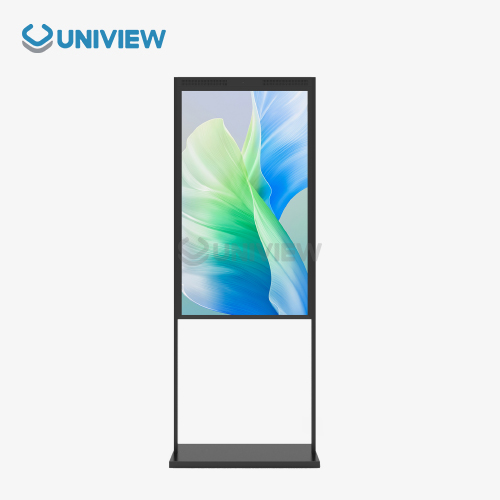
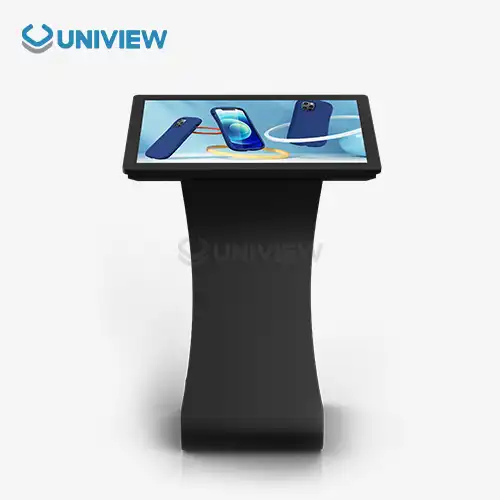
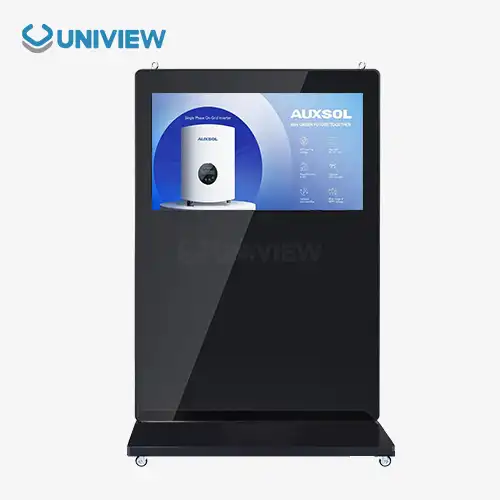
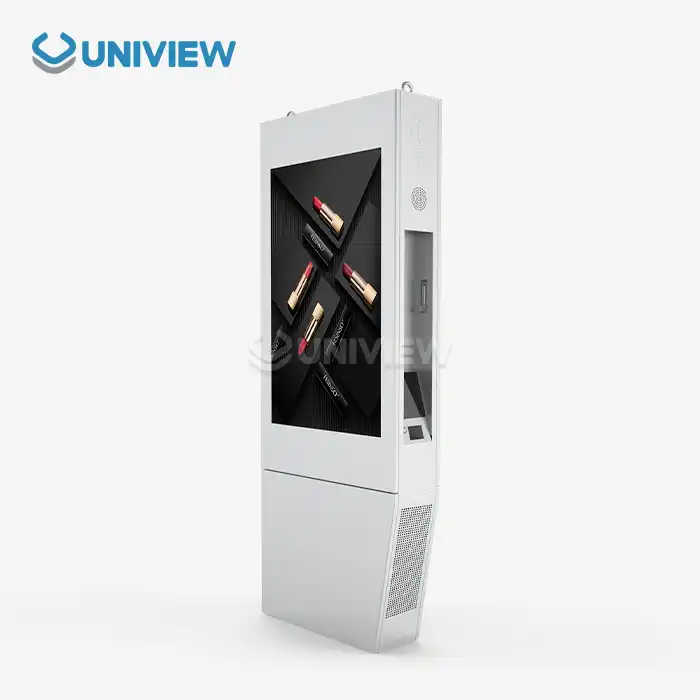
Uniview Commercial makes innovative portable rechargeable screens for B2B procurement in many industries. Our considerable experience in digital signage production has allowed us to produce sophisticated mobile solutions with durability, performance, and cost-effectiveness in a broad product line.
Our P110 Indoor Portable LCD Display System
Our flagship P110 model offers a 27-inch LCD panel with the latest portable display technology, outstanding image clarity, and energy efficiency. This battery-powered system is mobile and professional without power cable management. The device supports corporate presentations and retail consumer engagement indoors with variable mounting options.
The P110's height adjustment, landscape-to-portrait orientation change, and viewing angle optimization improve content visibility. Advanced heat dissipation technology stabilizes extended operation, and high-brightness display clarifies content in low light.
Advanced Technology Integration and Quality Assurance
Our mobile kiosks feature multiple device charging ports so clients can charge while viewing. Public hardware is protected by double-layer anti-theft locks and tamper-resistant architecture. Branding lets companies match displays to their looks and messages.
Live performance statistics, content control, and diagnostics simplify fleet administration across deployment locations with remote monitoring and management. These systems provide flexible deployment methods that increase user pleasure, dwell periods, and revenue through pay-per-use or advertising integration.
Uniview Commercial manufactures with quality in mind. We meticulously test our products to meet European, American, and Japanese standards. Premium materials, including offline-coated AR glass and European surface treatment, assure corrosion resistance. Our 3-5-year warranty and 24-hour global support reflect this quality commitment.
Conclusion
Advanced battery technology, durable design, and sophisticated power management make portable rechargeable kiosk displays reliable for different business applications. Superior battery performance, sturdy hardware construction, smooth technological integration, and extensive equipment and data security features determine reliability. Mobile solutions offer flexibility and operational efficiency that stationary displays cannot in retail, hospitality, events, and transportation. To ensure long-term value and performance, consider operational requirements, environmental circumstances, and supplier capabilities when choosing a portable kiosk.
FAQ
What is the typical battery life for portable rechargeable kiosks?
Battery life varies depending on usage patterns and environmental conditions, but most quality portable kiosks provide 8-12 hours of continuous operation. Heavy interactive use, maximum brightness settings, and extreme temperatures can reduce operational time, while power-saving modes and optimized content can extend battery life significantly.
How do portable kiosks compare to fixed installations in terms of cost-effectiveness?
Portable units offer superior cost-effectiveness for applications requiring flexibility, temporary deployments, or multiple location coverage. While initial costs may be higher than basic fixed units, the ability to relocate optimizes resource utilization and reduces the need for multiple permanent installations.
What maintenance requirements should be expected for portable rechargeable displays?
Regular maintenance includes battery health monitoring, routine hardware inspections, and software updates. Battery systems typically require assessment every 3-6 months, while software updates should be performed quarterly to maintain security and functionality. Professional servicing annually ensures optimal performance and extends equipment lifespan.
Partner with Uniview Commercial for Premium Portable Display Solutions
Uniview Commercial stands ready to transform your digital engagement strategy with our industry-leading portable rechargeable kiosk systems. Our P110 model exemplifies our commitment to innovation, combining 27-inch LCD clarity with advanced battery technology and comprehensive customization options. As a trusted portable rechargeable kiosk manufacturer, we deliver solutions that exceed performance expectations while providing exceptional value for procurement professionals seeking reliable mobile display technology.
Our global presence spans over 100 countries, supported by comprehensive warranty coverage and 24-hour technical support that ensures seamless operation across diverse deployment scenarios. Contact our expert team at sales@univiewlcdisplay.com to explore customized solutions that align with your operational requirements and discover how our portable rechargeable kiosk systems can enhance your customer engagement initiatives.
References
1. Chen, L. & Martinez, R. (2023). "Battery Technology Advancements in Portable Digital Signage Systems." Journal of Display Technology Research, Vol. 15, Issue 3, pp. 45-62.
2. Thompson, K. et al. (2022). "Reliability Assessment Framework for Mobile Kiosk Deployments in Commercial Environments." International Conference on Digital Signage Applications, pp. 78-91.
3. Williams, S. & Park, J. (2023). "Energy Management Systems in Battery-Powered Interactive Displays: Performance Analysis and Optimization Strategies." IEEE Transactions on Consumer Electronics, Vol. 69, No. 2, pp. 234-247.
4. Anderson, M. (2022). "Environmental Durability Testing Standards for Portable Electronic Display Systems." Quality Assurance in Electronics Manufacturing Quarterly, Vol. 28, Issue 4, pp. 123-138.
5. Roberts, D. & Kumar, A. (2023). "Security Architecture Design for Mobile Kiosk Networks in Enterprise Environments." Cybersecurity in Digital Infrastructure Journal, Vol. 7, No. 1, pp. 89-105.
6. Lee, H. & Brown, C. (2022). "Total Cost of Ownership Analysis for Portable versus Fixed Digital Signage Installations." Business Technology Investment Review, Vol. 12, Issue 2, pp. 67-84.
Learn about our latest products and discounts through SMS or email