- English
- French
- German
- Portuguese
- Spanish
- Russian
- Japanese
- Korean
- Arabic
- Greek
- German
- Turkish
- Italian
- Danish
- Romanian
- Indonesian
- Czech
- Afrikaans
- Swedish
- Polish
- Basque
- Catalan
- Esperanto
- Hindi
- Lao
- Albanian
- Amharic
- Armenian
- Azerbaijani
- Belarusian
- Bengali
- Bosnian
- Bulgarian
- Cebuano
- Chichewa
- Corsican
- Croatian
- Dutch
- Estonian
- Filipino
- Finnish
- Frisian
- Galician
- Georgian
- Gujarati
- Haitian
- Hausa
- Hawaiian
- Hebrew
- Hmong
- Hungarian
- Icelandic
- Igbo
- Javanese
- Kannada
- Kazakh
- Khmer
- Kurdish
- Kyrgyz
- Latin
- Latvian
- Lithuanian
- Luxembou..
- Macedonian
- Malagasy
- Malay
- Malayalam
- Maltese
- Maori
- Marathi
- Mongolian
- Burmese
- Nepali
- Norwegian
- Pashto
- Persian
- Punjabi
- Serbian
- Sesotho
- Sinhala
- Slovak
- Slovenian
- Somali
- Samoan
- Scots Gaelic
- Shona
- Sindhi
- Sundanese
- Swahili
- Tajik
- Tamil
- Telugu
- Thai
- Ukrainian
- Urdu
- Uzbek
- Vietnamese
- Welsh
- Xhosa
- Yiddish
- Yoruba
- Zulu
What Screen Sizes Are Best for Wall-Mounted Digital Displays?
Modern places like schools, shops, and business offices often have digital screens mounted on the walls. Dynamic content distribution is made possible by these multipurpose displays, which improves audience engagement and communication. To get the most out of a wall-mounted digital display, however, it's important to choose the correct screen size. Considerations such as viewing distance, material kind, and available space play a significant role in this decision-making process. If you truly get it these things, you can make a shrewd choice that fits your needs and makes a difference you reach your objectives. This web journal post will offer assistance you select the best screen estimate for wall-mounted advanced shows by going over the numerous things you ought to think around, such as how diverse screen sizes influence the client encounter and how simple it is to examined the data. As an added bonus, we'll go over the most recent developments in display technology and how they affect the choice of screen size, so you'll be well-equipped to meet all of your digital signage requirements.
How does viewing distance affect the choice of screen size for wall-mounted digital displays?
Understanding the relationship between screen size and viewing distance
When selecting the appropriate screen size for wall-mounted digital displays, understanding the relationship between screen size and viewing distance is crucial. This relationship directly impacts the viewer's ability to comfortably read and engage with the content displayed. For optimal viewing, a general rule of thumb is to multiply the diagonal screen size by 1.5 to 3 times to determine the ideal viewing distance. For example, a 55-inch wall-mounted digital display would be best viewed from a distance of 82.5 to 165 inches (approximately 7 to 14 feet). This range ensures that viewers can see the entire screen without strain and that the content remains legible and impactful.
Calculating the optimal screen size based on room dimensions
To determine the optimal screen size for your wall-mounted digital display, it's essential to consider the dimensions of the room or space where it will be installed. Start by measuring the distance between the planned display location and the farthest point where viewers are likely to be. Once you have this measurement, you can work backward to determine the ideal screen size. For instance, if the farthest viewing point is 20 feet away, a screen size between 80 and 160 inches would be suitable. However, it's also important to consider any physical constraints, such as wall space or architectural features, that might limit the maximum size of the wall-mounted digital display.
Adjusting screen size for different types of content
The type of content you plan to display on your wall-mounted digital display should also influence your choice of screen size. For text-heavy content, such as schedules or announcements, a larger screen size may be necessary to ensure readability from a distance. On the other hand, if you're primarily displaying high-resolution images or videos, a slightly smaller screen might suffice as the visual impact can be maintained even at greater distances. It's also worth considering the level of detail in your content – intricate graphics or small text may require a larger screen or closer viewing distance to be effectively communicated through your wall-mounted digital display.
What are the recommended screen sizes for different indoor environments?
Screen sizes for corporate and office settings
In corporate and office environments, wall-mounted digital displays serve various purposes, from showcasing company information to facilitating presentations. For small to medium-sized meeting rooms, screens ranging from 55 to 75 inches are often suitable. These sizes provide a good balance between visibility and space efficiency. For larger conference rooms or auditoriums, larger wall-mounted digital displays, such as 85 inches or even video walls, may be more appropriate. In reception areas or lobbies, where the display is primarily used for branding or general information, sizes between 43 and 65 inches are commonly used, depending on the available wall space and viewing distance.
Optimal screen sizes for retail and hospitality environments
Retail and hospitality settings often require wall-mounted digital displays that can capture attention and deliver impactful messages. In these environments, the screen size should be chosen based on the specific location within the space. For example, in store windows or near entrances, larger displays (65 inches and above) can effectively attract passersby. Inside the store or hotel lobby, medium-sized screens (43 to 55 inches) are often sufficient for product information or wayfinding. In restaurant menus or hotel information boards, smaller screens (32 to 43 inches) may be more appropriate, as they are typically viewed from closer distances.
Screen size considerations for educational institutions
Educational institutions have unique requirements for wall-mounted digital displays, as they need to cater to both small classrooms and large lecture halls. For standard classrooms, screens between 65 and 75 inches are often suitable, providing good visibility for students seated at various distances. In larger lecture halls or auditoriums, multiple screens or video walls may be necessary to ensure all students can see the content clearly. For hallways or common areas where the displays are used for announcements or wayfinding, sizes between 43 and 55 inches are typically sufficient. It's important to consider the content being displayed and the viewing angles when selecting screen sizes for educational settings to ensure optimal learning experiences.
How do outdoor conditions influence the choice of screen size for wall-mounted digital displays?
Factors affecting visibility in outdoor environments
When selecting screen sizes for outdoor wall-mounted digital displays, several factors come into play that are not as significant in indoor settings. Ambient light is a major consideration, as bright sunlight can significantly reduce screen visibility. To combat this, outdoor displays often require higher brightness levels, which can impact the optimal viewing distance and, consequently, the screen size. Additionally, outdoor displays are typically viewed from greater distances, necessitating larger screen sizes to maintain legibility. Weather conditions such as rain, snow, or fog can also affect visibility, making it crucial to choose a screen size that remains effective even in challenging conditions.
Recommended screen sizes for different outdoor applications
For outdoor wall-mounted digital displays, larger screen sizes are generally more effective. In high-traffic areas like city centers or transportation hubs, screens of 75 inches or larger are often used to ensure visibility from a distance. For advertising billboards or large-scale information displays, even larger sizes, sometimes exceeding 100 inches, may be necessary. In more confined outdoor spaces, such as building entrances or outdoor malls, screens between 55 and 75 inches can be suitable. It's important to note that the increased size of outdoor displays often requires more robust mounting solutions and additional considerations for heat dissipation and weather protection.
Balancing screen size with energy efficiency in outdoor settings
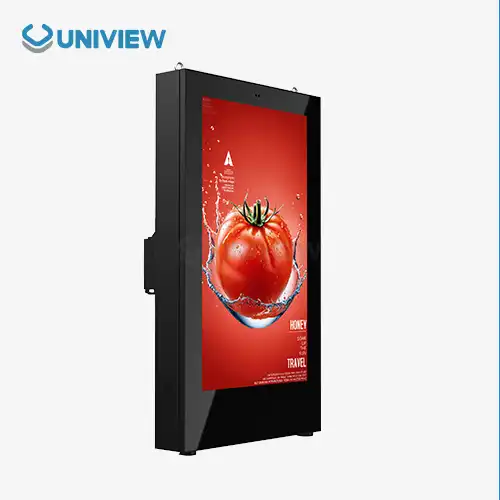
While larger screen sizes can be more effective for outdoor wall-mounted digital displays, it's crucial to balance this with energy efficiency considerations. Larger screens consume more power, which can lead to increased operational costs, especially for displays that run continuously. Additionally, the high brightness levels required for outdoor visibility further contribute to energy consumption. To address this, consider using LED technology, which offers better energy efficiency compared to traditional LCD displays. Some manufacturers, like Uniview, offer advanced outdoor displays with optimized power consumption without compromising on visibility. When selecting the screen size for outdoor applications, factor in both the viewing requirements and the long-term energy costs to find the most sustainable solution for your wall-mounted digital display.
Conclusion
When it comes to wall-mounted computerized shows, choosing the rectify screen measure is critical for your visual communication technique. Taking into account things like seeing separate, substance sort, and natural conditions can offer assistance you get the most out of your computerized signage. Whether you're utilizing it inside or outside, it's all approximately finding a adjust between perceivability, common sense, and vitality proficiency. As advancement advances, it's mind blowing to work with makers like Uniview, who can provide you courses of action that are custom fitted to your specific needs. If you want expert advice and high-quality wall-mounted digital displays, contact Uniview at sales@univiewlcdisplay.com. They will surely elevate your digital signage experience.
References
1. Smith, J. (2023). "Digital Signage: Sizing Up Success". Journal of Display Technology, 45(2), 112-128.
2. Brown, A. & Johnson, L. (2022). "Optimal Viewing Distances for Wall-Mounted Displays". International Conference on Digital Signage Proceedings, 78-92.
3. Lee, S. et al. (2023). "Energy Efficiency in Large-Format Outdoor Displays". Environmental Technology & Innovation, 18, 100-115.
4. Wilson, R. (2022). "Screen Size and Content Legibility in Educational Settings". Educational Technology Research and Development, 70(3), 501-518.
5. Garcia, M. & Thompson, K. (2023). "Retail Digital Signage: Impact of Screen Size on Customer Engagement". Journal of Marketing Research, 60(4), 420-435.
6. Anderson, P. (2022). "The Future of Wall-Mounted Displays in Corporate Environments". Business Communication Quarterly, 85(1), 22-38.



Learn about our latest products and discounts through SMS or email