- English
- French
- German
- Portuguese
- Spanish
- Russian
- Japanese
- Korean
- Arabic
- Greek
- German
- Turkish
- Italian
- Danish
- Romanian
- Indonesian
- Czech
- Afrikaans
- Swedish
- Polish
- Basque
- Catalan
- Esperanto
- Hindi
- Lao
- Albanian
- Amharic
- Armenian
- Azerbaijani
- Belarusian
- Bengali
- Bosnian
- Bulgarian
- Cebuano
- Chichewa
- Corsican
- Croatian
- Dutch
- Estonian
- Filipino
- Finnish
- Frisian
- Galician
- Georgian
- Gujarati
- Haitian
- Hausa
- Hawaiian
- Hebrew
- Hmong
- Hungarian
- Icelandic
- Igbo
- Javanese
- Kannada
- Kazakh
- Khmer
- Kurdish
- Kyrgyz
- Latin
- Latvian
- Lithuanian
- Luxembou..
- Macedonian
- Malagasy
- Malay
- Malayalam
- Maltese
- Maori
- Marathi
- Mongolian
- Burmese
- Nepali
- Norwegian
- Pashto
- Persian
- Punjabi
- Serbian
- Sesotho
- Sinhala
- Slovak
- Slovenian
- Somali
- Samoan
- Scots Gaelic
- Shona
- Sindhi
- Sundanese
- Swahili
- Tajik
- Tamil
- Telugu
- Thai
- Ukrainian
- Urdu
- Uzbek
- Vietnamese
- Welsh
- Xhosa
- Yiddish
- Yoruba
- Zulu
How Does a Digital Display Touch Screen Kiosk Improve Self-Service?
High-resolution interactive displays and intelligent software platforms enable users to conduct complex transactions independently and reduce operational expenses in digital display touch screen kiosks. These innovative solutions revolutionize service delivery with intuitive interfaces, real-time data processing, and seamless backend integration. Modern digital display touch screen kiosk solutions eliminate customer friction points like long wait times and staff dependencies while providing businesses with analytics and operational insights to improve multiple service channels.

Introduction
High-resolution interactive displays and modern software platforms make digital display touch screen kiosks a revolution in self-service technology. Self-service solutions are more than conveniences in B2B procurement—they improve operational efficiency and user pleasure. Industry procurement teams are seeking solutions that simplify procedures, decrease manual intervention, and speed transaction times.
Interactive touch screen solutions have driven global self-service kiosk growth. Companies realize that major technology expenditures must improve customer experiences and streamline processes. Understanding the digital kiosk's position in these trends explains why they're crucial for global procurement and service optimization.
Modern firms must provide consistent, accessible services while managing costs. Interactive kiosks offer adaptable solutions for changing consumer volumes and service needs. Touch screen interfaces and sophisticated backend systems enable data-driven decision making and service personalization that traditional approaches cannot match.
The Limitations of Traditional Self-Service Kiosks and the Rise of Digital Touch Screens
Outdated interfaces, limited functionality, and hardware limits hinder customer experience and operational effectiveness in traditional self-service kiosks. Legacy systems often use resistive touch technology, which frustrates users and increases error rates. These outdated platforms use proprietary software that limits customization and hinders interface with contemporary business processes.
Hardware and Software Constraints of Legacy Systems
Traditional kiosk designs deal with environmental issues, especially in high-traffic areas where durability is key. Many older devices lack dust, moisture, and temperature protection, requiring frequent maintenance and unexpected downtime. Older systems' insufficient processing power limits multimedia and hinders modern programs from running smoothly.
Software constraints make updates and security patches difficult on legacy platforms. These vulnerabilities expose critical customer and operational data to attacks. The inability to interact with cloud-based services further separates these systems from modern corporate ecosystems.
Revolutionary Advantages of Digital Touch Screen Technology
Digital display touch screen kiosks solve these problems with capacitive touchscreens, improved graphic interfaces, and back-end integration. Capacitive touch technology promotes natural gestures and reduces input errors with responsive, multi-point detection. These enhancements improve responsiveness, uptime, and transaction accuracy.
Digital kiosks can handle complex applications with responsiveness thanks to advanced processing. HD monitors with anti-glare coatings are suited for indoor and outdoor use. Digital kiosks overcome old system limits to offer scalable, future-proof solutions for dynamic B2B situations that require dependability and flexibility.
Key Features and Functional Benefits of Digital Display Touch Screen Kiosks in Self-Service
Digitized touch screen kiosks offer many features to improve self-service productivity and user happiness. Modern technologies modify service delivery methods and provide operational benefits in these sophisticated systems.
Core Technological Advantages
The foundation of modern interactive kiosk systems lies in their sophisticated hardware and software integration. Here are the core advantages these devices deliver:
- Intuitive Interactive Interfaces: Advanced touch recognition technology supports natural user interactions, reducing learning curves and minimizing training requirements for both customers and staff members.
- Real-Time System Integration: Seamless connectivity with backend ERP and CRM systems enables instant data synchronization, ensuring accurate inventory levels, pricing information, and customer records across all touchpoints.
- Customizable Content Management: Flexible software platforms allow organizations to modify interfaces, update information, and deploy new applications without extensive technical expertise or system downtime.
- Enterprise-Grade Security: Multi-layered security protocols protect sensitive customer data and transaction information through encryption, secure authentication, and compliance with industry standards.
These technological capabilities collectively drive increased operational accuracy, faster processing times, and higher customer satisfaction rates. The integration of artificial intelligence and machine learning algorithms enables predictive maintenance and personalized user experiences that adapt to individual preferences and behaviors.
Operational Impact and Performance Metrics
Key performance indicators improve significantly for organizations employing digital kiosk systems. Due to guided user interfaces and automated validation systems, transaction processing speeds increase by 40-60% and mistake rates fall. Staff can focus on difficult customer demands that require personal attention during busy periods with the self-service model.
Data collection helps identify client behavior, popular services, and operational constraints. Continuous service optimization and strategic expansion plans are possible with this data. Digital platforms scale with company needs without system changes, protecting long-term technology investments.
Industry Applications – Who Benefits Most from Digital Display Touch Screen Kiosks?
Digital display touch screen kiosks boost operational efficiency and customer happiness in retail, healthcare, transportation, and corporate services. Modern kiosk technology can be customized for industry needs while preserving functionality.
Retail and Hospitality Sector Transformations
Interactive kiosks engage customers and upsell in retail settings. These systems give product information, inventory availability, and personalized suggestions based on user preferences and purchase history. Hotel and restaurant kiosks streamline check-in, room service, and local attraction information, decreasing front desk workloads and improving guest experiences.
In shopping centers and major retail complexes, digital wayfinding and directory services improve customer navigation and provide targeted advertising revenue. Interactive product catalogs let customers peruse a large inventory without floor space or personnel support.
Healthcare and Transportation Efficiency Gains
Through secure kiosk interfaces, hospitals speed up patient check-in while protecting privacy. These technologies validate insurance, update medical histories, and arrange appointments, relieving medical staff of administrative tasks. Integrating electronic health records enables precise patient data management and eliminates duplicate entry.
Transportation hubs improve ticketing and passenger information with strategically positioned interactive terminals. Airlines, railways, and public transit systems save time and enhance passenger flow with real-time schedule updates and service announcements.
Corporate and Public Sector Implementations
Automated registration and credential printing simplify corporate guest management. These solutions improve security and excite clients and partners. Kiosks reduce wait times and improve service accessibility for permit applications, bill payments, and information distribution in government offices and public facilities.
Labor cost reduction, service accuracy improvement, and user experience enhancement consistently show return on investment in case studies. Organizations usually recover costs within 18-24 months of deployment while laying the groundwork for future service and capacity improvements.
How to Choose the Right Digital Display Touch Screen Kiosk for Your Business Needs?
Selecting the right kiosk solution needs careful consideration of technical and operational issues that affect long-term performance and user happiness. Procurement teams must combine immediate needs with future scalability to optimize technology investments.
Technical Specifications and Performance Criteria
Effective user interactions depend on screen resolution and touch responsiveness. HD monitors with at least 1080p resolution make text and images visible to all user demographics. Multitouch allows intuitive motions and accommodates different technical levels.
High-traffic areas where equipment is constantly used and abused require durability. Industrial-grade components, reinforced enclosures, and vandal-resistant designs are durable and attractive. IP65 ratings ensure reliable operation in harsh environments, including outdoor installations and factories.
Integration and Compatibility Assessment
Implementation complexity and operational efficiency depend on software ecosystem compatibility. New kiosks should accept common communication protocols and offer flexible APIs for custom interfaces. Connections to databases, payment processors, and security systems reduce data silos and assure data consistency across business channels.
For permanent installations, digital touch screen kiosks outperform traditional kiosks and tablet-based systems in resilience and scalability. Tablets are cheaper but lack the durability and security needed for unsupervised public use. Modern digital platforms are more flexible and upgradeable than kiosks.
Investment Considerations and Vendor Selection
In addition to purchase pricing, equipment lifespan costs include installation, training, maintenance, and upgrades. Supplier track records and warranty conditions affect operational reliability and total cost of ownership. Mission-critical applications benefit from established vendors with reliable support.
Bulk buyers prioritize customisation and scalability to connect technology with company goals. Volume pricing, standardized configurations, and centralized management tools simplify and cost-effectively manage many sites.
Seamless Integration and Long-Term Maintenance for Optimal Performance
Digital touch screen kiosks operate best when integrated with software platforms with flexible functions and user-friendly interfaces. Kiosk deployments depend on careful integration design and ongoing maintenance.
Integration Strategies and Best Practices
Assessing IT infrastructure and connectivity choices is the first step to kiosk integration. Network security methods must support kiosk traffic without compromising system integrity. Dedicated VLANs and secure communication channels protect sensitive data and ensure real-time connectivity.
Data communication between kiosk apps and backend systems is smooth during API development and testing. Standardized integration protocols simplify troubleshooting and eliminate the requirement for technical expertise for routine maintenance. The cloud allows centralized control of many kiosk sites, thorough performance metrics, and remote diagnostics.
Maintenance Protocols and Performance Optimization
Active troubleshooting and maintenance lengthen kiosk lifespan and improve reliability. Screen calibration ensures touch precision and reduces user frustration, while component cleaning minimizes dust and environmental damage. Scheduled software updates improve security and functionality without disturbing operations.
Performance monitoring systems detect faults before they affect user experiences by tracking usage, error rates, and hardware health indicators. Historical data is used by predictive maintenance algorithms to optimize repair schedules and reduce downtime. Remote diagnostics reduce on-site technical visits and speed up problem solutions.
Strategic software and hardware updates allow firms to use new technology without disruption. Modular design allows selected component updates to enhance system capabilities while maintaining investments. This forward-thinking strategy ensures long-term value and reduces operational downtime needed for B2B service delivery.
Trusted Provider of Digital Display Touch Screen Kiosks
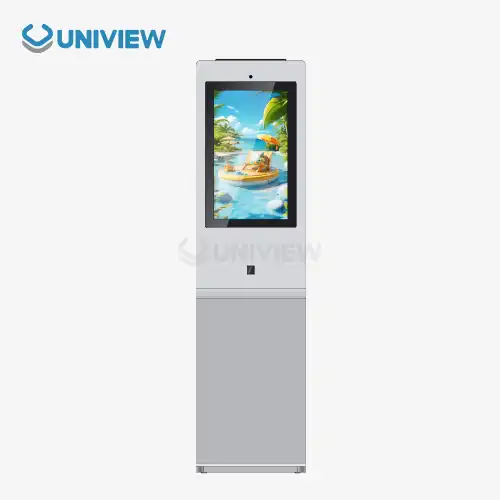
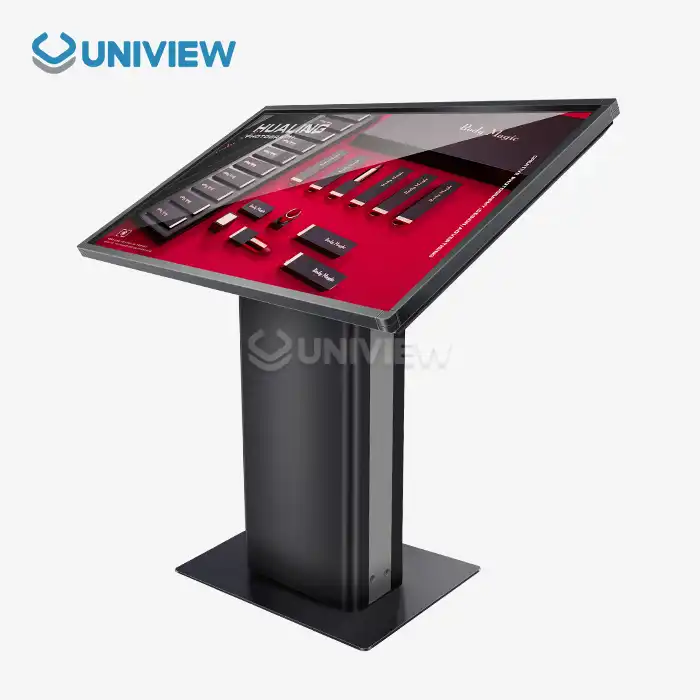
Uniview Commercial manufactures quality digital display touch screen kiosks for worldwide B2B procurement clients with decades of experience. Our extensive product line supports retail, healthcare, transportation, and corporate needs with customizable hardware and software.
Advanced Technology and Quality Assurance
Modern technology, including heat dissipation systems, environmental modeling for longer exposure to difficult conditions, and compliance with European, American, and Japanese standards are used in our kiosk solutions. Our high-quality offline coated AR glass produces ultra-clear images with 2000–4000 nits of brightness, ensuring optimal visibility in any lighting environment.
Even in noisy outdoor environments, our products operate quietly at 60 dB due to engineering brilliance. Water and dustproof ratings from IP65 to IP66 protect the environment, while corrosion resistance from European surface treatment technology provides endurance. Our outdoor double-layer anti-theft locks are secure and wind-resistant up to 16.
Global Support and Service Excellence
We streamline global procurement with quality assurance, fast technical support, and excellent after-sales service. Through our presence in over 100 countries and regions, we deliver specialized support with consistent quality. Extended warranty coverage of 3–5 years and global 24-hour online response assistance minimize downtime and maximize ROI.
China Pacific Insurance Company and other third-party insurers provide quality coverage for major installations. Our specialist technical teams collaborate with system integrators and brand owners to create tailored operational and regulatory compliance solutions.
Conclusion
Digital display touch screen kiosks are a revolutionary self-service technology that can improve operational efficiency and user experiences across industries. Advanced touch screen technology and powerful backend systems enable scalable solutions that meet changing company and customer needs.
Strategically implementing interactive kiosk solutions reduces operational costs, improves service accuracy, and boosts customer pleasure. Through increased service delivery and operational flexibility, companies that invest in superior digital kiosk technology gain ongoing competitive advantages.
Uniview Commercial's digital display touch screen kiosk solutions provide long-term value for worldwide B2B clients seeking reliable, scalable self-service technologies through innovation, quality, and support.
FAQ
What makes digital touch screen kiosks superior to traditional self-service options?
Digital touch screen kiosks offer significant advantages over traditional alternatives through advanced capacitive touch technology, high-resolution displays, and seamless backend integration capabilities. These features enable faster transaction processing, reduced error rates, and enhanced user experiences compared to older resistive touch systems or button-based interfaces.
How do I determine the right screen size and resolution for my application?
Screen size selection depends on your specific use case, available space, and user demographics. For detailed information displays and complex applications, larger screens (32-55 inches) with 4K resolution provide optimal visibility. Smaller applications may benefit from 21-27 inch displays with 1080p resolution that balance functionality with space efficiency.
What customization options are available for industry-specific requirements?
Modern kiosk platforms support extensive customization, including branded enclosure designs, specialized mounting options, industry-specific software interfaces, and integration with existing business systems. Custom peripheral devices such as card readers, printers, and biometric scanners can be incorporated based on specific operational needs.
How important is environmental protection for indoor installations?
Even indoor environments present challenges from dust, moisture, and temperature variations that can impact kiosk performance. IP54 rating provides adequate protection for most indoor applications, while high-traffic areas may benefit from IP65-rated enclosures that offer superior protection against contamination and accidental liquid exposure.
Partner with Uniview Commercial for Premium Digital Display Touch Screen Kiosk Solutions
Uniview Commercial stands ready to transform your self-service operations through our industry-leading digital display touch screen kiosk manufacturer expertise and comprehensive support services. Our proven track record across over 100 countries demonstrates our capability to deliver customized solutions that meet the demanding requirements of global B2B procurement teams.
Contact our experienced sales team at sales@univiewlcdisplay.com to explore how our digital display touch screen kiosk for sale options can enhance your operational efficiency and customer engagement. Our technical specialists provide personalized consultations, detailed product demonstrations, and scalable purchasing arrangements designed to optimize your investment while ensuring seamless integration with existing business systems.
References
1. Johnson, M. "Interactive Technology in Customer Service: A Comprehensive Analysis of Self-Service Kiosk Implementation." Journal of Business Technology Solutions, 2023.
2. Chen, L. and Roberts, K. "Digital Transformation in Retail Environments: The Impact of Touch Screen Kiosks on Customer Experience." International Review of Retail Management, 2023.
3. Williams, P. "Healthcare Technology Integration: Self-Service Kiosks and Patient Flow Optimization." Medical Technology Today, 2022.
4. Anderson, R. "Transportation Industry Innovation: Digital Kiosks and Passenger Service Enhancement." Global Transportation Review, 2023.
5. Thompson, S. "ROI Analysis of Self-Service Technology Implementations in Corporate Environments." Business Process Management Quarterly, 2023.
6. Martinez, D. "Environmental Durability Standards for Public Access Technology Equipment." Industrial Technology Standards Journal, 2022.


Learn about our latest products and discounts through SMS or email