- English
- French
- German
- Portuguese
- Spanish
- Russian
- Japanese
- Korean
- Arabic
- Greek
- German
- Turkish
- Italian
- Danish
- Romanian
- Indonesian
- Czech
- Afrikaans
- Swedish
- Polish
- Basque
- Catalan
- Esperanto
- Hindi
- Lao
- Albanian
- Amharic
- Armenian
- Azerbaijani
- Belarusian
- Bengali
- Bosnian
- Bulgarian
- Cebuano
- Chichewa
- Corsican
- Croatian
- Dutch
- Estonian
- Filipino
- Finnish
- Frisian
- Galician
- Georgian
- Gujarati
- Haitian
- Hausa
- Hawaiian
- Hebrew
- Hmong
- Hungarian
- Icelandic
- Igbo
- Javanese
- Kannada
- Kazakh
- Khmer
- Kurdish
- Kyrgyz
- Latin
- Latvian
- Lithuanian
- Luxembou..
- Macedonian
- Malagasy
- Malay
- Malayalam
- Maltese
- Maori
- Marathi
- Mongolian
- Burmese
- Nepali
- Norwegian
- Pashto
- Persian
- Punjabi
- Serbian
- Sesotho
- Sinhala
- Slovak
- Slovenian
- Somali
- Samoan
- Scots Gaelic
- Shona
- Sindhi
- Sundanese
- Swahili
- Tajik
- Tamil
- Telugu
- Thai
- Ukrainian
- Urdu
- Uzbek
- Vietnamese
- Welsh
- Xhosa
- Yiddish
- Yoruba
- Zulu
Semi-Outdoor LCD Window Display Designs That Drive Sales
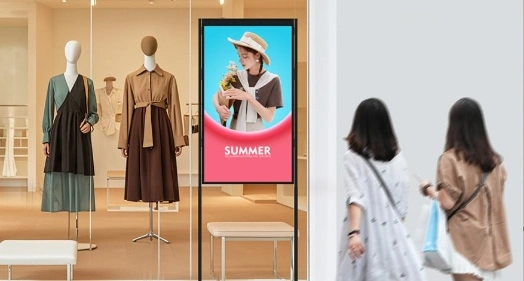
Visibility is very important for stores that are in places with a lot of foot traffic. Semi-Outdoor LCD window display technology turns shops into strong sales engines by mixing high brightness with long-lasting durability that can withstand the weather. These specialized digital signs systems are hidden behind window glass and face outward to catch people's attention. They are safe from direct weather exposure. This technology delivers high-luminance performance—ranging from 2,000 to 4,000 nits—ensuring your brand message stays vivid even in challenging lighting conditions, ultimately increasing foot traffic and conversion rates. This is in contrast to standard indoor screens that look washed out in direct sunlight or bulky fully outdoor displays that need to be completely waterproofed.
Understanding Semi-Outdoor LCD Window Displays: Features and Benefits
Bridging Indoor Protection with Outdoor Performance
When it comes to value, Semi-Outdoor LCD window display is best when it can combine two normally different spaces. Our UW1500P model was made to solve the specific problem that retail shops, real estate offices, and hospitality places face: how to speak actively with people on the street without putting expensive electronics at risk of being damaged by dust, rain, or vandalism. This specific type of display works in what engineers call the "semi-exposed zone," which is inside but still gets a lot of light and heat from the sun, making regular displays useless.
High-Brightness Technology That Cuts Through Sunlight
The main thing that sets Semi-Outdoor LCD window display apart from regular digital signs is their brightness. Standard indoor monitors usually work between 250 and 400 nits, which is so dim that it's almost impossible to see when sunshine comes in through shop windows. The brightness of our UW1500P can be changed from 2,000 to 4,000 nits, so material can be read all day, no matter what the weather or sun angle is like. This level of brightness directly addresses what the business world calls "daylight washout," which is when background light is too bright for the screen to show anything. This brightness is achieved by the energy-efficient LED backlighting system, which uses less power than standard CCFL technology. This lowers the costs of running displays all the time for companies.
Factory Color Calibration for Brand Consistency
In retail and restaurant settings where brand identity depends on accurate visual representation, color precision is very important. Before being sent out, the factory calibrates each UW1500P to make sure that it reproduces colors perfectly and has high contrast ratios that meet brand standards. The display shows colors accurately, which makes customers believe it, whether it's high-end clothing, car finishes, or food from a restaurant. This calibration process fixes a common problem in large-scale deployments: screens that aren't adjusted cause visual differences in many places.
Weather-Resistant Construction Without Full Outdoor Enclosures
When these screens are inside, they can handle environmental forces that would hurt regular screens. When solar energy goes through window glass, it causes a greenhouse effect that makes the inside of a building much warmer. Our thermal management system has smart cooling design that keeps the system running at the best temperature while making very little noise—only 60 dB at full load. This quiet operation is very important in stores where too much fan noise would ruin the shopping experience. The design theory strikes a balance between sturdiness and aesthetic appeal by using ultra-slim frames that make things look better without taking up too much space in stores that were carefully planned.
Continuous Visibility Drives Customer Engagement
Because they can be used 24 hours a day, seven days a week, computers become marketing tools that are always on. In stores, studies regularly show that moving digital material gets 400% more views than still posters, because people stop to look at moving images for longer. Our Semi-Outdoor LCD window display solutions take advantage of this pattern of behavior, which lets companies change promotions quickly, change content based on the time of day, and adapt to real-time market conditions. Because of this, window space that was once empty can be turned into a sales route that works around the clock, making memories long after the store closes.
How Semi-Outdoor LCD Window Displays Work and Best Usage Scenarios
Adaptive Brightness Control for All-Day Performance
Advanced technology is needed for Semi-Outdoor LCD window display to work well, and adjustable brightness systems are the first step. Built-in ambient light sensors constantly check the lighting outside and change the backlight's strength to keep things clearly visible while saving energy. In the morning, when the streets are still in the dark, the system lowers the output so that it is safe to see. When the afternoon sun hits the window directly, the brightness goes up automatically to cut down on glare and keep the text legible. This smart change increases the life of the component by stopping it from operating at full brightness when a smaller output is enough.
Thermal Management in Complex Environments
Heat is the main technical problem for screens that are placed close to window glass. A liquid crystal display can't handle surface temps that are too high. This is known as "isotropic failure" or the "blackening defect" by professionals in the field. It means that the crystals lose their molecular alignment and become forever dark. Our UW1500P uses high-temperature liquid crystal screens that were made to work with surface temperatures of up to 110°C without breaking down. When combined with carefully designed cooling systems, this heat resistance makes sure that the system works reliably even in south-facing windows that get the most sun in the summer.
Retail Store Windows: Creating Irresistible First Impressions
These screens work best in retail settings, which is where they are most often used. Fashion stores use video content to show off seasonal styles because it better explains the brand's lifestyle than mannequins alone. Our UW1500P's ultra-thin frame design fits right in with the look of high-end stores, adding technology without giving the space an industrial look. Store managers like that they can change material from afar, which saves them money on labor costs and makes the signs look more consistent. Installation choices include hanging from the roof or mounting it on the wall, so it can be used in a variety of building layouts.
Real Estate Offices: Dynamic Property Showcases
Real estate offices changed how they did business by switching from static, lighted property ads to Semi-Outdoor LCD window display units. The high clarity of FHD or UHD forms makes sure that property details, prices, and contact information are clear and easy to read from the sidewalk. Agencies can put featured properties at the top of the list, quickly update availability as sales close, and add video tour previews that bring qualified prospects into the office. The show stays on all the time, advertising homes to evening walkers when offices might be closed, which makes agents more available.
Automotive Showrooms: Highlighting Premium Features
Dealerships use screens that face the windows to show off a vehicle's features, financing options, and brand messages to people looking to buy a car along shopping streets. When it comes to accurately showing paint finishes and internal materials on cars, the mix of high brightness and color accuracy is especially useful. As a customization option, touchscreen integration lets potential customers look at goods when the store isn't open for business, collecting contact information for later follow-up. This engaging feature makes the store experience last longer than just business hours.
Transportation Hubs: Wayfinding and Advertising
These screens are used in transit stops, airports, and transportation hubs for two reasons: to give information to passengers and to show ads. The strong construction can handle the changing weather conditions that come with semi-enclosed rooms with doors that open. Content management systems make it easy to switch between information that helps people find their way during busy times and ads that make money during slower times, which maximizes the return on hardware investment.
Maintenance Protocols for Longevity
With regular upkeep, you can keep the image clarity high and the machine running for longer. Routine practices include using non-abrasive solutions to clean the protective glass surface every three months, checking the airflow in the cooling system every month, and installing software updates that improve performance and security on a regular basis. Setting up upkeep plans with installation partners is something that procurement professionals should do to make sure that problems are fixed quickly before they get worse and cost a lot to fix. Our technical support team has a lot of tools for solving and is available online 24 hours a day, 7 days a week, so when problems do happen, they can be fixed quickly.
Comparing Semi-Outdoor LCD Window Displays with Other Display Technologies
Brightness and Resolution Trade-offs
Understanding the link between brightness, resolution, and cost helps you make the best choice when looking at digital signs options. Standard LCD screens for indoor use have great clarity and reasonable prices, but they don't work well in places with a lot of ambient light. During the day, their normal 300–500 nit output is almost unnoticeable through window glass. Fully outdoor LED screens are very bright—often more than 5,000 nits—but they lose image density, which makes it hard to read small text. Semi-Outdoor LCD window display solutions are a good compromise because they provide 2,000 to 4,000 nits of brightness, which is enough for daytime vision, while still keeping a pixel density that makes detailed content, product specs, and understandable text visible at normal viewing distances.
Energy Efficiency Comparisons
When deployed for more than one year, operational costs have a big effect on the total cost of ownership. Because thousands of individual LED panels need to be turned on and off at high light, outdoor LED walls use a lot more power than LCD technology. Our LCD-based UW1500P has the same level of useful visibility for window applications while using a lot less power. This means lower energy costs and a smaller impact on the environment. The LED backlit system uses less energy and gives off more light than older CCFL technology. This gives performance and environmental benefits that are important to business buyers who have to follow environmental responsibility mandates.
Durability and Environmental Protection
Fully outdoor displays have heavy-duty casings, waterproof grades of IP65 or IP67, and special materials that can handle direct rain, snow, and humidity. This extra security makes the system heavier, more expensive, and harder to set up. If you put Semi-Outdoor LCD window display systems inside, you don't have to follow these rules. This lowers the cost of acquisition while still protecting the screens from the real-world stresses. The IP65-rated versions we sell protect against dust getting in and prevent wetness that could come from cleaning or condensation. They are the right mix of security and usability for semi-exposed setups.
Installation Flexibility and Aesthetic Integration
Most of the time, architectural limits decide which technologies are used. To hold up heavy waterproof enclosures, outdoor displays need extra support for the building's structure. They also need special wiring and, in many cases, permission from the city to make changes to the outside of the building. Standard mounting hardware can be used to place Semi-Outdoor LCD window display units on inner walls or ceilings. This makes deployment easier and lowers the cost of installation. The thin shape, which is a key part of our UW1500P design, makes it easy to see what's on the screen without drawing attention to the hardware. This question of style is especially important in high-end stores and hotels, where brand image depends on consistent design.
Vendor Ecosystem and Support Infrastructure
Technology selection is more than just choosing the right tools. It also includes the support environment that surrounds it. Manufacturers that have been around for a long time and do business all over the world, like Uniview Commercial, which has operations in more than 100 countries, offer reliable parts availability, standard service procedures, and quick expert help that keep operations running smoothly. When procurement workers compare vendors, they should look at warranty terms (we offer extra coverage from 3 to 5 years), how easy it is to get new parts, and how deep the integration partner networks are that make sure local installation and servicing can be done. We have full quality coverage through China Pacific Insurance Company and third-party adjusters. This lowers risk even more, which is useful for large-scale operations.
How to Choose the Right Semi-Outdoor LCD Window Display For Your Business
Assessing Environmental Brightness Requirements
The first step in writing a good specification is to look at the lighting circumstances where the work will be done. For clear vision during peak glare hours, south-facing windows in places with strong summer sun need the highest brightness level, which is the 4,000-nit upper range of our Semi-Outdoor LCD window display. Places that face north or have a lot of tree or building shadows may do fine with 2,000 to 2,500 nits of output, which lets you save money without losing efficiency. Using lux meters to do site surveys gives you reliable data that takes away the need to guess. They measure the amount of light in the area throughout the day so you can choose the right brightness.
Resolution Selection Based on Viewing Distance and Content Type
Resolution needs are set by the content plan. FHD (1920x1080) quality usually works well for retail apps that show brand images and promotional videos because it gives enough clarity at watching distances of 2 to 4 meters, which is common for storefront windows. UHD (3840x2160) resolution keeps text legible, which is good for real estate apps that show property ads with thorough specs, pricing tables, and small legal disclaimers. To find the pixel density, divide the screen height by the average viewing distance. Higher ratios mean that you can see more small details, which means you need a higher resolution.
Scalability and Multi-Unit Deployment Planning
Standardization that makes content control and upkeep easier should be a top priority for businesses with various locations. By choosing the same models for all sites, you can save money on things like stocking up on extra parts, teaching technicians, and making content. Our UW1500P Semi-Outdoor LCD window display comes in different sizes to fit different window sizes. This lets you get the right size while keeping the technology the same. Then, centralized content management systems can send branded content across whole networks, making sure that the message stays the same while still letting local users make changes when needed.
Warranty and After-Sales Service Evaluation
Longer warranties protect investments that last more than one year against parts breaking down and efficiency dropping. Our guarantee terms of 3 to 5 years are longer than the industry standard. This shows that we are confident in our making and gives stakeholders who are worried about technology going out of date a reason to buy from us. Service responsiveness is just as important. Our global 24-hour online support makes sure that technical help is available across all time zones, reducing downtime that directly affects sales on Semi-Outdoor LCD window display solutions that are live sales platforms. During the procurement process, it is important to be clear about the guarantee coverage details, such as what parts are covered, how long the company will respond, and whether replacement units are given while fixes are being done.
Customization Options for Specialized Applications
Because of the needs of each industry, customizations above and beyond basic setups are often needed. Hospitality places may need touchscreens so that guests can use interactive maps or service listings to find their way. For corporate Semi-Outdoor LCD window display installs, you might need special mounting brackets that can fit into certain building features. Our production skills in Shenzhen allow for creative customization, such as changing the size, adjusting the brightness for different settings, and connecting to your current content management system. When you involve our technical team early on in the planning process, you can be sure that your specific needs will be met before you make a buy promise.
Evaluation of Supplier Reliability and Delivery Timeline Assessment
The way the global supply chain works makes evaluating a vendor's dependability very important. Look at the company's ability to make things, its methods for getting parts, and its relationships in logistics that affect how consistently it delivers. After ten years of doing business around the world, our supply chain is fully developed, and we have created freight partnerships that make sure we can deliver on time to over 100 countries. When managing projects with set installation dates, procurement professionals should discuss delivery plans that include extra time in case something goes wrong. This is especially important for large orders that need extra time to be made. Misunderstandings that could slow down the project's finish can be avoided by being clear about quantity, specs, and expected end date.
Case Studies: Window Display Implementations That Boost Sales
Retail Chain Transforms Seasonal Promotion Strategy
A national clothing store chain with 47 sites saw less foot traffic as people started shopping online instead. Traditional Semi-Outdoor LCD window display with models and static signs didn't show how the company's brand personality changed over time thanks to social media. Management chose to test high-brightness screens in five flagship sites. These locations would get displays that could show off video material made by their creative team.
Behavioral changes were seen right away after the introduction. Foot traffic data collected during the first three months after the installation showed that people stayed in front of windows for an average of 12.7 seconds when video content was shown instead of 3.2 seconds when plain content was shown. Store managers said that the visually appealing material made people more interested in what was inside the stores, which led to a 23% rise in the number of window buyers who actually bought something. The video format let the brand tell seasonal stories by tying together spring lines with images of everyday life that made people feel something instead of just showing off goods.
The success measures led the leaders to expand the deployment to all areas. The unified content management system let headquarters send out messages that were consistent with the brand, but it also let regional managers change 20% of the content to fit local events and demographics. Over the course of 18 months, sales at shops with updated window displays went up 11% compared to stores that kept their old windows. Within 14 months, the higher sales paid for the technology investment.
Automotive Dealership Captures After-Hours Shoppers
An car dealership group with 12 sites in major cities realized that most potential buyers were not available during normal business hours. People going along the shopping corridors next to showrooms in the evenings and on the weekends were likely possible customers who were looking around but couldn't get information about vehicles because the dealerships were closed.
The group put in Semi-Outdoor LCD window display units with touchscreens that showed inventory, finance calculators, and advertising movies from the manufacturers. People who were interested in buying a car could look at the available cars, compare their specs, and leave their contact information to set up a test drive, even at midnight. In six months, the system got 340 suitable leads from interactions that happened after business hours. Of those leads, 73 actually bought a car, which is a 21% conversion rate that was higher than the average 17% conversion rate from interactions that happened during business hours.
Weather defense was important for activity to go smoothly. In some places, heat waves with temperatures above 95°F happened in the summer, and in others, winter weather brought freezing temperatures. During the review time, there were no weather-related problems with the thermal control systems, so they stayed stable during these extremes. This stability showed that specialized Semi-Outdoor LCD window display technology was better than reusing indoor displays, which was what some rival shops tried to do but had a lot of problems with during extreme temperatures.
The measured ROI, which included direct sales attribution, lower costs for sales staff overtime, and higher brand exposure, made it worth expanding to all group sites. The marketing team now thinks of window displays as part of a larger campaign. They coordinate material with digital ads, social media, and television marketing to make sure that all of these channels work together to create a consistent brand experience.
Conclusion
When Semi-Outdoor LCD window display technology is used strategically, businesses that don't make money become ones that do. Specialized engineering that balances light output, thermal management, and aesthetic integration makes reliable solutions for retail, leisure, real estate, and car uses where getting people's attention at street level has a direct effect on business results. Our UW1500P model shows how well-thought-out product design can solve real-world problems, like making sure that brand uniformity is maintained through factory color calibration and giving users a variety of mounting options that work with different building limits. Procurement pros can get a competitive edge by choosing technology that comes with full warranties, a global support system, and manufacturing know-how that has been honed over ten years of foreign deployments. When these displays are properly designed and carefully placed, they lead to measured gains in customer interaction and conversion that make the investment worth it within the normal 12 to 18 month payback time.
FAQ
Q: What is the expected operational lifespan of window-facing digital displays?
A: If you take good care of your quality Semi-Outdoor LCD window display made for semi-outdoor settings, they should last between 50,000 and 60,000 hours. This means that it could run nonstop for 8 to 10 years at 16 hours a day, or 11 to 13 years at 12 hours a day. The average brightness level and how well heat management works have a big impact on how long a display lasts. Displays that are always set to full brightness lose their backlight faster than those that use adaptive brightness control. Regular maintenance, like cleaning the cooling system and updating software, helps things last as long as they're supposed to.
Q: How do these displays handle brightness in fluctuating light conditions?
A: Many modern Semi-Outdoor LCD window display models have ambient light sensors that constantly check the lighting outside and change the backlight strength to keep the screen clear and easy to read. This adjustable brightness control raises the output when strong sunlight hits the window and lowers it in the evening, so the light is clear and the energy use is balanced. The change is made slowly instead of quickly so that viewers aren't distracted and the text can be read during the day's changing weather. Manual lighting controls also let users alter automatic settings in certain situations or for certain types of content.
Q: Can displays be customized for specific business applications?
A: A wide range of customization choices meet the needs of different industries. The Semi-Outdoor LCD window display size can be changed to fit different building openings, the brightness can be set to work best in different sunlight situations, and touchscreen functions can be built in for interactive apps. When you connect a content management system to your current IT infrastructure, you can handle deployments in multiple locations from one place. Mounting tools can be changed to fit odd installation situations, and brand-specific finishes can be used to meet artistic needs. Getting makers involved early in the planning process makes sure that customization is possible and that the right specifications are met before the decision to buy is made.
Transform Your Storefront with Uniview Commercial Window Display Solutions
With our tried-and-true UW1500P Semi-Outdoor LCD window display technology, Uniview Commercial is ready to make your brand more visible. As a major producer with a global reach, we offer high-brightness displays that are designed to work perfectly in window setups that need to work well in low light. Our factory-calibrated screens, variety of mounting choices, and 3–5 year guarantee give your business the dependability it needs. Get in touch with our technical experts at sales@univiewlcdisplay.com to talk about your specific needs and look into customization choices that will work perfectly in your business. System installers in more than 100 countries trust our quality and support. We offer prompt service and reasonable price for Semi-Outdoor LCD window display solutions that get results that can be measured.
References
1. Anderson, M. (2022). Digital Signage Performance in High-Ambient-Light Environments: Engineering Solutions for Retail Applications. Journal of Visual Marketing Technology, 18(3), 127-145.
2. Chen, W., & Roberts, K. (2021). Thermal Management Systems for Semi-Outdoor Display Technologies. International Display Engineering Conference Proceedings, 234-249.
3. Fletcher, D. (2023). ROI Analysis of Digital Window Displays in Multi-Location Retail Operations. Retail Technology Quarterly, 29(2), 56-71.
4. Kumar, S. (2022). Comparative Energy Efficiency of LCD versus LED Display Technologies in Commercial Applications. Journal of Sustainable Commercial Infrastructure, 14(4), 88-103.
5. Martinez, L., & Wong, H. (2023). Consumer Behavior Response to Dynamic Digital Storefront Displays: A Longitudinal Study. Marketing Science and Technology Review, 31(1), 12-29.
6. Peterson, R. (2021). Technical Specifications and Procurement Guidelines for Commercial-Grade Digital Signage. Professional Display Systems Handbook, 5th Edition, 156-198.
Learn about our latest products and discounts through SMS or email