- English
- French
- German
- Portuguese
- Spanish
- Russian
- Japanese
- Korean
- Arabic
- Greek
- German
- Turkish
- Italian
- Danish
- Romanian
- Indonesian
- Czech
- Afrikaans
- Swedish
- Polish
- Basque
- Catalan
- Esperanto
- Hindi
- Lao
- Albanian
- Amharic
- Armenian
- Azerbaijani
- Belarusian
- Bengali
- Bosnian
- Bulgarian
- Cebuano
- Chichewa
- Corsican
- Croatian
- Dutch
- Estonian
- Filipino
- Finnish
- Frisian
- Galician
- Georgian
- Gujarati
- Haitian
- Hausa
- Hawaiian
- Hebrew
- Hmong
- Hungarian
- Icelandic
- Igbo
- Javanese
- Kannada
- Kazakh
- Khmer
- Kurdish
- Kyrgyz
- Latin
- Latvian
- Lithuanian
- Luxembou..
- Macedonian
- Malagasy
- Malay
- Malayalam
- Maltese
- Maori
- Marathi
- Mongolian
- Burmese
- Nepali
- Norwegian
- Pashto
- Persian
- Punjabi
- Serbian
- Sesotho
- Sinhala
- Slovak
- Slovenian
- Somali
- Samoan
- Scots Gaelic
- Shona
- Sindhi
- Sundanese
- Swahili
- Tajik
- Tamil
- Telugu
- Thai
- Ukrainian
- Urdu
- Uzbek
- Vietnamese
- Welsh
- Xhosa
- Yiddish
- Yoruba
- Zulu
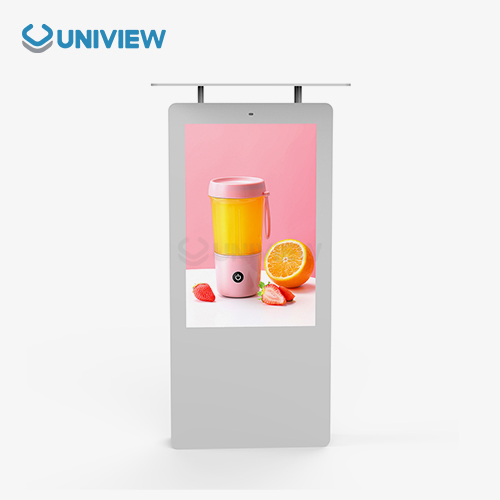
Semi-Outdoor LCD Window Displays With Floor or Wall Mount
Semi-Outdoor LCD window display units are a special kind of high-brightness digital signs that can be put up inside and faced outward through shop windows. Unlike most indoor screens, which only offer 350 to 500 nits of brightness, these units offer 2000 to 4000 nits, so content can be seen even when it's directly in sunlight. They're a compromise between regular indoor screens and fully waterproof outdoor units. They offer better light and temperature control without the bulk and cost of IP65-rated outdoor options. This technology is used in places like shopping, leisure, transportation, and business, where getting people's attention at street level is very important.
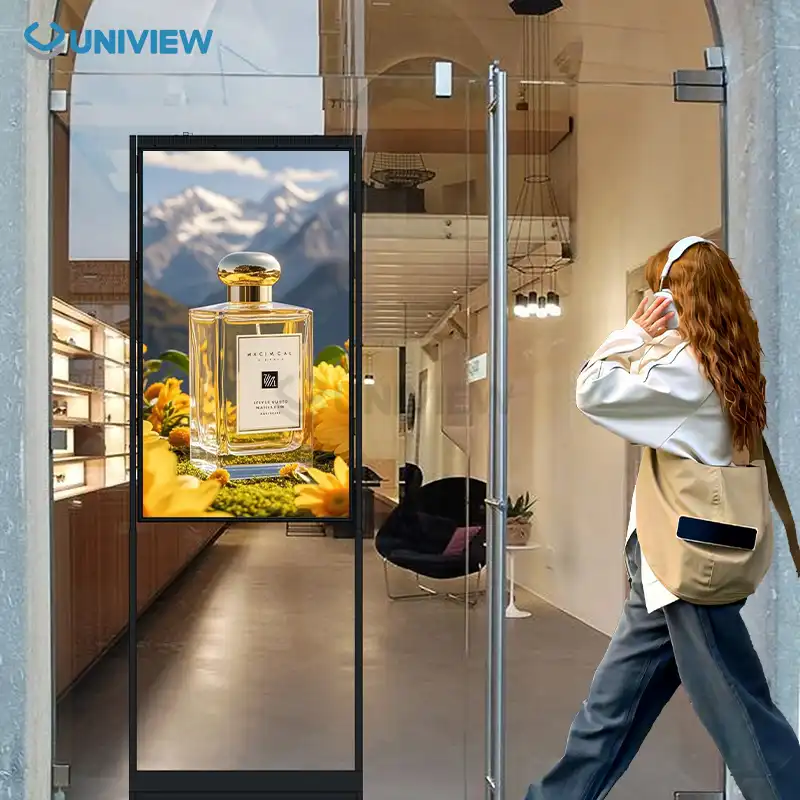
Understanding Semi-Outdoor LCD Window Displays
Defining Features and Core Technology
The main difference between Semi-Outdoor LCD window display solutions is that they are specially designed to deal with high levels of light and heat from the sun. When direct sunlight streams through glass onto traditional indoor commercial displays, they fail. Images become washed out, and the feared "blackening defect" happens. This is when liquid crystals lose their molecular orientation under heat stress, leaving lasting dark spots. This problem is solved in our UW1500P model by using Hi-Tni (High Temperature Nematic Isotropic) LCD panels that stay structurally sound at surface temperatures of up to 110°C.
Brightness engineering is another important way to set yourself apart. Normal store displays use 300 to 700 nits, but apps that face a window need 2000 to 4000 nits to make up for the high amounts of ambient lux caused by direct sunlight. To make this possible, the UW1500P uses cutting-edge LED backlighting systems that give off more light than old CCFL technology while also cutting power use by up to 40%. Factory color calibration makes sure that every unit keeps accurate color reproduction with contrast ratios above 3000:1. This is important for high-end retail and leisure settings that can't risk losing brand color accuracy.
Typical Applications Across Industries
Most applications are in retail. Fashion retailers employ video screens to showcase seasonal fashions and attract customers. They're better than UV-fading paper placards. Our displays feature ultra-slim frames that increase the viewing area. This makes advertising materials more lively while maintaining high-end retail appeal. Real estate firms are employing this technology to update property adverts in real time. This reduces labor expenses from printing and altering window displays by hand.
More fast-food establishments have digital plates in their windows to attract customers from the street. Semi-outdoor technology is crucial since solar radiation and cooking heat make these setups considerably more temperature-sensitive. Train stations and airports utilize these displays to direct passengers and advertise in natural light. Corporate lobbies and banks utilize the technology to provide financial information, special discounts, and marketing messaging. Hotels, cabins, and event venues utilize them to advertise services, events, and directions.
Performance Parameters and Resolution Standards
The resolution has a direct effect on how well the content works and how far away you can see it. The UW1500P comes in both Full HD (1920x1080) and Ultra HD (3840x2160), so buying teams can choose the right pixel density for each watching situation. When people are within 6 to 10 feet, Full HD makes text-heavy material like real estate ads or menu boards very clear. Ultra HD resolution is necessary for large-format installations or uses that need to be able to see fine details from farther away, like luxury car shops showing off features of cars or hospitality places showing high-resolution photos of destinations.
Even brightness across the screen's surface ensures constant image quality, with no hotspots or dimming around the edges. Professional displays keep the difference in brightness from the middle to the edges to less than 10%. This is important when showing big blocks of color or gradient images, which are popular in fashion and lifestyle ads. Viewing angle performance, which is usually 178° horizontally and vertically on IPS-based screens, makes sure that content stays bright and true to color even when people walking by at right angles to the window plane look at it from an angle.
Critical Performance and Durability Factors
Environmental Resistance and Operating Conditions
Thermal control systems are particularly crucial to the reliability of semi-outdoor LCD window display installations. The greenhouse effect of direct sunlight behind glass elevates the temperature 15–25°C over the outside air temperature. Our engineers developed a multi-layered thermal design to overcome this. It has aluminum heat sinks with improved fin design, sophisticated variable-speed cooling fans that adjust speed depending on internal temperature sensors, and heat-pipe technology to cool LCD components. People shopping inside won't notice the cooling system's 60-decibel hum. In quiet shops, this is an overlooked yet crucial factor to consumer satisfaction.
Keeping moisture and dust out requires technical attention, even if it doesn't need IP65/IP66 standards for exterior installations. Nighttime condensation may accumulate on glass due to warm, humid air. This may penetrate improperly sealed places. We use sealed back panels with precisely arranged ventilation ducts to help heat escape and prevent moisture. Filtered air intakes prevent dust from damaging internal components and clear glasses after years of operation.
Brightness Regulation and Power Efficiency
Automatic brightness change based on environmental light sensing has two benefits: it increases the life of the components and lowers the costs of running the system. During the day, when lighting is strongest, the screen is set to its brightest setting to keep it visible. As night falls and streetlights become the main source of light, the system automatically lowers the lighting level by 40 to 60%. This drastically cuts power use while keeping the screen from looking too bright against the dark street scene. This dynamic change lowers the total number of hours that the LED backlight has to run at full power, which increases its lifespan. This directly affects the total cost of ownership over a normal 5-year deployment of the Semi-Outdoor LCD window display.
Calculations of energy use become especially important for operations with more than one unit. Modern LED backlight design makes the UW1500P power-efficient; it uses between 180W and 250W, based on the brightness levels and screen size. Compared to older CCFL technology that needed 300–400W for the same level of brightness, this new technology uses about 2,400–3,000 kWh less energy each month, which saves the retail chain about $3,000–4,500 a year at normal business power rates. When weighing the cost of purchases against the cost of the initial capital investment, these operational economics make ROI estimates more accurate.
Temperature Tolerance and Longevity Indicators
Ambient temperatures for semi-outdoor uses are usually between 0°C and 50°C, but internal component temperatures can hit 80 to 90°C during high solar loading. Professional displays use Hi-Tni liquid crystal formulas that keep their optical performance across this temperature range without the phase transition problems that happen a lot in regular screens. Storage temperature values that go from -20°C to 60°C make sure that units can handle yearly temperature changes in warehouses that don't have climate control while they are being shipped and set up.
Ratings for Mean Time Between Failures (MTBF) give numbers that show how reliable something is. Commercial-grade displays that are meant to be used 24 hours a day, seven days a week, should have MTBF values higher than 50,000 hours, which is about 5.7 years of constant use. This standard talks about how reliable important parts are, like power sources, LED backlights, and thermal control systems. When paired with our 3–5 year warranty coverage and full insurance backing through China Pacific Insurance Company, these measures give buying teams the peace of mind they need to make big capital investments.
Semi-Outdoor LCD Window Displays: Floor vs. Wall Mount Solutions
Wall-Mounted Configuration Advantages
Wall hanging is the most space-efficient option to show a Semi-Outdoor LCD window display, making it ideal for establishments where every square foot matters. Stores minimize floor space by placing displays against windows or walls to showcase items and allow consumers to roam around. The installation creates a permanent, tamper-proof solution with double-layer anti-theft locks, which are crucial in busy cities where theft is still a major issue. Wall installations place the screen at eye level for streetwalkers, 60 to 72 inches from the ground to the center.
The correct wall anchoring makes the structural connection straightforward. Business AV experts may rapidly install the UW1500P using typical VESA mounting patterns. Wall-cavity routing simplifies cable management in high-end stores while maintaining a clean appearance. Set placement ensures consistent viewing geometry and content alignment. When coordinating many displays in a window bank, visual symmetry helps the brand seem more professional.
When you place a Semi-Outdoor LCD window display on the wall, rear-facing ventilation takes heat from the viewing area into the room, where HVAC systems can manage it, making cooling more efficient. In multi-screen systems, this position prevents heat from building up against the window glass. A permanent installation also makes it easy to connect electrical equipment directly to the wall without extension cables, reducing trip risks and fire hazards in visible locations.
Floor-Standing Installation Flexibility
Floor mounts allow you to reposition objects, which is essential in businesses that alter their window displays seasonally or highlight new products monthly. The movable arrangement allows workers to move screens without tools or technical expertise. This allows them to swiftly adjust to new product ideas or unique event sets. Retail pop-up stores benefit from this flexibility since displays may be relocated without permanent mounting equipment.
Floor mounts are cheaper and simpler to install since they can be used alone. Instead of hiring specialists to drill holes in walls and examine the construction, the display may be installed immediately with electricity. This advantage accelerates deployment plans, which is crucial in retail leasing scenarios where time-to-operation affects profitability. The self-contained design includes built-in cable management lines to appear professional while allowing for increased cable exposure without being wall-mounted.
Changeable viewing height is another plus. Telescopic mounts on many floor stand systems adjust to varied ceiling heights and increase viewing angles. Corporate offices may elevate displays for adults in work clothing, while street retailers may lower them for youngsters and those sitting down. When placed near frequently opened and closed doors that vary in air pressure, the weighted base renders it stable and passes the 16-level wind resistance regulations.
Selection Criteria Based on Operational Requirements
To evaluate mounting options, you need to look at a number of practical factors. Most of the time, the decision is limited by the room. For example, small window openings with limited width require wall mounting, while open atriums can handle freestanding installations. When there is a chance of overnight mischief, mounting on the wall is the safer option because it is forever attached and less likely to be stolen or tampered with than movable floor stands.
Costs for both starting capital and installation work need to be thought about when making a budget. Wall hanging usually costs more to install because of the structural work, electrical rough-in, and possible need for a permit. However, the long-term security benefits may make up for these costs. Floor stands make installation easier, but you may need more expensive display models with built-in structural support. Accessibility for maintenance is another factor that goes into the choice. For example, wall-mounted units may need lifting lifts or steps to get to the service area, while floor-standing models can be wheeled away from the windows for maintenance.
Procurement Guide: Selecting and Buying Semi-Outdoor LCD Window Displays
Assessing Business Needs and Specifications
Clearly stating the exact needs of a program is the basis of good procurement for a Semi-Outdoor LCD window display. The type of content determines the resolution. For example, financial institutions that show interest rates need Ultra HD resolution to make sure that small fonts can be read clearly, while fashion stores that focus on videos may find that Full HD is enough for motion content seen from medium-to-long distances. Touch screens are needed for interactive apps, and there are different types of touch technologies to think about, such as capacitive touch for multi-touch response in hotel wayfinding or infrared touch for durability in high-traffic transportation settings.
A review of the environment defines the brightness levels that are needed. Windows that face south and get full sunlight for six to eight hours a day need to be able to handle up to 3500 to 4000 nits of brightness. Windows that face north or have building overhangs that block the light may be able to handle 2000 to 2500 nits. Specification development is based on measurements of the window's size, the depth that can be installed, and how close it is to HVAC vents that could affect temperature management. Assessing the electrical infrastructure, including the voltage, circuit capacity, and conduit layout, can help avoid expensive surprises in the middle of a project that cause delays in rollout.
Vendor Evaluation and Brand Considerations
Choose a manufacturer or seller based on more than just the initial purchase price. Uniview Commercial boasts quality control and customisation advantages as a Shenzhen-based company with direct control over manufacturing. Quality control at our manufacturing includes 72-hour burn-in testing at high temperatures to identify issues before shipping. Field failures are reduced to less than 0.5% with this technology, making display replacement in crowded shop areas less costly.
Global assistance is crucial yet sometimes underestimated. We can swiftly resolve issues since we provide live technical support 24/7 and have service relationships in over 100 countries. System installers prefer vendors with thorough technical documentation, CAD drawings for installation design, and pre-sales engineering consultations to ensure solutions work before buying. We provide 3- to 5-year warranties, so long-term maintenance expenses are now fixed annual guarantee premiums. This simplifies financial planning for multi-year deployments.
Customization suits each task. Standard stock items may be utilized in many circumstances, although they may need to be altered to match an architectural window, have varied light levels, or contain sensors and IoT connections. Engineers collaborate with customers to develop innovative solutions. They may calibrate colors for Pantone brand matching, install environmental sensors for data collecting, or ensure that housing finishes meet corporate interior design standards.
Procurement Channels and Commercial Terms
Working directly with manufacturers offers reduced prices due to no distributor profits, direct access to engineers for technical problems, and priority production scheduling during strong demand. Uniview Commercial, a leading manufacturer of Semi-Outdoor LCD window display units, provides flexible minimum order quantities for single-unit testing and hundred-unit rollouts, as well as volume pricing tiers for larger commitments. Our manufacturing and supply tracking systems provide 15–25-day lead times for standard configurations. This is crucial when putting items during shop renovations or annual campaign launches.
The distributor and reseller channels are significant because they package local items and installation services. System installers prefer regional wholesalers because they can bundle screens, mounting hardware, media players, and content management software. Transport, customs clearance, and local warranty servicing are handled by these partners, who charge 15–25% more than the direct manufacturer. The whole landed cost—including shipping, taxes, insurance, and installation—should be considered when comparing prices.
Payment and credit terms affect cash flow. We provide net-30 terms for long-term clients and flexible payment arrangements for large assignments. Leasing from a third party turns capital expenditures into operational costs. Accounting changes may assist certain businesses' finances. Trading in old display technology may minimize the cost of new technology and make it simpler to dispose of old equipment sustainably.
Conclusion
To choose the right window-facing display technology, you have to weigh the technical requirements against the needs of the business and your budget. Semi-Outdoor LCD window display signage is a compromise between indoor and outdoor options that offers great exposure without the full cost of weatherproofing. The UW1500P is a great example of this type of display because it has a brightness range of 2000 to 4000 nits, good heat management that lets it run continuously, and a variety of mounting choices that let it be installed in a variety of ways. A complete needs assessment, vendor evaluation that focuses on support infrastructure and customization options, and lifetime planning that includes maintenance procedures and upgrade strategies are all important for a successful procurement. When businesses buy these technologies, they get strong communication tools that work at the street level. These tools bring in more customers, improve brand awareness, and give businesses a clear return on investment (ROI) through more engaged customers and more flexible operations.
FAQ
Q: What distinguishes semi-outdoor displays from fully outdoor units?
A: Semi-Outdoor LCD window display screens focus on high brightness and heat control for looking outward when installed indoors. They can reach 2000–4000 nits without needing weatherproof IP65/IP66 enclosures. Fully outdoor displays need to be fully sealed against rain, snow, and high temperatures (-40°C to 60°C), which adds to their cost and weight. The choice relies on where the work will be done: in a protected window area or on the outside of a building.
Q: Can these screens work when the weather is really bad?
A: Installing windows naturally protects against rain and other elements of the weather. Most climate-controlled indoor settings can handle temperatures between 0°C and 50°C, but window greenhouse effects can make temperatures rise, so strong thermal management is needed. Places where the temperature inside is outside of this range need climate control or options that can be used outside. Our UW1500P thermal design can handle tough window conditions in most temperate and warm areas.
Q: What kind of guarantee and customer service can I expect?
A: Commercial screens come with warranties that last between 3 and 5 years, which is a lot longer than warranties for household electronics. Uniview Commercial gives this extra security with technical help available 24 hours a day, 7 days a week, around the world, and third-party insurance through China Pacific Insurance Company. The warranty should cover parts, labor, and the screen, which is the most expensive part that can be fixed. Check to see if the manufacturer's service network covers the areas where you do business, and if they offer reaction time promises for installations that are important to the business.
Partner With Uniview Commercial for Your Display Solutions
With the best Semi-Outdoor LCD window display technology in the business, Uniview Commercial is ready to help you with your digital signs projects. Our UW1500P model has the brightness, thermal performance, and mounting options that your business, hotel, or store space needs. As a well-known company that makes things in Shenzhen, we offer direct access to technical knowledge, reasonable pricing, and the ability to customize products that other companies that sell similar products can't match. Our presence in over 100 countries around the world means that we can provide responsive local help no matter where your operation is located.
Email our team at sales@univiewlcdisplay.com to talk about your particular needs. For multi-unit jobs, we offer free site assessments, thorough technical specs, and bulk discounts. Through our advice process, we find the best setup for your watching area and content strategy, including the best brightness level, resolution, and mounting method. Work with a maker that cares about your success and offers a thorough warranty, ongoing professional support, and a partnership based on long-term value rather than transactional relationships.
References
1. Digital Signage Federation. "Commercial Display Brightness Standards for Retail Environments." Technical Publication Series, 2023.
2. Society for Information Display. "LCD Technology Thermal Management in High-Ambient Applications." Journal of Display Technology, Vol. 18, 2022.
3. National Retail Federation. "Impact of Window Display Technology on Foot Traffic Conversion Rates." Retail Research Institute Annual Report, 2023.
4. International Electrotechnical Commission. "Environmental Testing Standards for Commercial Electronic Displays: IEC 60068 Series." Technical Standards Documentation, 2022.
5. Chen, Willia,m and Martinez, Sofia. "Total Cost of Ownership Analysis for Commercial Digital Signage Systems." International Journal of Retail Technology Management, 2023.
6. American Society of Heating, Refrigerating and Air-Conditioning Engineers. "Thermal Load Calculations for Electronic Display Equipment in Commercial Spaces." ASHRAE Technical Guidelines, 2022.
Learn about our latest products and discounts through SMS or email