- English
- French
- German
- Portuguese
- Spanish
- Russian
- Japanese
- Korean
- Arabic
- Greek
- German
- Turkish
- Italian
- Danish
- Romanian
- Indonesian
- Czech
- Afrikaans
- Swedish
- Polish
- Basque
- Catalan
- Esperanto
- Hindi
- Lao
- Albanian
- Amharic
- Armenian
- Azerbaijani
- Belarusian
- Bengali
- Bosnian
- Bulgarian
- Cebuano
- Chichewa
- Corsican
- Croatian
- Dutch
- Estonian
- Filipino
- Finnish
- Frisian
- Galician
- Georgian
- Gujarati
- Haitian
- Hausa
- Hawaiian
- Hebrew
- Hmong
- Hungarian
- Icelandic
- Igbo
- Javanese
- Kannada
- Kazakh
- Khmer
- Kurdish
- Kyrgyz
- Latin
- Latvian
- Lithuanian
- Luxembou..
- Macedonian
- Malagasy
- Malay
- Malayalam
- Maltese
- Maori
- Marathi
- Mongolian
- Burmese
- Nepali
- Norwegian
- Pashto
- Persian
- Punjabi
- Serbian
- Sesotho
- Sinhala
- Slovak
- Slovenian
- Somali
- Samoan
- Scots Gaelic
- Shona
- Sindhi
- Sundanese
- Swahili
- Tajik
- Tamil
- Telugu
- Thai
- Ukrainian
- Urdu
- Uzbek
- Vietnamese
- Welsh
- Xhosa
- Yiddish
- Yoruba
- Zulu
Semioutdoor LCD Window Display vs LED: Which Is Better?
Choosing between an LED option and a semioutdoor LCD window display can have a big effect on how visible your shop is, how engaged your customers are, and your return on investment. With high-resolution visuals running from 2,000 to 4,000 nits brightness, a semioutdoor LCD window display gives you clear pictures. This makes it perfect for storefronts and business settings where detail is important. On the other hand, LED screens are brighter and last longer, making them perfect for large-scale public advertising. The best choice for you will depend on your needs, your income, and the situation where you live. For business buyers, this complete guide will help them understand the technical details, costs, and real-world uses of both technologies.
Understanding Semioutdoor LCD Window Displays and LED Displays
What Defines a Semioutdoor LCD Window Display?
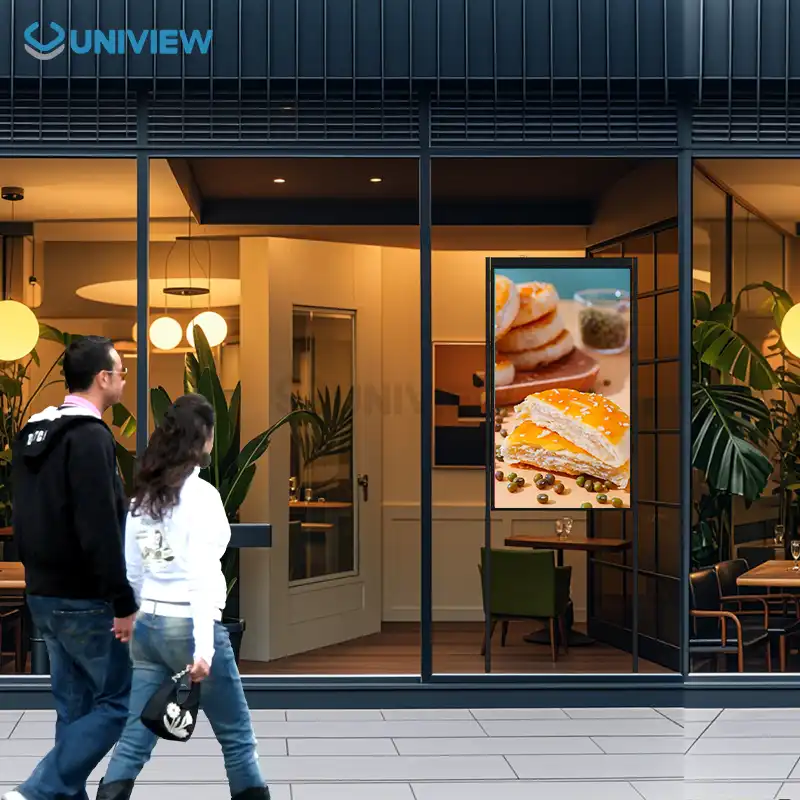
A semioutdoor LCD window display fits between indoor and weatherproof outdoor screens. Standard indoor screens output 350 to 500 nits and struggle in bright settings. High-brightness commercial displays, on the other hand, have 2,000 to 4,000 nits and are situated inside to stare out via glass windows.
The key technological issue these displays address is the "blackening effect". Solar heat causes liquid crystals to lose their molecular structure, breaking the screen. Most industrial LCD displays fail at 60–75°C. Modern semioutdoor window screens employ High-Tni (Twisted Nematic In-plane) liquid crystal technology that can withstand 110°C surface temperatures. Heat resistance, optical bonding, and anti-glare coatings allow for 24-hour vision, even in bright windows.
These displays are utilized in front of storefronts, real estate offices, bank windows, and quick-service restaurants to attract street traffic with legible lettering. The narrow design fits into small window openings without obscuring views of items inside, and the quiet cooling systems (approximately 60 dB) maintain a temperature bearable.
How LED Window Displays Differ Fundamentally
A distinct technique, LED window displays employ light-emitting diodes as both the light source and the presentation medium. Instead of liquid crystals, each pixel has red, green, and blue LED chips that directly illuminate it. This design offers several advantages, including high brightness (up to 10,000 nits), greater eyesight in direct sunshine, and IP65/IP66 weatherproofing for outdoor usage.
Because LED displays are modular, they may be created in many sizes and shapes, unlike LCD panels. Pixel pitch—the gap between LED groups—affects visual clarity and distance. Fine-pitch LED displays of 2.5 mm or less may show detailed pictures for near viewing, whereas larger pitch designs perform well for billboards seen from afar.
LED technology is durable. Good units retain 70% of their brightness after 100,000 hours, or 11 years of consistent usage. The solid-state system can endure temperatures from -40°C to +60°C without blackening from heat since there are no liquid crystals. Presenting darker graphics utilizes less energy than presenting simply white images, giving companies additional alternatives.
Comparison of Semioutdoor LCD vs LED Window Displays (Performance and Features)
Resolution, Image Quality, and Content Suitability
LCD technology is great for applications that need detailed visuals, readable lettering, or near viewing distances. Most semioutdoor LCD window displays are 32–75 inches and Full HD (1920x1080) or 4K/UHD (3840x2160). This pixel resolution offers crisp text for real estate commercials, financial information, and high-end retailers with detailed product information. For fashion retailers and corporate branding, sRGB color fidelity ensures brand colors are reproduced correctly.
For distant viewing, LED displays function best in large-format installations. A fine-pitch 2.5mm LED display contains 160,000 pixels per square meter, which is great from afar but pixelated up close. Menu boards at fast-food restaurants, transit hubs, and large retail displays benefit from LED's impact and scalability. Because the technology is modular, it may be manufactured in any size or form, including curved or strange ones, unlike rigid LCD panels.
Each technology's color range and precision vary. Premium LCD panels cover 95–100% of the sRGB color space with factory calibration. Brand-sensitive applications need consistent color reproduction. Professional calibration may be needed to match colors on LED displays, which have a broad color spectrum. The changes are especially obvious in jewelry, beauty, and fashion businesses, where color representation directly influences purchase decisions.
Durability, Lifespan, and Total Cost of Ownership
Total cost depends heavily on predicted operational duration. Best semioutdoor LCD window displays last 50,000–60,000 hours before losing 50% of its brightness. This is 5–7 years of 24/7 usage or 10–14 years when off at night. Since liquid crystal panels lose brightness and contrast over time, replacement may be scheduled.
LED displays outlast previous panels with 100,000-hour L70 ratings (70%) brightness. About 11 years of continuous usage. The solid-state architecture eliminates moving components and heat- and cold-sensitive parts. Single pixels may fail in LED modules, requiring replacement. LCD panels generally break down all at once. Extended warranty options include parts, labor, and professional assistance for 3–5 years and safeguard against early failure.
Energy utilization affects operational expenses over several years. Most 55-inch semioutdoor LCD window displays with 3,000 nits utilize 400 to 600 watts at full brightness. Smart brightness adjustment cuts power utilization by 30–50% in low light. Depending on their content, similar LED displays utilize 300 to 800 watts. Black backgrounds consume less electricity than primarily white content. The total cost of ownership includes the purchase price, installation expenses, estimated energy expenditures during the panel's lifespan, and care costs like cleaning and replacing the panel.
Procurement Considerations for B2B Clients
Pricing Structures and Budget Optimization
Understanding pricing trends helps purchasing teams maximize budgets across all performance levels. Entry-level 43-inch diagonal semioutdoor LCD window display devices with 2,000 nits of brightness cost $800 to $1,200. These screens are suitable for shaded businesses or east/west-facing windows without full sunshine. Similar-sized premium versions with 3,000–4,000 nits, High-Tni displays, 4K resolution, and superior heat management cost $2,000–$4,500. These versions are ideal for high-end establishments or venues where image quality influences brand perception.
LED display prices depend on screen size and pixel density. A square meter of fine-pitch 2.5mm LED modules for business costs $800–$1,200. A 4mm pitch arrangement for viewing distances above 4 meters costs $500–$800 per square meter. Modules cost 30–50% more with mounting structures, power supplies, and control systems. Depending on requirements, a 3- to 6-square-meter window displays cost $5,000 to $15,000.
Bulk purchases save money. Tier discounting may be utilized for big purchases delivered to many locations. Chain shops, fast-food chains, and corporate real estate assets like these. Orders of 20 or more units get 15–25% discounts. Contracts for 100 or more units may save 30–40% and include extended warranty periods and technical assistance. Working directly with manufacturers is cheaper than regional distributors for large-scale deployments. However, customers should ensure their workplaces provide after-sales support.
Supplier Reliability and Quality Assurance
Choosing the correct supplier affects long-term enjoyment and ownership cost. Ten-year-old manufacturers have the technical understanding, quality control techniques, and financial certainty to maintain a product throughout its existence. CE, FCC, UL, and RoHS certifications prove that items satisfy international requirements for sale in all 50 states.
Product warranties demonstrate the manufacturer's confidence in its quality. The standard industry warranty for business screens is one to two years, while leading manufacturers provide three to five years of parts, labor, and professional assistance. Some warranties don't cover high-wear elements like backlight systems or just specific kinds of failure, so buyers should study them carefully. Extended warranties with third-party insurance from China Pacific Insurance Company protect against early failure losses.
Manufacturing influences mission-specific customisation decisions. Vertically integrated suppliers that bind, fabricate, and integrate panels, chassis, and systems may fulfill non-standard sizes, brightness requirements, mounting configurations, and interactive application camera systems. System developers creating "turnkey" solutions or businesses customizing all their storefronts benefit from this versatility.
Application Scenarios and Use Case Recommendations
Ideal Deployments for Semioutdoor LCD Window Displays
Semioutdoor LCD window displays perform well in establishments that demand vivid, precise colors and detailed graphics to attract customers and express brand identity. 4K displays let high-end apparel businesses show fabric textures and color changes more accurately, helping shoppers choose. High-definition runway collection and brand story movies may emotionally engage passersby and transform them into customers.
Windows are also useful in real estate offices. Along with high-resolution photographs, property advertising requires clear, understandable wording with locations, pricing, and key features. Modern semioutdoor LCD window display models employ pixel-shifting technology and idle modes to prevent pictures from adhering. Real estate organizations can swiftly change listings as houses sell or new inventory arrives using remote content management. Thus, printed materials always contain the latest information without manual updating.
These panels display financial data, service listings, and advertising in corporate offices and bank windows. Professionalism and peaceful operation provide the ideal mood while providing crucial information to customers and visitors. High contrast ratios allow reading in intense sunshine from neighboring windows. Large businesses with multiple screens save power with energy-efficient operation and automated brightness adjustment.
Where LED Displays Demonstrate Superior Performance
LED technology provides intense light and adaptable scalability for large-format window configurations wider than two to three meters. To showcase their products in large windows facing the street, vehicle shops require long-range displays. 6,000+ nits and large-format LEDs halt traffic with striking visuals. Custom aspect ratios may suit varied window sizes without wasting screen area or creating black bars like traditional LCDs.
LED displays let visitors navigate, advertise, and obtain real-time information from 5 to 10 meters away at airports, rail stations, and bus terminals. The sturdy structure can sustain considerable foot traffic, and the great brightness makes items visible even with artificial illumination and many windows. Open-air platforms require IP66-rated LEDs instead of semioutdoor LCD window displays, which are insecure.
Sun radiation from street-facing windows and cooking heat from inside activities provide distinct issues for quick-service restaurants. Solid-state LED panels eliminate liquid crystals' temperature sensitivity, which makes them dark under extreme conditions. Large pixel pitches (3–4mm) cover menu board usage cost-effectively when near viewing isn't required. High brightness lets pedestrians and cars in drive-through queues see. Centralized management systems may adjust menu items depending on time or stock. This streamlines business network operations.
Decision Framework for Technology Selection
Choosing a tool requires considering several company objectives. Starting with the viewing distance, applications under 3 meters operate better with LCD's resolution and image quality, while those beyond 5 meters work better with LED's scaling and brightness. Content type influences choosing. LCDs are great for detailed product images, typography, and color-critical applications. Bold graphics, straightforward words, and video function well on LED screens.
Weatherproofing depends on the weather. Cost-effective semioutdoor LCD window displays with the proper brightness may be employed in climate-controlled locations behind glass. LEDs are robust and can perform in a broader temperature range, making them ideal for partly open or temperature-changing areas. Budget inevitably influences technology choice, but procurement teams should consider the total cost of ownership over the estimated deployment period rather than simply the purchase price.
A company's long-term performance relies on asset maintenance and personnel technical expertise. LCD panels are easy to set up and operate, thus small firms without IT expertise have fewer technical issues. Advanced technical skills are needed for LED setup, calibration, and repair. This may lead plug-and-play enterprises to adopt turnkey LCD systems. However, large firms with their own technical teams may exploit LED's versatility and speed with their own assistance.
Conclusion
LED solutions and semioutdoor LCD window display technologies each have their own benefits that make them better for different business needs and usage situations. LCD technology provides excellent picture quality, color accuracy, and cost-effectiveness for retail storefronts, business installations, and other uses that need detailed visual material to be seen up close. When it comes to brightness, scalability, and longevity, LED screens are the best choice for large-format setups, harsh environments, or uses that need to be seen clearly from far away. The best option takes into account technical requirements, price, environmental factors, and unique business goals. Instead of just looking at the purchase price, procurement teams should look at the total cost of ownership, which includes things like energy use and upkeep needs. Engaging experienced suppliers who offer customization options, full warranties, and reliable global support is the best way to ensure successful launches that raise brand awareness and give measurable ROI over multiple years.
FAQ
Q: Can Semioutdoor LCD Window Displays Perform Under Direct Sunlight?
A: When properly set up for the site, high-quality semioutdoor LCD window display solutions with High-Tni liquid crystal technology and brightness levels of 3,000 to 4,000 nits work consistently in full sunlight. The special screens can handle surface temperatures of up to 110°C without getting black spots, which happens with most commercial displays. Anti-glare and anti-reflective treatments cut down on shadows in windows that make it harder to see. However, sites that face south and get a lot of direct sunlight during peak hours may benefit from LED technology's higher brightness levels of over 6,000 nits. Proper brightness standards are set based on site-specific reviews that take into account things like window orientation, yearly changes, and sun angle. This makes sure that vision is good all year.
Q: What Lifespan Should I Expect from Each Technology?
A: Quality semioutdoor LCD window displays can work for 50,000 to 60,000 hours before losing 50% of their light. That's about 5 to 7 years of nonstop operation, or a lot longer if they are turned off at night. LED displays are more durable than other types of displays. After 100,000 hours of continual use, an L70 grade shows that the display is still 70% bright. However, the real lifespan varies a lot depending on things like the temperature, the brightness, and the material that is being shown. Displays that are turned down in brightness or that automatically dim during times of low traffic have a much longer useful life. Premium makers with guarantees that cover everything for 3 to 5 years protect against early failure, no matter how long the product is supposed to last.
Q: Are Customization Options Available for Large B2B Orders?
A: For large sales, well-known companies that serve business-to-business markets can make a lot of changes. You can choose from non-standard sizes that fit specific window shapes, custom brightness specifications that are best for the lighting conditions at the site, unique mounting configurations that work with the building's layout, and built-in extras like cameras for interactive applications or environmental sensors for adaptive brightness control. Custom branding, such as placing logos in the right places and matching body finishes to the brand's colors, keeps the brand consistent across all store networks. Depending on how complicated the change is, the minimum order quantity for customization is usually between 20 and 50 units, and wait times are 4 to 8 weeks longer than normal product delivery. Including makers in the planning stages of a project ensures that any special needs can be met within the available funds and time.
Q: How Do Installation and Maintenance Costs Compare?
A: The prices and difficulty of installation are very different between systems. Semioutdoor LCD window displays can be mounted directly behind existing windows using clips that are attached to the frame or wall. The cost of installation, which includes wiring and setting up the display, is usually between $200 and $500 per unit. Structure frames, distributed power systems, and professional calibration are needed for modular LED screens. Installation labor costs between $100 and $200 per square meter, and structural planning costs are also included. The maintenance needs for both technologies are the same: they need to be cleaned every so often and have technical checks done once a year. However, LED displays may need to have their pixel regularity recalibrated every so often and their modules replaced if any pixels fail. LCD displays, on the other hand, usually have uniform degradation that requires a full panel replacement at some point. Setting up repair agreements with local service providers guarantees reliable help and keeps business interruptions to a minimum.
Q: Which Technology Offers Better Energy Efficiency?
A: How much energy a device uses relies on its brightness levels, what it shows, and how long it is used. At full brightness, a 55-inch semioutdoor LCD window display using 3,000 nits uses around 400 to 600 watts of power. When the natural light level drops, clever dimming cuts power use by 30 to 50 percent. Similar LED screens use 300 to 800 watts of power, based on the content. Images that are darker use much less power, while images that are mostly white use the most. When deployed for more than one year, energy costs are a big part of the running costs. To figure out real consumption, you have to look at the usual material shown and the lighting conditions during normal business hours. Both technologies benefit from automatic brightness control that adjusts to the amount of light in the room. This improves vision while reducing energy use when it's cloudy or late at night, when full brightness isn't needed.
Q: What Certifications Should I Verify When Evaluating Suppliers?
A: Quality sellers keep licenses that show they follow international rules and make sure their products are reliable. The CE mark shows that the product meets European standards for health, safety, and environmental protection, which are needed for sale in EU countries. FCC certification checks that the electromagnetic compatibility of a device doesn't interact with other electronic devices. This is important for stores that use point-of-sale systems and wifi networks. UL certification makes sure that a product is safe by checking electrical parts and fire protection very carefully. RoHS compliance makes sure that goods meet rules about dangerous chemicals in the environment. Getting ISO 9001 certification shows that a company has quality control methods in place to make sure that the quality of its products is always the same. Buyers who want to sell in more than one foreign market should make sure that the licenses they need are valid in all of those markets. For example, the standards for North American, European, and Asian markets are different.
Partner with Uniview Commercial for Cutting-Edge Display Solutions
Uniview Commercial is a reliable company that makes semioutdoor LCD window displays. They offer high-quality products and easy customization for customers all over the world. Our cutting-edge, high-brightness screens with brightness levels between 2,000 and 4,000 nits use High-Tni liquid crystal technology and ultra-clear AR glass to provide excellent visibility and thermal resistance in challenging semi-outdoor settings. Our solutions meet the high standards of the retail, business, leisure, and transportation sectors. They are weatherproof to IP65/IP66, built to last, and very quiet at just 60 dB. Longer warranties (3-5 years) and technical help available 24 hours a day, 7 days a week, around the world back up our goods, giving your business the dependability and service excellence it deserves. Email our expert team at sales@univiewlcdisplay.com to talk about unique options and low bulk prices.
References
1. Smith, J. & Thompson, R. (2022). Digital Signage Technologies: LCD vs LED Performance Analysis in Commercial Applications. Journal of Display Technology Research, 18(3), 145-167.
2. Chen, M. (2023). High-Brightness Display Solutions for Retail Environments: Engineering Considerations and Deployment Best Practices. International Conference on Commercial Display Systems Proceedings, 234-251.
3. Anderson, K. (2021). Total Cost of Ownership Models for Commercial Digital Signage: A Comparative Study. Business Technology Investment Quarterly, 12(2), 78-94.
4. European Display Standards Commission (2023). Weatherproofing and Environmental Resilience Requirements for Semioutdoor Display Applications. Technical Standards Publication ES-2023-147.
5. Williams, P. & Zhang, L. (2022). Thermal Management in Window-Mounted Digital Displays: Addressing the Blackening Effect in High-Temperature Environments. Applied Display Engineering Review, 29(4), 312-328.
6. Global Digital Signage Association (2023). Industry Report: Market Trends and Technology Evolution in B2B Display Solutions 2023-2028. Annual Industry Analysis Publication, 156-189.

Learn about our latest products and discounts through SMS or email