- English
- French
- German
- Portuguese
- Spanish
- Russian
- Japanese
- Korean
- Arabic
- Greek
- German
- Turkish
- Italian
- Danish
- Romanian
- Indonesian
- Czech
- Afrikaans
- Swedish
- Polish
- Basque
- Catalan
- Esperanto
- Hindi
- Lao
- Albanian
- Amharic
- Armenian
- Azerbaijani
- Belarusian
- Bengali
- Bosnian
- Bulgarian
- Cebuano
- Chichewa
- Corsican
- Croatian
- Dutch
- Estonian
- Filipino
- Finnish
- Frisian
- Galician
- Georgian
- Gujarati
- Haitian
- Hausa
- Hawaiian
- Hebrew
- Hmong
- Hungarian
- Icelandic
- Igbo
- Javanese
- Kannada
- Kazakh
- Khmer
- Kurdish
- Kyrgyz
- Latin
- Latvian
- Lithuanian
- Luxembou..
- Macedonian
- Malagasy
- Malay
- Malayalam
- Maltese
- Maori
- Marathi
- Mongolian
- Burmese
- Nepali
- Norwegian
- Pashto
- Persian
- Punjabi
- Serbian
- Sesotho
- Sinhala
- Slovak
- Slovenian
- Somali
- Samoan
- Scots Gaelic
- Shona
- Sindhi
- Sundanese
- Swahili
- Tajik
- Tamil
- Telugu
- Thai
- Ukrainian
- Urdu
- Uzbek
- Vietnamese
- Welsh
- Xhosa
- Yiddish
- Yoruba
- Zulu
Semioutdoor LCD Window Display Trends You Should Know
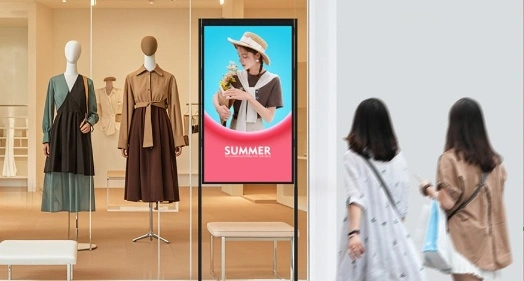
The market for semioutdoor LCD window displays is growing very quickly as companies look for ways to get clear images inside while also making them easier to see outside. These special displays, which are made with brightness levels between 2,500 and 5,500 nits, solve the important problem of being able to read in direct sunlight while still looking great for shop use. With advanced thermal management and high-brightness technology, semioutdoor LCD window displays bridge the gap between standard indoor screens that wash out in natural light and bulky outdoor units that need to be fully weatherproofed. This makes them essential for retail, hospitality, real estate, and transportation sectors that want to grab people's attention from the street.
Understanding Semioutdoor LCD Window Displays
What Makes Them Different from Indoor and Outdoor Units
The unique thing about semioutdoor LCD window displays is the way they are professionally built. The brightness of most indoor screens is between 250 and 500 nits, which is not enough to compete with the sunlight coming in through shop windows. Fully outdoor screens have waterproof ratings of IP65 or IP66 and can be brighter than 5,000 nits, but they are usually too big, expensive, and hard to install for window-facing uses.
Semioutdoor options are carefully placed in this middle ground. Their brightness levels range from 2,000 to 4,000 nits, which is enough to block out glare and keep vision high during the day. They also have thin profiles that make them easy to place in window openings that aren't very big. These units fix the "blackening defect" problem that happens when liquid crystals lose their orientation due to sun's heat. They do this by using High-Tni (Twisted Nematic In-plane) screens that can handle surface temperatures of up to 110°C without losing their performance.
Core Technology and Operational Advantages
The technology that makes these screens work is based on a number of new ideas that work together. Optical bonding gets rid of air holes between LCD layers, which lowers reflection. Anti-glare and anti-reflective glass treatments make sure that the screen can be seen 24 hours a day, 7 days a week, no matter what the weather is like. Intelligent thermal management systems—often with fanless or very quiet rotating fans—keep working temperatures at the right level without disturbing the peaceful environment that customers expect inside.
Another big benefit is that it can dim itself automatically. Built-in environmental light sensors change the backlight's strength on the fly, turning it down in the evening to save energy and stop light pollution. This smart adaptation not only makes parts last longer, but it also cuts down on operating costs by a large amount compared to fixed light settings. Together, these features make it easier to interact with customers, use less energy, and require less upkeep in a wide range of business settings.
Key Trends Shaping the Semioutdoor LCD Window Display Market
Enhanced Brightness and Color Fidelity
In order to make material that can be read in direct sunlight, brightness requirements have gone up while color clarity has stayed the same. Modern units can now reach 3,000 nits or higher while still maintaining sRGB color accuracy, which is important for high-end store settings where colors and textures of fabrics must look real even when they're in full sunlight. This new technology solves a basic problem: getting people's attention from oncoming traffic requires more than just light; it also needs to have a visual appeal that speaks to the right people.
In the same way, contrast ratios have gotten better, with high-end models hitting 3,000:1 or higher. High contrast makes sure that text can be read on restaurant boards, real estate ads, and banking information, all places where clarity affects how customers make decisions. These technical changes have measured business effects, such as more foot traffic, longer watching times, and better brand recall among people who see semioutdoor LCD window displays on their way to and from work.
Integration of Interactive Touchscreen Capabilities
As high-brightness screens and touch technology come together, they are changing what customers expect. People walking by can use interactive semioutdoor LCD window displays to customize their experiences. They can look through product catalogs, see what items are in stock, or get information about services when the business isn't open. This accessibility 24 hours a day, seven days a week improves operating capacity without adding staff. This is especially helpful for real estate offices, car dealerships, and places that host events.
Touch-enabled semioutdoor units need extra care that isn't needed for regular interactive screens. Optical bonding is needed not only to cut down on reflections but also to make sure that touches register correctly when they are in full sunlight. As a result, manufacturers have come up with capacitive touch solutions that keep the sensitivity while adding protective hardened glass that is resistant to damage from theft and weather. These solutions make engaging experiences that are strong enough to be used in public places where people can interact with them without being watched.
Shift Toward Energy-Efficient and Sustainable Models
Environmental effect is becoming more and more important in procurement rules, along with performance requirements. Using 40 to 60 percent less power than older screens, LED backlighting and smart brightness control can make displays more energy-efficient. This efficiency fits with the company's goals for sustainability and saves real money across operations of multiple units.
The choice of materials also follows this trend toward ecology. Visual clarity and gadget life are both extended by UV-resistant optical bonding that stops yellowing over time. To meet international environmental standards, manufacturers are using parts that can be recycled and cutting down on materials that are harmful. These green efforts are especially popular with business and hospitality clients whose brands stress being environmentally friendly. This makes sustainability features a key differentiator in buying decisions.
Expanding Industry Applications
Even though retail stores are still the most common use, acceptance has sped up in many other areas as well. Transportation hubs use semioutdoor LCD window displays to help people find their way, keep track of schedule changes, and advertise in places where standard outdoor units wouldn't work. They are used on corporate sites to inform visitors and keep employees in the loop, and they can be seen from outside paths. Quick-service restaurants use menu boards that face the street and can handle both the heat from the sun and the heat from the kitchen.
Semioutdoor LCD window displays in hospitality places have proven to be very useful for advertising events and showing potential guests what amenities are available through changing content. The technology's adaptability comes from its ability to balance aesthetic integration with practical performance—displays improve architectural design instead of taking away from it, which is something that becomes more important as buying decisions involve both technical and creative partners.
How to Choose the Right Semioutdoor LCD Window Display for Your Business
Assessing Your Operational Scenario
The first step in procurement is to honestly look at the surroundings and how it is used. Think about how much sun the window will get during the day. In the Northern Hemisphere, south-facing windows get long periods of strong sunlight, which means they need to meet strict brightness requirements and have good heat management. Installations that face east or west get strong but short-lived sunlight, which could mean that they can have slightly lower lighting ratings and save money.
The conditions inside are just as important. In retail settings, temperatures are kept stable, but in quick-service restaurants, cooking heat can get into places where displays are mounted. In transportation settings, HVAC changes and vibrations may be important that aren't important in fixed stores. Keeping track of these external factors makes sure that the requirements match up with how things work in the real world, not just how they should work in a lab.
Prioritizing Technical Specifications
Brightness is still the most important factor, but buying teams should also look at how bright the whole panel is, not just the highest nit scores. Uneven lighting makes hotspots that are annoying and lowers the quality of the material. Choosing the right resolution relies on how close you are watching the screen and what you are viewing. For example, 4K panels show clear details in high-end stores that are close to foot traffic, while lower resolutions work fine for bigger text and graphics that you are viewing from farther away.
Panels should last between 50,000 and 70,000 hours of use before their brightness drops to 50% of what it was at first. To measure the total cost of ownership and replacement cycles, it helps to understand this decline curve. When used for more than one year, differences in maker quality become most clear in areas like brightness retention, panel flaws, and backlight failure. This is exactly what the warranty should cover.
Evaluating Supplier Reliability and Support Infrastructure
The bond with the supplier goes far beyond the initial buy. How well international operations work affects arrival times and the chance of damage during shipping. We suggest checking with sellers to see how much experience they have with customs paperwork, freight consolidation for orders of multiple units, and regional warehousing, which makes getting new parts quickly. Established makers have technical support teams that know how to deal with fitting problems that are unique to window-facing uses. This means that they can advise that generic sellers can't.
The ability to customize sets basic sellers apart from strategic partners. Window sizes change a lot from property to property, and off-the-shelf sizes rarely work perfectly with building requirements. When suppliers offer custom sizes, mounting bracket configurations, and input interface choices, installations can look like they were purpose-built instead of retrofitted, which is something customers notice and value.
Installation, Maintenance, and Optimization of Semioutdoor LCD Window Displays
Strategic Positioning for Maximum Impact
The placement of the display during installation affects how well it can be seen. Tilting the panel slightly lower makes it easier for people on the street to see while also reducing the direct sunlight that hits the screen. Putting semioutdoor LCD window displays a little behind the window glass makes an air gap that slows heat transfer, but this has to be weighed against the fact that light will bounce off of the displays more. Professional fitters check the outdoor lux levels at different times to guess how bright the area needs to be and make sure they meet all the requirements before they finish the job.
The gear used to mount the screen has to be able to handle both its weight and its growth over time. Ventilation behind the unit keeps heat from building up, which speeds up the breakdown of parts. Maintaining uniform alignment and spacing across multiple units makes the space look more professional and supports the idea that the brand is of high quality. These installation details, which are often ignored during the buying process, will decide whether the investment pays off in the end.
Maintenance Best Practices
Regular care keeps things looking good and makes them last longer. External glass surfaces need to be cleaned once a week to keep dust from building up and making the light seem less bright. Inspections of the inside parts every three months help check wire connections, fan operation, and the state of the thermal paste on heat sinks. These preventive steps find new problems before they become major problems during busy times.
Temperature monitoring devices let building managers know when the cooling system isn't working right, before the panels hit dangerous levels. Many high-end units have remote troubleshooting features that let providers fix performance problems without having to go to the site, which cuts down on downtime by a large amount. Setting up maintenance rules during procurement—making it clear whether seller contracts include preventive service or if maintenance will be handled by internal staff—avoids confusion about who is responsible for what in the long term.
Energy Optimization Techniques
Choosing the right hardware sets the standard for how much energy is used, but how it is used during operations can save even more energy. Content management systems can set up automatic changes to the brightness of displays to fit the normal lighting conditions in a room, such as turning them down at night or when it's cloudy to save power. Motion sensors that turn on displays when people walk by use less power when traffic is light, but keep the displays' attention-grabbing effect when people are there.
LED backlight technology uses a lot less power than old fluorescent systems, but buying teams shouldn't just trust maker figures; they should also check real consumption measures. When you test sample units in real-world situations, you can see if the claims of efficiency are true. This is especially important for large-scale deployments where total consumption affects building power budgeting and sustainability reporting.
Procurement Insights: Where and How to Buy Semioutdoor LCD Window Displays
Understanding Price Structures and Value Proposition
Prices for good semioutdoor LCD window displays vary a lot depending on the features and where the maker stands in the market. Budget units with 55-inch screens that start at about $2,000 often skimp on even brightness and heat management, which causes them to break down early and waste what seemed like savings. Premium makers charge between $4,000 and $8,000 for similar sizes, but their products have better panels, stronger cooling systems, and longer guarantees that lower the total cost of ownership over five years.
When you order in bulk, you can get discounts that range from 10 to 25 percent, based on the amount you order and how much the maker is using their capacity. But along with unit price, procurement teams should talk about warranty terms and support promises. Longer guarantees, usually three to five years and offered by trustworthy sellers, lower the risk of early failure and should be a big part of figuring out value after comparing the purchase price.
Sourcing from Established Manufacturers
Well-known companies like Uniview Commercial show their dedication by offering real advantages. Even when they are actively cooling, our screens run at 60 dB or less, which keeps the quiet atmosphere that stores need. The IP65 to IP66 ratings keep dust and water out, and European surface treatment technology that doesn't rust makes sure that the product will last in seaside and industrial settings. Ratings for wind resistance up to level 16 show that the structure is solid, which is very important for installations on the outside of buildings that are open to bad weather.
Quality assurance includes more than just standards. It also includes certifications for the manufacturing process and the ability to track down parts. Coverage through insurance companies like China Pacific Insurance Company shows that the company that made the product trusts that it will work. These guarantees are especially helpful for system designers and distributors whose names depend on the success of deployments across a wide range of client settings and applications.
Customization and Strategic Ordering
Custom configurations meet specific design needs without the long wait times that usually come with custom manufacturing. By giving specific measurements, you can avoid installation choices that hurt the look or block air flow. Customizing the input interface by choosing which HDMI, DisplayPort, or networked video sources to use ensures compatibility with current content management systems, saving you the cost of buying expensive adapters or signal conversion gear.
When planning when to buy something, strategic procurement takes into account manufacturing wait times, which are usually between four and eight weeks for custom specs. Planning setups for times when the weather isn't too bad makes operations easier and cuts down on delays caused by bad weather. Coordinating rollouts in multiple locations lets you take advantage of big discounts while spreading out deliveries to make sure that installation crews are available and that there isn't too much storage on-site that could damage the equipment before it's used.
Conclusion
The semi-outdoor LCD window display market is still changing quickly. This is due to new technologies that improve brightness, heat management, and interactive features, as well as more businesses using them. To do a good job of procurement, you need to find a balance between technical requirements and factors like source dependability, ability to customize, and total cost of ownership. When companies choose semioutdoor LCD window displays strategically, they know how to get the best return on their investment and make sure their customer engagement infrastructure will work in the future. To do this, they need to know about their specific environment, evaluate manufacturers on both product quality and support infrastructure, and plan for long-term maintenance and optimization. These screens will become even more important to omnichannel marketing strategies as they become more energy-efficient and brighter. They will connect real places with digital content experiences.
FAQ
Q: What is the typical lifespan of a semioutdoor LCD window display?
A: Quality units work steadily for 50,000 to 70,000 hours before they lose half of their light. At 12 hours of use every day, this means it will last 11 to 16 years. Premium brands offer guarantees that last up to five years and cover both broken parts and the cost of keeping the light. How well thermal management works has a big impact on how long something lasts. Displays that are constantly heated above the suggested temperatures break down faster, no matter what their stated semioutdoor LCD window display specifications are.
Q: Can semi-outdoor displays withstand extreme weather conditions?
A: These displays work best in partly covered areas, like shop windows, where rain and snow can't touch them directly because of the way the buildings are built. Temperature ranges for operation are usually between -20°C and 50°C (-4°F to 122°F), which is good for most climates. Treatments that stop rust and protect against salt air exposure are helpful for sites near the coast. However, fully outdoor-rated units should be used instead for uses that need full IP67 waterproof ratings for direct weather contact.
Q: How do semioutdoor displays compare to outdoor LED walls in energy efficiency?
A: LCD screens that are partially outside use 40 to 60 percent less power than LED video walls of the same size and light. This energy benefit comes from smart brightness control systems and backlight technology that adjusts output based on the environment. Lowering energy use lowers both running costs and cooling needs. This is especially important for deployments with multiple units, where the total power demand affects the ability of the facility's infrastructure.
Partner with Uniview Commercial for Your Display Solutions
Uniview Commercial is ready to be your go-to semioutdoor LCD window display maker. They have been making high-quality products around the world for ten years and have recently developed new technology that is perfect for harsh business environments. Our screens are 2,000 to 4,000 nits bright and use high-quality offline-coated AR glass to make pictures very clear. They also have advanced heat management that keeps them running at a whisper-quiet 60 dB and stops the blackening problems that happen with cheaper screens.
We know that procurement includes more than just product specs. It also includes the ability to customize products, solid shipping logistics that cover more than 100 countries, and a full support system. Our extended warranties for 3 to 5 years, backed by China Pacific Insurance Company, and our 24-hour global reaction teams keep your risk to a minimum while increasing the success of your operations. Our engineering team creates solutions that are specific to your architectural needs and performance standards, whether you're setting up a single high-end boutique or arranging rollouts in multiple locations for retail chains.
Email our team at sales@univiewlcdisplay.com to talk about the specifics of your application. We'll give you full specs, low pricing based on your business needs, and expert advice to make sure that your investment pays off from the first day it's used and for years to come.
References
1. Johnson, M., & Williams, R. (2023). Digital Signage Technology: Advances in High-Brightness LCD Panels for Commercial Applications. Commercial Display Quarterly, 45(3), 112-128.
2. Chen, L., Park, S., & Thompson, K. (2022). Thermal Management Strategies for Window-Facing Digital Displays. Journal of Electronic Cooling Systems, 18(2), 67-84.
3. Martinez, A. (2023). B2B Procurement Trends in Digital Signage: A Five-Year Market Analysis. International Journal of Retail Technology, 31(4), 201-219.
4. European Digital Signage Association. (2022). Standards and Best Practices for Semi-Outdoor Display Installation. EDSA Technical Guidelines Series, Volume 12.
5. Zhang, W., & Anderson, P. (2023). Energy Efficiency Comparisons: LCD vs LED in Commercial Signage Applications. Sustainable Technology Review, 29(1), 45-62.
6. Roberts, J., Kim, H., & Patel, N. (2022). Interactive Display Technologies: Touch Integration in High-Brightness Environments. Human-Computer Interaction Quarterly, 38(3), 156-173.
Learn about our latest products and discounts through SMS or email