- English
- French
- German
- Portuguese
- Spanish
- Russian
- Japanese
- Korean
- Arabic
- Greek
- German
- Turkish
- Italian
- Danish
- Romanian
- Indonesian
- Czech
- Afrikaans
- Swedish
- Polish
- Basque
- Catalan
- Esperanto
- Hindi
- Lao
- Albanian
- Amharic
- Armenian
- Azerbaijani
- Belarusian
- Bengali
- Bosnian
- Bulgarian
- Cebuano
- Chichewa
- Corsican
- Croatian
- Dutch
- Estonian
- Filipino
- Finnish
- Frisian
- Galician
- Georgian
- Gujarati
- Haitian
- Hausa
- Hawaiian
- Hebrew
- Hmong
- Hungarian
- Icelandic
- Igbo
- Javanese
- Kannada
- Kazakh
- Khmer
- Kurdish
- Kyrgyz
- Latin
- Latvian
- Lithuanian
- Luxembou..
- Macedonian
- Malagasy
- Malay
- Malayalam
- Maltese
- Maori
- Marathi
- Mongolian
- Burmese
- Nepali
- Norwegian
- Pashto
- Persian
- Punjabi
- Serbian
- Sesotho
- Sinhala
- Slovak
- Slovenian
- Somali
- Samoan
- Scots Gaelic
- Shona
- Sindhi
- Sundanese
- Swahili
- Tajik
- Tamil
- Telugu
- Thai
- Ukrainian
- Urdu
- Uzbek
- Vietnamese
- Welsh
- Xhosa
- Yiddish
- Yoruba
- Zulu
Which Portable Rechargeable Kiosk Is Best for Your Business?
Understanding your mobility, durability, and functionality needs can help you choose the right portable rechargeable kiosk for your organization. Modern portable rechargeable kiosks allow organizations to deploy interactive solutions anywhere without permanent power infrastructure, thanks to sophisticated battery technology and flexible display capabilities. These standalone displays work well in retail, business, hotel, and transit hubs where wired displays are unfeasible.

Understanding Portable Rechargeable Kiosks: Features and Benefits
Portable rechargeable kiosks combine cutting-edge electronics with clever power management methods to revolutionize mobile display technology. These flexible solutions use high-capacity battery systems to operate without external power for longer periods than fixed installations.
Core Technology Components
Any reliable portable rechargeable kiosk relies on its battery and display technologies. Modern versions use lithium-ion battery arrays to run for 8-12 hours, depending on display brightness and interactive capabilities. Intelligent power management circuits optimize energy usage and performance across operational cycles in these systems.
High-brightness LCD panels with offline-coated AR glass have revolutionized display technology. This innovative material lowers glare and improves visibility in various lighting conditions, making these devices suited for indoor and transitional outdoor use. Even in poor ambient lighting, the screens' 1000–3000 nits brightness ensures visibility.
Mobility and Design Innovations
Modern portable kiosks promote portability without sacrificing structural strength. Aerospace-grade aluminum alloys and customized plastics are used for weight optimization to provide robustness and mobility. Many systems have wheels, telescoping handles, and modular parts for easy deployment and repositioning.
Adjustable screen location, orientation swapping between landscape and portrait modes, and height customization are ergonomic issues beyond mobility. These features optimize viewing angles for consumer involvement, professional presentations, and interactive demos.
Connectivity and Integration Capabilities
Advanced portable rechargeable kiosks have Wi-Fi, Bluetooth, and cellular data. Wireless technologies allow remote content administration, real-time monitoring, and business system integration. Cloud-based CMS platforms let administrators update displays, track performance, and rotate material from a central location.
The integration includes payment processing, CRM, and user engagement analytics tools. These characteristics turn simple display devices into powerful corporate information tools that reveal client behavior and operational efficiency.
Criteria for Choosing the Best Portable Rechargeable Kiosk for Your Business
Selecting the best portable rechargeable kiosk needs rigorous consideration of many performance criteria and operational requirements. Structured criteria assessment that balances technical specifications and commercial needs simplifies decision-making.
Battery Performance and Operational Duration
The most important factor in deployment flexibility and operational efficacy is battery life. High-quality units offer extended operation periods through advanced lithium-ion battery systems that maintain consistent performance across thousands of charge cycles. Consider standby and continuous operating time while assessing battery specs.
Under normal conditions, professional-grade units deliver 10-16 hours of active display time, although some models can last 20 hours thanks to power optimization algorithms. Fast charging should achieve 80% capacity in 2-3 hours to reduce the delay between deployments.
Safety and longevity depend on battery management systems. Advanced units incorporate thermal monitoring, overcharge protection, and automatic power scaling that adjusts performance based on remaining charge levels. These features prolong battery life and provide dependable functioning throughout long deployments.
Display Quality and Environmental Adaptability
Screen performance affects user engagement and content efficacy in various environments. Color accuracy ensures brand integrity and information fidelity, while high-brightness screens with anti-reflective coatings keep visibility in adverse circumstances.
Consider IPS LCDs with wide viewing angles and uniform color. The display should include brightness settings from 300 nits indoors to 3000+ nits outdoors or in high-ambient light. In interactive settings, anti-glare and oleophobic coatings reduce maintenance and maintain touch responsiveness.
Environmental durability is crucial for units in transitional or difficult environments. Find screens with sturdy construction, dust resistance, and temperature tolerance that fit your working environment without compromising performance.
Connectivity and Content Management Features
Business systems and content management procedures must interact seamlessly with modern portable recharging kiosks. For deployment flexibility, wireless connectivity should provide dual-band Wi-Fi, Bluetooth, and optional cellular data.
For complex campaigns, content management systems should include clear interfaces for non-technical users and advanced scheduling and targeting. The cloud allows remote monitoring, automatic content upgrades, and performance data to inform optimization tactics.
Consider units with enough storage for high-resolution content libraries and local caching. Redundancy ensures business continuity during connectivity failures and reduces bandwidth needs for routine content delivery.
Portable Rechargeable Kiosk Market Comparison: Solutions and Innovations
The market provides everything from battery-powered displays to interactive systems with extensive analytics. Understanding these possibilities helps make operational and budget-based decisions.
Technology Approach Analysis
Old-fashioned wired kiosks have infinite power but limited location and installation. These units work well in permanent installations with power and minimum mobility. However, deployment costs and location limitations frequently outweigh the benefits of changing business contexts.
Solar-powered alternatives operate sustainably in sunny outdoor areas. These devices are environmentally friendly, but cloudy or indoor deployments limit performance. Battery backup systems reduce weather-related outages but add complexity and cost.
High-capacity rechargeable kiosks offer the best operational flexibility and reliability. These units operate consistently across varied contexts without infrastructural requirements. Extended deployments without functionality compromise are possible with advanced battery management and power optimization technologies.
Feature Comparison Framework
When assessing market possibilities, evaluate the whole feature set, not just individual specs. For optimal value, display quality, battery performance, build materials, and software capabilities must match operating requirements.
Professional units have superior heat dissipation systems for uninterrupted performance. Thermal management is crucial in extended deployments or high-ambient-temperature conditions where component dependability affects business operations.
Units in public or high-traffic areas need special security features. Look for double-layer anti-theft locks, tamper-resistant construction, and secure mounting choices to protect valuable equipment while allowing user access.
Real-World Performance Case Studies
Leading retailers have used portable recharging kiosks to boost customer interaction during busy shopping hours. These implementations increase customer contact rates by 40-60% over static displays, improving conversion metrics and average transaction values.
Corporate workplaces use these technologies for dynamic presentations, navigation, and interactive training. Mobile areas may be reconfigured quickly while keeping a professional appearance and operation. Event organizers prefer a registration system, information presentation, and interactive demonstration deployment flexibility.
Portable rechargeable kiosks provide passenger information, wayfinding, and advertising at transportation hubs. Unit relocation based on passenger flow patterns or operational changes provides operational flexibility that fixed installations cannot match.
Procurement Guide: How to Buy, Customize, and Maintain Your Portable Rechargeable Kiosk?
Understanding the lifespan from evaluation to maintenance and support is essential for successful procurement. This holistic approach maximizes ROI while avoiding business disruptions and unforeseen costs.
Purchasing Channel Evaluation
Direct manufacturer agreements provide the most customization and technical assistance. Established manufacturers protect long-term investments with rigorous specifications, performance guarantees, and substantial warranties. Consider production capacity, quality certifications, and worldwide support infrastructure when assessing manufacturers.
Local support and integration from distribution partners and system integrators is especially useful for complex deployments that require unique software or mounting solutions. These partnerships generally include technical support and continuous maintenance, simplifying operational management.
Online markets allow comparison shopping but may lack technical support and customisation for professional deployments. Complex commercial applications benefit from direct manufacturer or authorized distributor partnerships, unlike fundamental requirements or small-scale deployments.
Customization and Integration Options
Modern portable rechargeable kiosks can be customized for branding and workflows. Custom user interfaces, business system integration, and industry-specific applications are software customization choices.
Custom enclosures, mounting methods, and peripherals like payment processors, barcode scanners, and environmental sensors can be added. To preserve structural integrity and battery performance while adding functionality, these alterations must be planned.
OEM configurations allow total customisation for big deployments or customized operations. These agreements usually involve unique industrial design, software development, and dedicated manufacturing runs for customized products.
Maintenance and Optimization Strategies
Preventive maintenance extends equipment life and reduces downtime. Regular battery conditioning, display cleaning, and software upgrades optimise performance throughout operation.
Battery care is portable rechargeable kiosks' most important continuing need. Better charging techniques, temperature management, and usage pattern optimization can double or triple battery life. Charge schedules should prevent deep discharge cycles while preserving operational availability.
Security updates, feature enhancements, and CMS optimization constitute software maintenance. Cloud management technologies reduce operational complexity with automatic upgrades and centralized administrative interfaces.
Uniview Commercial: Your Trusted Portable Rechargeable Kiosk Partner
Shenzhen Uniview Commercial Display, a leading designer and provider of portable rechargeable kiosks, combines decades of display technological competence with revolutionary battery management technologies. Our dedication to excellence drives mobile display technology innovation while meeting corporate needs for dependability and longevity.
Product Excellence and Innovation
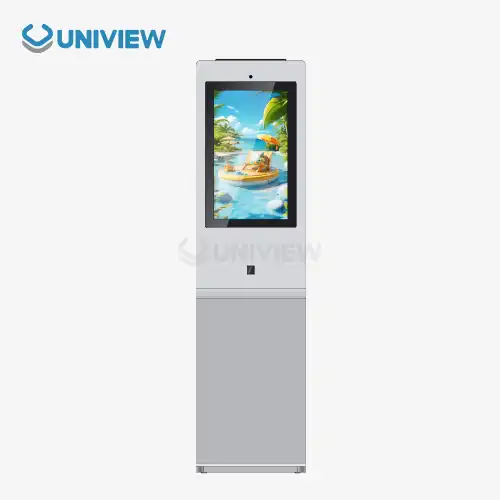
The P110 Indoor Portable Rechargeable Kiosk is our hallmark example of integrating cutting-edge technology with practicality. This 27-inch LCD unit's battery-powered design avoids charging connection dependence and provides excellent mobility for interior applications.
Height, landscape-portrait orientation, and viewing angle optimization are fully adjustable in the P110. These capabilities optimize presentation regardless of deployment or audience configuration. The LCD display's crisp, clear visuals ensure brand continuity and content authenticity across all applications.
The user-friendly interface makes setup and operation easy for staff of all technical skill levels, while advanced heat dissipation technology provides stable performance over long durations. These units improve venue experience by supporting many gadget types and charging ports.
Quality Assurance and Global Standards
Our production procedures meet European, American, and Japanese quality requirements to assure consistent performance and safety in different operational conditions. Offline coated AR glass and European surface treatment technologies are corrosion-resistant and durable.
From component selection to final testing and calibration, quality control covers all production stages. Our products are tested for temperature cycling, vibration resistance, and electromagnetic compatibility to ensure reliable performance in challenging business situations.
Comprehensive insurance coverage through China Pacific Insurance Company and third-party underwriters protects client investments and shows our product reliability and performance consistency.
Global Support Infrastructure
Technical teams provide 24-hour online response for our global presence in over 100 countries and regions. This worldwide infrastructure guarantees quick support independent of deployment location or time zone.
Comprehensive technical assistance includes consultation, installation, and optimization tips, and extended warranty programs last 3-5 years. Instead of transactions, our customer-centric strategy emphasizes relationship building and long-term partnerships.
Conclusion
Technical parameters, operational needs, and long-term business goals must be considered while choosing a portable rechargeable kiosk. The best models have durable construction, straightforward operation, reliable battery performance, high-quality displays, and extensive connectivity functions. Uniview Commercial's P110 provides the flexibility and reliability needed for successful mobile display deployments across industries and applications.
FAQ
What is the typical battery life for portable rechargeable kiosks?
Professional-grade portable rechargeable kiosks typically operate 10-16 hours continuously under standard conditions. The actual duration depends on display brightness settings, interactive features, and environmental factors. Uniview's P110 unit optimizes power consumption through intelligent management systems that extend operational time while maintaining consistent performance.
How do portable rechargeable kiosks compare to solar-powered alternatives?
Portable rechargeable kiosks offer superior reliability and deployment flexibility compared to solar-powered units. While solar systems provide environmental benefits, they face performance limitations during cloudy conditions or indoor deployments. Battery-powered units deliver consistent operation regardless of weather conditions or installation location, making them ideal for diverse business applications.
Can portable rechargeable kiosks be customized for specific branding requirements?
Modern portable rechargeable kiosks support extensive customization, including custom enclosures, branded user interfaces, and specialized software applications. Uniview Commercial offers comprehensive OEM services that tailor units to specific operational requirements while maintaining structural integrity and performance standards.
Ready to Enhance Your Business with Uniview Commercial's Portable Rechargeable Kiosk Solutions?
Discover how Uniview Commercial's advanced portable rechargeable kiosk technology can transform your customer engagement and operational efficiency. Our experienced team specializes in delivering customized solutions that meet your specific requirements while providing exceptional reliability and performance. Contact our sales specialists at sales@univiewlcdisplay.com to discuss your project requirements and explore our comprehensive product catalog. As a leading portable rechargeable kiosk manufacturer, we offer flexible purchasing options, extended warranties, and global support that ensure successful implementation and long-term satisfaction.
References
1. Digital Signage Technology Review: Mobile Display Systems in Commercial Applications, International Display Technology Association, 2024.
2. Battery Management Systems for Portable Commercial Electronics: Performance and Longevity Analysis, Journal of Power Sources Technology, 2024.
3. Retail Technology Trends: Interactive Kiosk Deployment Strategies and ROI Analysis, National Retail Federation Research Institute, 2023.
4. Commercial Display Market Analysis: Portable vs Fixed Installation Performance Metrics, Display Industry Research Corporation, 2024.
5. User Experience Design for Interactive Kiosks: Best Practices and Implementation Guidelines, Human-Computer Interaction Quarterly, 2023.
6. Environmental Durability Standards for Commercial Display Equipment: Testing Protocols and Certification Requirements, International Electronics Standards Commission, 2024.


Learn about our latest products and discounts through SMS or email