- English
- French
- German
- Portuguese
- Spanish
- Russian
- Japanese
- Korean
- Arabic
- Greek
- German
- Turkish
- Italian
- Danish
- Romanian
- Indonesian
- Czech
- Afrikaans
- Swedish
- Polish
- Basque
- Catalan
- Esperanto
- Hindi
- Lao
- Albanian
- Amharic
- Armenian
- Azerbaijani
- Belarusian
- Bengali
- Bosnian
- Bulgarian
- Cebuano
- Chichewa
- Corsican
- Croatian
- Dutch
- Estonian
- Filipino
- Finnish
- Frisian
- Galician
- Georgian
- Gujarati
- Haitian
- Hausa
- Hawaiian
- Hebrew
- Hmong
- Hungarian
- Icelandic
- Igbo
- Javanese
- Kannada
- Kazakh
- Khmer
- Kurdish
- Kyrgyz
- Latin
- Latvian
- Lithuanian
- Luxembou..
- Macedonian
- Malagasy
- Malay
- Malayalam
- Maltese
- Maori
- Marathi
- Mongolian
- Burmese
- Nepali
- Norwegian
- Pashto
- Persian
- Punjabi
- Serbian
- Sesotho
- Sinhala
- Slovak
- Slovenian
- Somali
- Samoan
- Scots Gaelic
- Shona
- Sindhi
- Sundanese
- Swahili
- Tajik
- Tamil
- Telugu
- Thai
- Ukrainian
- Urdu
- Uzbek
- Vietnamese
- Welsh
- Xhosa
- Yiddish
- Yoruba
- Zulu
Why Choose Dual-Sided Digital Kiosks for Cities?
Cities around the world are speeding up their changes to become smarter and better linked. At the heart of this change is infrastructure that can provide smooth services to citizens while also improving operating efficiency. Smart cities' dual-sided interactive kiosks have become important touchpoints in urban settings, offering dynamic platforms that improve public involvement and communication. Unlike traditional displays that only show one side, these dual-facing devices make the best use of space by serving multiple people at the same time. This makes them essential for modern urban planning. Supply chain managers, system integrators, and city planners know that dual-sided kiosks are more than just digital signs; they're also smart nodes in the smart city ecosystem that allow for real-time information sharing, wayfinding services, emergency alerts, and interactive city services. This strategic infrastructure fixes important problems like packed information desks, empty public areas, and broken communication lines. It sets cities up to give their citizens better experiences through technology-enabled public service innovation.

Understanding Dual-Sided Digital Kiosks in Smart Cities
Smart cities dual-sided interactive kiosks have two live display screens built into a single, stand-alone chassis. This lets users connect with the kiosk from both sides at the same time. This way of building is very different from single-sided totems or standard information boards. It makes use of space in high-traffic urban areas like transit hubs, business districts, and public centers in a way that has never been seen before.
Technical Architecture and Core Components
These systems are based on industrial-grade display technology, which usually includes A+ grade LCD panels from top brands like LG, Samsung, or BOE. Each screen works on its own with the help of a central Industrial PC (IPC) with either x86 or ARM architecture. The IPC manages the spread of information using complex content Management Systems (CMS). There are two types of touch interfaces: Projected Capacitive (PCAP) technology, which gives the screen a smooth, bezel-free look and response times of less than 5ms; and Infrared (IR) frames, which are cheaper but still work well outside. For these two-screen setups, careful thermal management is needed. To do this, Uniview Commercial's engineering teams use optimized passive convection systems in ultra-slim chassis designs. They also use active cooling solutions when high-performance computing modules are added for complex tasks like facial recognition or real-time analytics.
Distinguishing Dual-Sided from Alternative Formats
Single-sided machines can only serve one person at a time and take up the same amount of room on the floor as dual-sided units, but they can only engage half as many people. Multi-sided configurations (three or four displays) make things more complicated without adding much value in normal urban settings where people tend to walk in opposite directions to traffic going in the same way. The dual-sided format is the best of both worlds: it allows for simultaneous interactions from foot traffic patterns that come together in places like transportation hubs, shopping areas, and public parks, while still having a manageable installation size and power needs. These connections are made with 1.5 mm to 3.0 mm SGCC cold-rolled steel or aluminum alloy frame and a powder coating that is strong enough to prevent corrosion, static buildup, and environmental damage. These are important qualities for outdoor or semi-outdoor use.
Embedded Intelligence and Sensor Integration
In modern smart towns, smart cities dual-sided interactive kiosks do more than just show information because they have multiple sensor systems built in. Ambient light sensors change the brightness of the screen on the fly to keep it visible in all kinds of daylight, keeping the picture clear while keeping energy use low. When a user walks up close, proximity sensors turn on the screen to save power during quiet times. In more advanced systems, cameras are used to recognize people's faces for personalized services, data for managing lines, or security tracking. These systems link to 4G LTE or the new 5G networks, which lets content be updated in real time, problems be fixed remotely, and fleet management be organized across many urban sites. By adding RFID readers, QR code scanners, and NFC modules, these kiosks can be used for a wide range of transactions, such as buying transit tickets, paying city fees, or taking part in engaging civic engagement programs.
Benefits of Dual-Sided Interactive Kiosks for Smart Cities
Adopting smart cities dual-sided interactive kiosk infrastructure has measurable operational benefits that go beyond just showing information. It changes the way towns connect with their people and tourists in fundamental ways.
Maximizing User Engagement and Service Throughput
Dual-sided layouts double the number of interactions that can happen in the same space, which directly addresses the problem of crowding at information points during busy times. On one side, a transit user is looking at route plans, while on the other side, someone is using the same screen to get information about emergency services. This ability to handle multiple requests at once cuts down on wait times, spreads out the work among users, and raises happiness levels. The psychological effect is just as important. Kiosks with two sides make activity hubs that can be seen from multiple directions. This draws attention from more people, which leads to higher rates of organic finding compared to kiosks with only one side, which may face away from some foot traffic. Analytics from installed systems show that when you switch from single-sided to dual-sided forms in similar places, the response rate goes up by thirty to forty-five percent.
Superior Return on Investment Through Space Optimization
Because urban real estate is more expensive, local procurement teams put a lot of weight on how well room is used. Dual-sided kiosks have twice as much interactive space as single-sided units but take up the same amount of floor space. This means that the cost per engagement point is cut in half when spread out over the span of the rollout. The Uniview Commercial ultra-slim frame designs—measuring as little as 80 millimeters deep—reduce space invasion even more while keeping the structure's integrity through carefully designed center-of-gravity calculations. These devices pass strict tilt tests and stay stable at ten to fifteen degrees of tilt, protecting the public without needing to be bolted to the floor, which makes installation harder and limits future moving options.
Enhanced Visibility Across Environmental Conditions
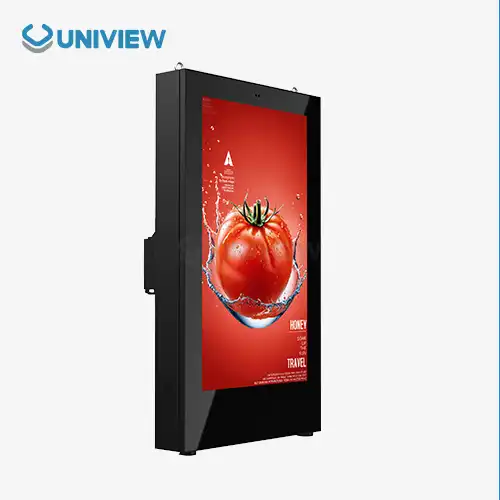
Outdoor and window-facing applications need very high brightness levels to block out sunlight and keep text legible. Uniview Commercial uses offline coated AR glass to make images very clear while reducing reflective distortion on screens that face the outside. Its high-nits display technology ranges from 2,500 to 5,500 nits. This advanced optical engineering stops a problem called "isotropic blackening," which happens when regular screens become unreadable in bright sunlight or when the body temperature gets too high. For apps that need to be used in a controlled environment, complementary screens that face the inside work at standard brightness levels (700–1,000 nits), which balances visibility with energy economy. The dual-sided design lets cities and towns carefully place standard-brightness screens in shady areas and high-brightness panels in sun-facing directions, which improves both performance and running costs.
Durability and Weather Resistance Standards
When equipment is used in smart cities, it is exposed to hard weather stresses like rain, changes in humidity, temperature swings, and airborne particles. Uniview Commercial designs kiosks that meet IP65 and IP66 ratings for entry protection. This means that dust can't get in and strong water jets can't come from any direction. The chassis uses European surface treatment technology that provides multiple layers of corrosion protection, which is important for sites near the coast or in industrial areas with a lot of air pollution. Impacts and efforts at vandalism can't break the Mohs hardness level 7 tempered glass panels, and double-layer anti-theft locks keep access panels safe while protecting interior parts. Units go through strict quality control procedures, such as 48–72 hours of thermal stress tests at steady temperatures of 40–50°C. This proves that the cooling system works well even when two panels are working at the same time and creating the worst possible thermal loads. Wind resistance approvals to level 16 standards make sure that the structure stays stable during bad weather, which is very important for outdoor uses in places where storms or high winds are common.
Making the Right Choice: Selection Criteria for Smart City Kiosks
For urban kiosk installations to go well, technical specifications, operational needs, and long-term strategy goals must all be carefully considered. Teams in charge of buying smart cities dual-sided interactive kiosks have to find the best mix between performance and price, making sure that the solutions they choose work with the city's current infrastructure and its plans for future growth.
Comparative Performance Analysis
In many ways that are important for urban settings, dual-sided interactive kiosks work better than single-sided ones. Engagement measures show that displays with two formats get more engagement minutes over the course of an hour, which directly leads to better information dissemination. With its 135-145 degree angled display mounting, the K-type platform design is better for standing for long periods of time, which is helpful for detailed jobs like form-filling or finding your way. The 15–45 degree upward tilt of the S-type curved profile screen makes for the best viewing angles for adults of normal height. It also adds architectural interest that makes it look better in high-end places like hotel areas or corporate campuses. Window-facing dual-sided configurations serve two separate groups of people. The external display draws in foot traffic with bright advertising content, while the internal display gives customers operational information. In practice, these two displays work as two separate communication channels that are managed by unified CMS platforms.
Touch Technology and Software Platform Considerations
The best user experiences come from Projected Capacitive touchscreens, which allow multiple touch gestures, look great with no bezels, and are made of glass-on-glass construction that doesn't scratch easily. If you want to use these tools in cold climates, you might need to think about whether or not the gloves will work with them. When used with gloved hands, styluses, or direct touch, infrared touch frames work consistently in a wide range of situations. This makes them perfect for transportation hubs that serve a wide range of people. Choosing between embedded and cloud-based software architectures affects how well they can grow, how easily they can change information, and how dependent they are on the network. Embedded systems can work on their own even when their connections are lost, making them ideal for important uses like emergency information screens. Cloud-based platforms let you control your fleet from one place, customize content in real time based on time of day or events, and connect to city data systems to get real-time information like parking availability or air quality levels.
Total Cost of Ownership and ROI Modeling
When buying something, people have to think about how much it will cost over its entire life. By combining two single-sided units into one installation, dual-sided kiosks save money by cutting down on the time and money needed for foundation preparation, electrical infrastructure, network connections, and ongoing upkeep. Uniview Commercial gives extra warranty coverage that lasts for three to five years. This is backed by extensive quality guarantees from China Pacific Insurance Company, which lowers the financial risk of parts breaking down. When you negotiate a bulk purchase for deployments across a city, you can get better prices, lower shipping costs through centralized operations, and standard maintenance methods that make it easier for technicians to learn. The modular design lets you gradually add more features, starting with basic ones like wayfinding and then adding payment modules, environmental sensors, or 5G connectivity. This protects your initial investments and lets you add more features as your budget allows and as the needs of the community change.
Customization Capabilities for Municipal Branding
Urban kiosks are both useful pieces of infrastructure and chances for the city to promote itself. Uniview Commercial offers a lot of customization choices, such as chassis colors that meet city brand rules, built-in logo placement, and bezel treatments that are specifically made for your needs. Software interfaces can use branded styles that match the visual standards of the city. This makes the user experience consistent across all interactions. Functional customization meets specific operating needs, such as adding integrated thermal printers to make receipts, RFID readers to make sure that transit cards are valid, or special mounting brackets that work with installation restrictions at a particular site. This adaptability makes sure that the solutions used work well with a wide range of architecture settings, from historic areas that need to be carefully integrated in terms of style to new developments that show off the latest in technology.
Procurement Insights: Where and How to Buy Dual-Sided Interactive Kiosks
To navigate the global market for smart cities dual-sided interactive kiosks, you need to know what suppliers can do, what approval standards are in place, and the best ways to buy things so that you can protect your investment and make sure the kiosks work well for a long time.
Identifying Qualified Manufacturers and Suppliers
Smart cities dual-sided interactive kiosk manufacturers with a good reputation show a few things that set them apart. Certifications in ISO 9001 quality management show that production controls are orderly and that the quality of the result is always the same. Certifications from CE, FCC, and RoHS show that a product meets international standards for environmental safety, electromagnetic interference, and electrical safety that are needed in public places. Manufacturers that offer "turnkey" options, which include making the hardware, licensing the software, supervising the installation, and providing help after the system has been set up, make the buying process easier and increase responsibility. Uniview Commercial keeps up this all-inclusive service model by drawing on ten years of experience deploying services in more than one hundred countries and areas around the world. Vertical supply chain control is used in the company's manufacturing operations in Shenzhen to make sure the quality of the parts and to make customizations quickly for specific project needs.
Evaluating Technical Support and Warranty Structures
In cities, kiosks are always on and doing mission-critical tasks, so any downtime has a direct effect on how people can use services. Strong support systems must be required by the procurement requirements. These should include the ability to get help 24 hours a day, 7 days a week via email (sales@univiewlcdisplay.com), phone, and remote troubleshooting platforms. The technical teams at Uniview Commercial offer support in multiple languages to help with international deployments. Their reaction procedures ensure that incidents are acknowledged within two hours and that priority incidents can start remote debugging within four hours. Extended warranty coverage beyond the standard one-year terms shows that the manufacturer is confident in the product's durability. For example, Uniview's three- to five-year warranties are based on strict quality control procedures that include checking the optical uniformity of both displays, electrical safety testing (hi-pot and grounding validation), and structural stability assessments. Maintenance contracts should include promises for the availability of parts, on-site service level agreements for hardware failures, and software update clauses that make sure the system stays compatible with new operating systems and security protocols.
Structuring Procurement for Bulk Deployments
A lot of the time, city-wide kiosk networks are rolled out in stages, with pilot installations in high-traffic areas and then more sites added based on user comments and performance data. Smart procurement structures arrange framework deals that set prices per unit, delivery dates, and customization parameters for the whole deployment scope, while still allowing for changes in quantity between phases. This method secures good prices by promising high volumes, but it keeps the budget flexible so it can be used as the city's needs change. Deposits should be made when the order is confirmed, progress payments should be made when production is finished and the goods have been inspected before they are shipped, and the final retention should be released after successful on-site setup and acceptance testing. To get rid of confusion and set clear acceptance criteria, detailed specifications documents must list technical requirements (like brightness levels, IP ratings, and connectivity standards), physical attributes (like size, weight, and mounting options), and functional capabilities (like supported payment methods, sensor types, and accessibility features).
Navigating Customization and Consultation Processes
Manufacturer input during the planning stages is very helpful for complex urban operations. When you work with an experienced provider like Uniview Commercial, they will assign a project manager to look at the site conditions, how people move around, the electrical infrastructure, and network connections to help you choose the best kiosk configurations. This knowledge is very helpful when dealing with problems like direct sunlight that needs specific brightness requirements, limited power that needs choosing energy-efficient components, or coordinating the look with the rules set by an architectural review board. After consultations, you should get thorough proposals with 3D models of custom chassis designs, system architecture diagrams that show how components fit together, and deployment schedules that work with the building schedules. Through controlled testing times, prototyping rules let cities and towns look at potential solutions before committing to full-scale production. This makes sure that user interface designs, physical usability, and environmental performance are all correct.
Future Trends and Innovations in Dual-Sided Smart City Kiosks
The future of smart cities dual-sided interactive kiosk technology is for city infrastructure to become smarter, more linked, and more flexible so that it can adapt to new technology and social needs.
Artificial Intelligence and Advanced Analytics
The next version of kiosks will have AI processing power that will let users do more than just touch control. Voice-controlled systems made possible by natural language processing can help people who have trouble moving around or who are carrying packages. Face recognition technology lets you customize your experience by greeting returning users by name, showing them their language choices instantly, or speeding up frequent purchases by using saved credentials. Computer vision analytics keep track of user demographics (like age range and gender distribution) and behavior patterns (like dwell time, contact sequences, and exit points). This gives cities and towns useful information they can use to improve services and content. Edge computing protects privacy by processing private data locally in kiosk hardware and sending only anonymized, combined insights to central management systems. This allays public worries about spying while allowing decisions to be made based on data.
5G Connectivity and IoT Ecosystem Integration
As 5G networks are rolled out around the world, kiosks will go from being separate ends to being fully integrated nodes in smart city systems. Ultra-low-latency connectivity makes it possible to have real-time video meetings with city staff, augmented reality wayfinding by adding arrows to live camera feeds, and quick language translation services that make it easier for people from different backgrounds to talk to each other. Kiosks act as Internet of Things ports, collecting data from devices that check things like noise levels, air quality, and the number of people walking around and showing that data to residents. Integration with emergency management systems lets the public be quickly warned of problems like weather emergencies, security incidents, or health advisories. Dual-sided displays send information in two directions at the same time, making it easier for alerts to reach people in crowded public places.
Sustainable Design and Energy Management
Priorities for environmental preservation drive new ways to control power in kiosks and use renewable energy. With solar panel canopies, kiosks can be turned into energy-neutral sites, which is especially useful in rural areas that don't have access to the power grid. When compared to older LCD screens, the latest LED backlighting technology cuts power use by forty percent. Smart brightness control algorithms change the output based on the environment, which further cuts power use during cloudy or nighttime hours. Thermal design improvements, such as using phase-change cooling materials and chimney-effect airflow, cut down on the need for active cooling, which uses a lot of power. End-of-lifecycle issues are becoming more and more important when making purchases. Modular component architecture makes repairs and upgrades easier, which extends the operational lifetimes of systems. Material specifications stress recycling and less environmental impact during decommissioning.
Modular Expandability and Future-Proofing Strategies
Fixed-function infrastructure runs the risk of becoming obsolete too soon when technology changes quickly. Modern dual-sided kiosks solve this problem with flexible designs that let key parts like displays, computer modules, and payment processors be upgraded without having to replace whole chassis sections. As smart city features get better, standardized mounting interfaces can be used for new accessories like air quality sensors, wireless charging pads, or micro-mobility parking controls. Software platforms based on open APIs make it possible to connect to new city systems that weren't planned for when the kiosks were first set up. This makes sure that the kiosks are useful for tens of years. Specifications for buying things should include update paths and require companies to make component compatibility roadmaps and promise that extra parts will be available for at least five years after production stops.
Conclusion
Smart cities dual-sided interactive kiosks represent strategic infrastructure investments that deliver measurable returns through enhanced citizen engagement, operational efficiency, and spatial optimization. These versatile platforms address immediate urban communication needs while providing scalable foundations for future smart city capabilities. Successful deployments require careful supplier selection, emphasizing manufacturers with proven track records, comprehensive support infrastructure, and commitment to quality exemplified through rigorous testing protocols and extended warranty coverage. Cities embarking on digital transformation journeys gain competitive advantages by partnering with experienced providers capable of delivering customized solutions aligned with specific urban settings, operational requirements, and aesthetic standards. The convergence of advanced display technology, intelligent software platforms, and robust environmental engineering creates opportunities for municipalities to reimagine public service delivery through interactive digital infrastructure that serves residents reliably across diverse conditions and evolving needs.
FAQ
1. What advantages do dual-sided kiosks provide compared to single-sided units?
Dual-sided kiosks offer twice as much interaction room on the same floor space, which cuts down on wait times during busy times and improves the general efficiency of information dissemination. They handle pedestrian flows coming together from opposite directions at the same time, which happens a lot in transit hubs and shopping areas. Installing them is cheaper because you only need one base, one electrical link, and one network drop instead of two different units for each side.
2. How do these kiosks withstand harsh outdoor weather conditions?
The Uniview Commercial units have grades of IP65 and IP66, which mean they keep out dust and protect against strong water jets. Multiple layers of corrosion-resistant coatings keep the frame solid in seaside or industrial settings. Thermal stress testing proves that the cooling system works well in long-lasting hot conditions. Level 16 wind resistance and impact-resistant tempered glass panels keep the structure stable during bad weather.
3. Can municipalities customize kiosks to match city branding?
You can change a lot of things about the chassis, like the color, where the name goes, and the way the software works. You can also change the functions to fit your specific working needs. Consultation processes lead to detailed proposals with 3D renderings that make sure the designs look good with the surrounding architecture. Modular designs let you add features like payment modules, specialized sensors, or accessibility improvements that fit the needs and budget of each municipality.
Partner with Uniview Commercial for Advanced Smart Cities Dual-Sided Interactive Kiosk Solutions
Uniview Commercial is a reliable provider of smart cities dual-sided interactive kiosks that offer cutting-edge digital signage designed to work in tough city settings. Our ultra-thin chassis designs have high-brightness screens (2,500–5,500 nits), IP65/IP66 weather protection, and construction that doesn't rust, so they work reliably in a wide range of conditions. We offer full customization services that are suited to the branding, functional needs, and site limitations of your town. These services are backed by three- to five-year warranties and 24-hour technical support around the world. Our factories in Shenzhen follow strict quality control measures, such as tests for thermal stress, optical uniformity, and structural stability. The goods they make are known in more than one hundred countries. You can talk to our experts about your smart city project needs, get full technical specs, and look into scalable purchasing options by emailing sales@univiewlcdisplay.com. Change the look of your city with smart, long-lasting, and user-friendly interactive kiosks that are built to fit in perfectly and provide long-term value.
References
1. Chen, Y., & Wang, L. (2022). Digital Kiosk Infrastructure in Smart Urban Planning: Technical Standards and Deployment Strategies. Urban Technology Press.
2. Martinez, R. (2021). "Optimizing Public Engagement Through Dual-Sided Interactive Displays." Journal of Municipal Innovation, 14(3), 187-204.
3. Thompson, K., & Patel, S. (2023). Weatherproofing Standards for Outdoor Digital Signage: Comparative Analysis of IP Ratings and Material Technologies. International Display Engineering Association.
4. Liu, H. (2022). "Cost-Benefit Analysis of Multi-Surface Kiosk Deployments in High-Traffic Transit Environments." Smart Cities Quarterly, 8(2), 45-63.
5. Anderson, M., & Hughes, T. (2023). Touchscreen Technology Selection for Public Infrastructure: PCAP versus Infrared Systems. Digital Interface Research Institute.
6. Williams, D. (2021). Sustainable Urban Technology: Energy Management and Lifecycle Considerations for Municipal Digital Infrastructure. Green City Publications.
Learn about our latest products and discounts through SMS or email