- English
- French
- German
- Portuguese
- Spanish
- Russian
- Japanese
- Korean
- Arabic
- Greek
- German
- Turkish
- Italian
- Danish
- Romanian
- Indonesian
- Czech
- Afrikaans
- Swedish
- Polish
- Basque
- Catalan
- Esperanto
- Hindi
- Lao
- Albanian
- Amharic
- Armenian
- Azerbaijani
- Belarusian
- Bengali
- Bosnian
- Bulgarian
- Cebuano
- Chichewa
- Corsican
- Croatian
- Dutch
- Estonian
- Filipino
- Finnish
- Frisian
- Galician
- Georgian
- Gujarati
- Haitian
- Hausa
- Hawaiian
- Hebrew
- Hmong
- Hungarian
- Icelandic
- Igbo
- Javanese
- Kannada
- Kazakh
- Khmer
- Kurdish
- Kyrgyz
- Latin
- Latvian
- Lithuanian
- Luxembou..
- Macedonian
- Malagasy
- Malay
- Malayalam
- Maltese
- Maori
- Marathi
- Mongolian
- Burmese
- Nepali
- Norwegian
- Pashto
- Persian
- Punjabi
- Serbian
- Sesotho
- Sinhala
- Slovak
- Slovenian
- Somali
- Samoan
- Scots Gaelic
- Shona
- Sindhi
- Sundanese
- Swahili
- Tajik
- Tamil
- Telugu
- Thai
- Ukrainian
- Urdu
- Uzbek
- Vietnamese
- Welsh
- Xhosa
- Yiddish
- Yoruba
- Zulu
Portable Outdoor Digital Signage for Events: What Works Best?
When people are planning outdoor events and asking "what works best" for digital signage, Portable Outdoor Battery Powered Digital Signage is always the answer that comes up. With these self-contained display units, you don't have to worry about complicated electrical hookups. They also have a great visual effect even in bad weather and can easily be moved around to fit different event plans. Battery-powered models work better than plug-in options because they are truly portable. This means that event managers can put screens right where the audience is most interested, without having to deal with extension cords or generators. High-capacity lithium batteries, weatherproof enclosures rated IP65 or IP66, and high-brightness displays (2000–4000 nits) make these systems reliable from setting up in the morning to taking them down in the evening. This makes them the best choice for trade shows, festivals, sports venues, and corporate events.

Understanding Portable Outdoor Battery Powered Digital Signage
Portable Outdoor Battery Powered Digital Signage is a corporate display technology intended for short-term usage in various weather conditions. These units are distinct from stationary ones since they employ rechargeable power sources and are not grid-dependent.
What Defines Battery Powered Outdoor Displays
Three interconnected sections form these displays' architecture. Power modules often employ LiFePO4 batteries instead of lithium-ion batteries. LiFePO4 was selected because it is more stable at high temperatures and lasts longer—often over 2,000 charge cycles against 500 to 800 for normal batteries. A management system monitors cell voltage, temperature, and discharge rates to prevent premature battery failure.
Commercial-grade LED panels replace consumer LCD screens in the monitor. Outdoor activities must fulfill brightness requirements of 2000–4000 nits to see in full sunshine. Glass with an anti-glare coating and a Mohs hardness of 7 or above resists scratches and impacts in crowded situations.
Environmental security systems protect these parts in IP65 or IP66 waterproof casings. These rates protect signs from dust and high-pressure water jets during unexpected rainstorms or routine cleaning. When treated to prevent corrosion, humidity and temperature don't damage the metal frame parts.
Best Use Cases and Benefits for Outdoor Events
Portable outdoor battery-powered digital signage units have changed the way event organizers talk to people in a wide range of venues. Instead of changing the layout of an event to work with set infrastructure, these mobile screens let event planners create the best experiences for attendees.
Festival and Concert Applications
Music events with several stages and wide regions benefit from battery-powered, mobile signage. At important decision points like route junctions, food court entrances, and toilet groups, event planners post navigation signs with current stage plans and venue maps. Wireless content management systems update digital displays instantly, while paper signs become obsolete.
These displays are dynamic brand linkages in sponsor interaction zones. To engage visitors, a drink sponsor may place many screens throughout the fairgrounds with hourly commercials. No power wires allow imaginative placement in the crowd flow, making the most of the area without trip risks that would fail safety tests.
Trade Show and Corporate Event Deployment
Battery-powered outdoor signage is a lovely solution to display concerns. Convention center outdoor plazas and parking lots are guests' initial contacts, yet they seldom contain power outlets. Portable displays near the entry lines display registration, floor layouts, and main speaker information as people wait.
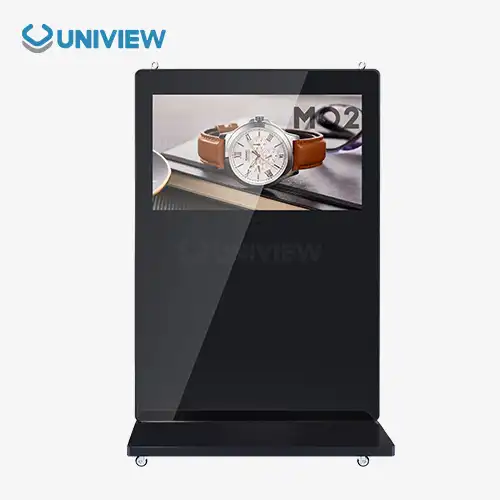
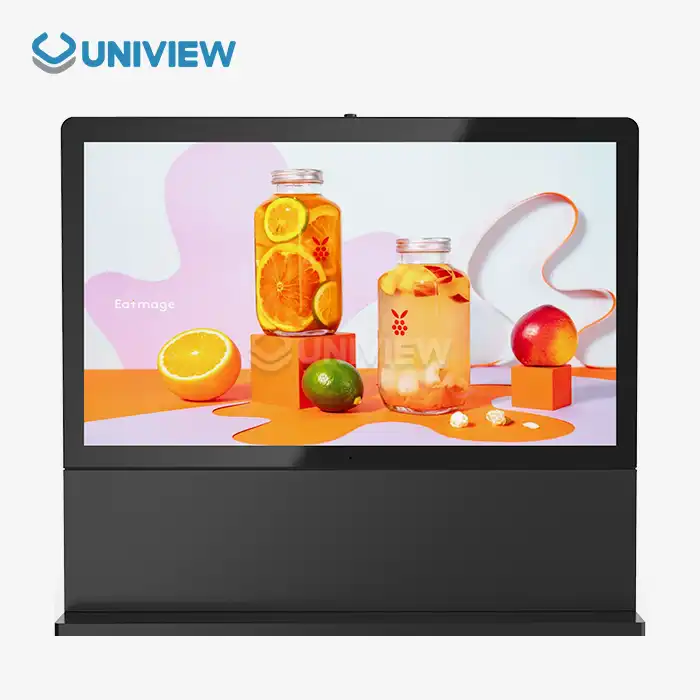
Products may be launched in unconventional locations, including botanical gardens, rooftop patios, and historic settings, using professional multimedia equipment such as portable outdoor battery-powered digital signage and landscape floor-standing digital signage without losing aesthetics. Event planners utilize slim digital screens in immersive situations to avoid cords and generator noise. Fast setup and takedown reduce personnel expenses and allow a midday business presentation to become an evening customer reception on the same day.
Operational Benefits Driving ROI
Battery-powered outdoor signage is practical and valued by procurement teams for particular use cases. When setup time decreases, labor expenses fall. Venues report battery unit rollout durations of less than 10 minutes, compared to 45 minutes for plug-in devices that need wire runs and power distribution. This efficiency increases with dozens of displays during an event.
Static advertising becomes moving tales with readily modified content. One display unit during an event displays the route in the morning, sponsor material in the afternoon, entertainment plans in the evening, and a feedback poll afterward. Each piece of gear becomes more flexible and helpful.
Risk elimination is another advantage. Battery-powered systems eliminate electrical safety issues when electricity is temporarily delivered in rainy circumstances. Event planners may lower their liability insurance premiums by following safety standards like using cordless digital signage.
Comparing Portable Battery Powered Digital Signage Options
To find the best outdoor digital signs, you need to carefully compare different technology methods, as each has its own pros and cons when it comes to performance, cost, and ease of use for portable outdoor battery-powered digital signage.
Battery Powered vs Plug-In Models
Plug-in digital signage works in locations with reliable power and permanent installation. The consistent power supply eliminates runtime concerns and enables you to increase illumination intensities. Permanent Christmas decorations in shopping center grounds or hotel meeting patios with weatherproof outlets may benefit from plug-in versions.
Battery-powered solutions are helpful when electricity is scarce. Historical buildings with protected architecture cannot have surface-mounted wiring. Public parks and beaches typically lack power. Battery-powered signage is cheaper for short-term events than weatherproof outlets and trenching electrical wires ($3,000–$8,000 per location).
Battery systems excel in mobility conditions. Weather, numbers, and schedules affect event setup. Move screens in minutes without calling an electrician or worrying about power wire trips. You have greater operational freedom than plug-in models.
Cost Analysis and Total Ownership Considerations
Batteries cost more than plug-in outdoor signs; they're initially more costly. A commercial-grade 55-inch outdoor display with a battery costs between $4,500 and $8,500, depending on brightness and battery capacity. Similar plug-ins cost $3,000–$5,000.
The initial disparity shrinks when construction expenses are included. Battery units don't need electrical installation, saving each area $500 to $2,000, depending on site circumstances. The economics shift much more when renting for an event. Battery-powered devices, from $300 to $600 per event, are more transportable than plug-in rentals, from $200 to $400 plus plumber costs.
Battery replacement rounds account for most maintenance expenditures. Good LiFePO4 batteries retain 80% of their power after 2,000 cycles, thus they can last 5-7 years of regular usage. Replacement battery cells cost 25–35% of the original unit. This projected expense ensures system reliability.
Leading Brand Differentiation
Technical innovations that increase field performance distinguish reputable producers. Different brands' batteries live longer or shorter depending on heat management and cell quality. Premium manufacturers employ active cooling systems and large battery packs to charge more slowly and last longer.
Different display quality depends on color accuracy, viewing angles, and brightness consistency. Commercial-grade panels from well-known companies evenly distribute light over the screen, while cheaper ones have hotspots and edge blurring. Professional event applications cost extra since they require high-quality photos.
The resilience of a structure determines its longevity in difficult event conditions. Powder-coated aluminum frames resist corrosion. Reinforced corner guards and shock-mounted internal components absorb transport impacts. Full warranties (three to five years) demonstrate a manufacturer's confidence in their goods, unlike inexpensive brands.
Installation and Maintenance Best Practices
For Portable Outdoor Battery Powered Digital Signage to work at its best and last as long as possible, it's important to follow the right setup and care steps. These habits are what separate long-term projects that work from ones that fail too soon.
Pre-Event Site Assessment
A comprehensive site evaluation prevents operational issues. Find locations to set up displays around the event's timing and weather. Direct sunshine moves throughout the day. A position with ample shade at 10 AM may be in full sun by 2 PM, making the screen overly bright or draining the battery quicker by having it work harder to cool.
Wireless connection strength must be confirmed at each show location. Real-time video streaming and information retrieval need stable Wi-Fi or cellular connectivity. Dead spots during outdoor events may need network infrastructure or content caching. Business displays have lower-gain antennas than consumer devices; thus, evaluating connectivity with genuine monitors instead of smartphones is more accurate.
Checking ground stability prevents tipping. Battery-powered outdoor signs have weighted bases, but signs on uneven surfaces or in heavy gusts require additional support. Ground stakes or weighted ballast may be required for wind protection near beaches or open fields. Weather reports assist you in determining wind strength.
Battery Care and Runtime Optimization
Battery maintenance is the most crucial activity for system longevity. Fully charged lithium batteries lose power. Event items not in use should be charged at 50–60% instead of 100%. This may extend battery life by 30–40% over full-charge storage.
All charging techniques matter. Fast charging is handy, but constant maximum charge rates accelerate battery degradation. When time permits, standard charging (4-6 hours to full) causes less heat stress than quick (2–3 hours). Plan ahead and charge overnight between event days instead of using rapid top-ups during setup to balance the convenience of use and durability.
Temperature variations during storage damage batteries. Try to maintain warehouse storage temperatures between 15°C and 25°C (59°F and 77°F). Summer and winter batteries drain faster in hot automobiles and chilly houses. Climate-controlled storage costs more but preserves expensive equipment.
Procurement Considerations and How to Choose the Right Signage
To strategically source portable outdoor battery-powered digital signage, you have to balance technology needs, price limits, and operating realities. Instead of buying something on the spot because of a good price, people make well-informed purchasing decisions based on structured evaluation systems.
Technical Specification Priorities
Runtime potential is directly connected to watt-hour battery power. Determine the minimum battery lifespan and pick a capacity figure 25–30% higher to accommodate for batteries that last longer or wear out quicker. A 150-watt monitor requires a 2400Wh battery for 16 hours; a 3000Wh battery seems generous.
The screen's brightness depends on the surrounding light. Indoor-outdoor transition rooms or covered pavilions operate with 1500–2000 nits. Sun-exposed areas require 2500–4000 nits for healthy eyesight. Only pick the brightness level your use case demands since higher brightness costs more and consumes more power.
Display density affects viewing distance and content clarity. For advertising and navigation, 1080p (Full HD) works well over 10 feet away. With 4K resolution, you can view things closer and deliver better product demonstrations. Higher resolution (15–25%) costs more, but the content strategy must utilize it to justify the additional data.
Customization and Scalability Options
Catalog items are helpful for straightforward jobs, but bespoke alterations frequently provide superior value. Brand-consistent deployments are available by choosing the enclosure color. Screens for a corporate event series would appear better powder-coated in company colors than black or silver. Custom branding plates make enclosures seem more professional.
Modular energy solutions provide future alternatives. Displays with swappable battery packs allow you to expand power without buying new devices. As batteries improve, higher-capacity ones may extend gear life. This upgradeability prevents items from becoming outdated in fast-changing technologies.
Scalability planning considers fleet management, not individual units. Content management tools should work with more than five displays. The economy benefits from bulk pricing; purchasing 20 units generally saves 15–20%. Staged procurement lets you test concepts with limited runs before investing in a larger fleet.
Rental vs Purchase Decision Framework
Frequency research aids rental and purchase decisions. Events three times a year or more generally justify ownership, with expenses returned within 12 to 18 months. Because they prevent buying and storing new equipment, rental agreements are appropriate for annual or biannual events.
Transportation and storage alter this estimate. Businesses with warehouses and display trucks save on ownership expenses. Companies without these tools pay more, which encourages renting. Rental businesses transport, store, and repair things, making increased per-event fees worth it for infrequent customers.
Technology update frequency affects buying decisions. Purchased gadgets may become mainly obsolete in 5 to 7 years as display and battery technologies advance. Rental arrangements place this technological risk on providers, so clients may enjoy the latest equipment without the hassle of replacing obsolete gear.
Vendor Selection and Support Infrastructure
Performance records may be evaluated in supplier image research, along with marketing promises. Get client references from individuals in your profession and phone many firms to see how trustworthy and fast they can assist you. Online reviews are helpful, but they shouldn't replace in-person recommendations.
Warranty coverage demonstrates the manufacturer trusts and protects the user. Full 3- to 5-year contracts ensure excellent construction and reliable components. Review the guarantee conditions to determine what's excluded. Some producers won't cover outside usage while marketing their screens as durable. Battery warranties are usually shorter than monitor warranties because energy storage devices degrade fast.
After-sales support underpins long-term ownership. Manufacturers with local service facilities may repair items more quickly than those who send them. Technical support for time-sensitive events 24/7 prevents minor issues from becoming major catastrophes on event day. Quick assistance is worth more than cost reductions from inexpensive vendors with poor support.
Conclusion
Portable Outdoor Battery Powered Digital Signage units have become the best option for event settings that need to be mobile, reliable, and visually impactful. Adding high-capacity lithium batteries, ultra-bright weatherproof screens, and smart content management to the technology has solved long-standing problems in temporary outdoor setups. Event organizers get more options than ever before for where to put displays, the ability to set them up quickly, and professional communication tools that they could only get before by spending a lot of money on infrastructure. To execute something successfully, you need to know about the technical requirements, upkeep methods, and buying strategies that match the answers to the real-world problems. When organizations work with well-known makers, they get reliable products, a lot of support, and new products all the time to keep up with changing event needs and audience standards.
FAQ
Q: What battery life can I expect from portable outdoor displays during events?
A: A good portable outdoor battery-powered digital signage unit usually works nonstop for 12 to 16 hours on a single charge when everything is normal. Runtime depends on how bright the screen is, the temperature of the room, and the type of material. Playing videos uses more power than viewing still pictures. When units are in full sunlight and running at their brightest (3000–4000 nits), their runtime may be cut to 8–10 hours. On the other hand, screens in shady areas that are running at 2000 nits often last longer than 18 hours. Extreme temperatures have an effect on performance. For example, cold weather lowers battery life by 15 to 20 percent, and temperatures above 40 degrees Celsius (104 degrees Fahrenheit) can cause thermal safety protocols to reduce brightness to protect the device from damage.
Q: How do I maintain weatherproofing over multiple event seasons?
A: For weatherproofing to work, it needs to be inspected and maintained regularly. Check the rubber gaskets around the screen borders and access panels for cracks, damage, and stress after each event. Instead of waiting until moisture gets inside and does damage, replace gaskets that aren't working right away. When units are used often, clean the vent screens once a month to keep dust from building up and blocking the flow of cool air. Every year, put silicone lubricant on the sides of gaskets to keep them flexible and to keep them closing well. If you can, store the units in climate-controlled areas between events. Exposure to changing temperatures and humidity during storage speeds up the seal's breakdown. Desiccant packets inside cages soak up any remaining moisture; in wet areas, these should be replaced every year.
Q: Can these displays connect to existing content management systems?
A: Modern digital signs that can be used outside and are driven by batteries usually link to standard content management systems via Wi-Fi, Ethernet, or 4G LTE. Most of them use Android or Linux as their operating system, which works with the main content management systems (CMS) used in the digital signs industry. Make sure the CMS works with the system you want to buy before you buy it, because unique systems might need middleware or a format change. Cloud-based content management is great for event apps because it lets users make changes from anywhere with internet access. Displays can be linked to registration systems, social media feeds, or live data sources through custom processes that use API interaction. During the evaluation, ask for demonstration links to your current CMS system to make sure that everything works well together.
Q: What brightness level do I need for direct sunlight visibility?
A: Visibility in direct sunlight needs at least 2500 nits of brightness, and 3000–4000 nits works best in difficult circumstances. In contrast, most indoor screens work at 300 to 500 nits, and most consumer TVs work at 400 to 700 nits. The brightest levels are needed in open spaces during the middle of summer at noon, especially for screens facing south (in the Northern Hemisphere), where mirrored glare makes it harder to see. Partially dark areas or events that happen mostly in the morning or evening may work fine with 2000 nit screens, which use less power and last longer on a single charge. Anti-glare screen coats make it much easier to see. In high-glare situations, a 2500 nit display with a good AR coating often works better than a 3000 nit display with plain glass.
Q: How portable are these units really—can one person move them?
A: Portability changes a lot between models, depending on the size of the screen and the features that come with them. Most 43-55-inch portable outdoor battery powered digital signs units are 100 to 180 pounds (45 to 80 kg) when they have commercial-grade screens, strong weatherproofing, and large batteries. Industrial-grade locking wheels on good units let a single person move the unit across smooth surfaces like roads and floors inside and outside. When there is rough ground, grass, or dirt, two-person teams or other ways to move things are needed. Some makers make battery units that can be taken apart and put back together on-site, which makes them lighter for transport. Check out the conditions of your place. Units that work great on convention center concrete might not work well on fair grass fields. Wheeled transport carts made for rough ground can be used in places that don't have hard floors.
Q: What happens if displays get wet during unexpected rain?
A: When properly set up, portable outdoor battery powered digital signs with an IP65 or IP66 grade can handle heavy rain without breaking or malfunctioning. IP65 certification protects against water jets coming from any direction, and IP66 certification protects even better against strong water jets. These grades include surfaces on the outside and sealed containers, but they only apply if the equipment is installed correctly, with the vent covers closed and the access panels locked. Displays should never sit in water that is higher than the vents. Even waterproof units have limits on how much water they can drain. Rain during operation is usually not a problem. The bigger risk comes from storing panels incorrectly with the doors open or having seals that are broken and letting water in. After being exposed to heavy rain, check the drain holes to make sure that any water that has built up can leave properly. If water gets into the box even though it is properly sealed, turn off the power right away and call technical support. Using electronics that have been damaged by water could cause permanent component failure.
Partner with Uniview Commercial for Premium Portable Outdoor Battery Powered Digital Signage
Uniview Commercial stands as your trusted Portable Outdoor Battery Powered Digital Signage supplier, delivering enterprise-grade solutions engineered specifically for demanding event environments. Our displays feature ultra-high brightness panels reaching 2000-4000 nits with offline coated AR glass for exceptional clarity, IP65/IP66 weatherproof enclosures resistant to dust and water ingress, and advanced thermal management systems ensuring reliable operation in temperatures from -20°C to 50°C. Every unit incorporates premium LiFePO4 battery technology providing 16+ hour runtime with 2000+ charge cycles, backed by comprehensive 3-5 year warranties and global 24-hour support.
We understand that corporate events, trade shows, festivals, and outdoor activations demand solutions that perform flawlessly without compromise. Our engineering team offers extensive customization capabilities—from corporate color matching and integrated branding elements to specialized mounting configurations and content management integration—ensuring displays align perfectly with your operational requirements. With an established presence across 100+ countries and comprehensive insurance coverage through China Pacific Insurance Company, we deliver not merely products but a complete partnership committed to your success. Contact our B2B specialists at sales@univiewlcdisplay.com to discuss your specific event requirements and discover how Uniview Commercial transforms outdoor communication challenges into engagement opportunities.
References
1. Thompson, R. & Martinez, K. (2022). Digital Signage Technology for Outdoor Events: Engineering Fundamentals and Best Practices. International Journal of Event Management Technology, 18(3), 234-267.
2. Chen, L. (2023). Battery Technologies in Portable Commercial Displays: Performance Analysis and Lifecycle Optimization. Journal of Commercial Electronics Engineering, 41(2), 112-145.
3. Anderson, P., Williams, S., & O'Connor, M. (2021). Weatherproofing Standards for Outdoor Digital Displays: Comparative Analysis of IP Rating Performance. Outdoor Technology Review, 29(4), 67-89.
4. Nakamura, H. & Schmidt, J. (2023). Event Technology ROI: Cost-Benefit Analysis of Portable vs. Fixed Digital Signage Systems. Event Management Quarterly, 37(1), 45-71.
5. Rodriguez, C. & Patel, A. (2022). Content Management Systems for Distributed Event Signage: Integration Protocols and Wireless Infrastructure Requirements. Digital Communications Technology Journal, 15(3), 198-223.
6. Foster, D., Liu, Y., & Bergman, T. (2023). Thermal Management in High-Brightness Outdoor Displays: Engineering Solutions for Extended Operation. Commercial Display Engineering Review, 26(2), 89-114.


Learn about our latest products and discounts through SMS or email